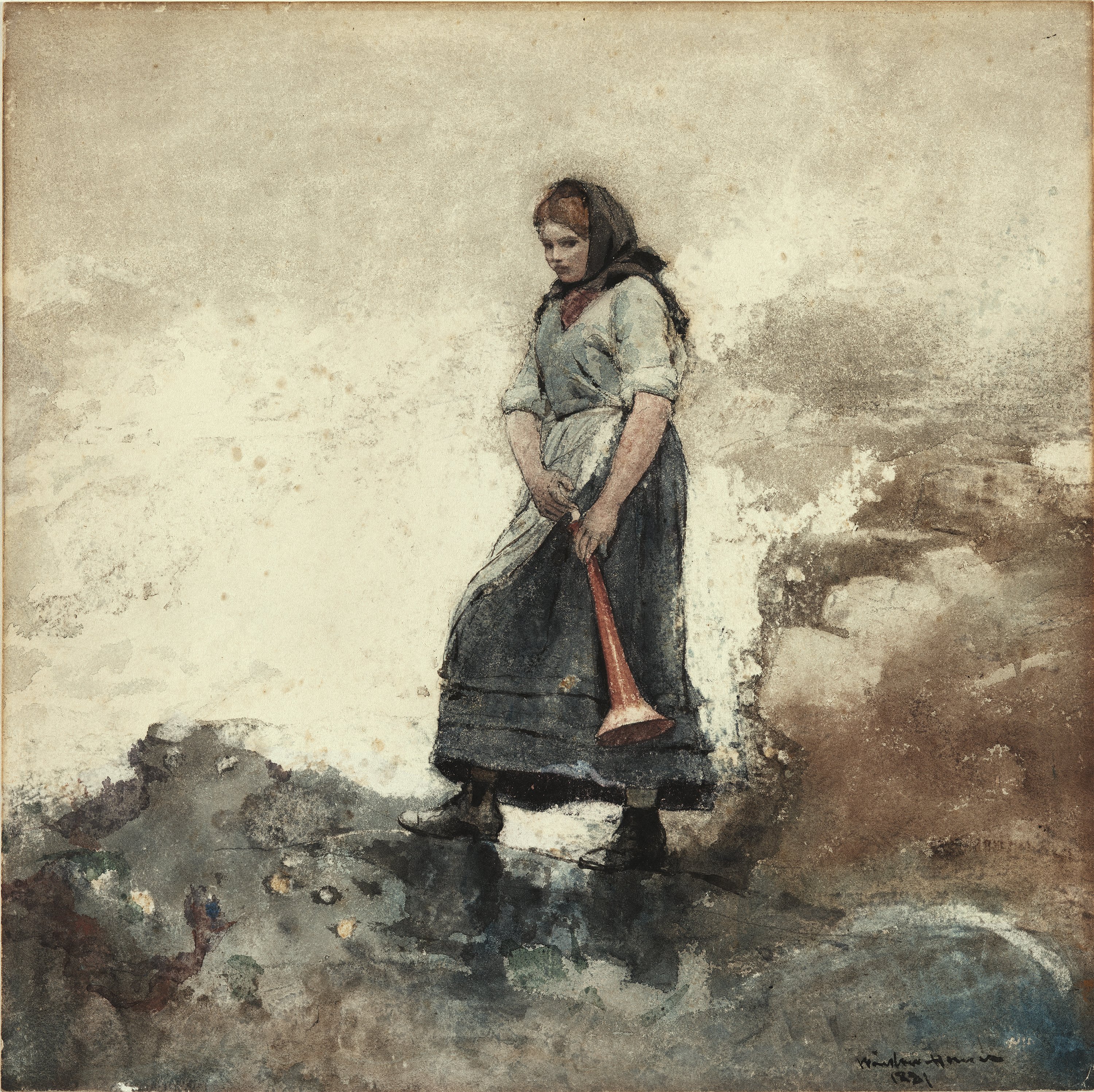
Daughter of the Coast Guard
1881
Watercolor on Paper.
34.3 x 34.3 cm
Museo Nacional Thyssen-Bornemisza, Madrid
Inv. no.
592
(1983.41
)
Not exhibited
Level 2
Permanent Collection
Level 1
Permanent Collection
Level 0
Carmen Thyssen Collection and Temporary exhibition rooms
Level -1
Temporary exhibition rooms, Conference room and EducaThyssen Studio
Homer travelled to England in 1881 and, after spending a few weeks in London, settled in the village of Cullercoats near Tynemouth on the craggy North Sea coast, remaining there until spring 1882. This remote place, nestled on a hill by a small bay, was inhabited by a small community of fisherfolk, whose customs and hazardous lives Homer observed and depicted in his works. This stay was such a revealing experience for the artist that both he and his art underwent a significant transformation.
Throughout these months Homer used watercolour almost exclusively, employing a very loose technique and a sombre palette suited to capturing the misty atmosphere of the place. The village women, who soon became the main subjects of his are depicted performing their domestic chores or helping their husbands with fishing tasks. Kenyon Cox noted in 1914 that “the first and most important of these effects of the Tynemouth visit upon Homer’s style is the awakening in him of a sense of human beauty and, particularly, of the beauty of womanhood.” The artist himself defined them in an article published in 1882 as “stout, hardy creatures, with petticoats of blue flannel [...] they stand on the beach in the morning full equipped for a hasty journey to town.”
In Daughter of the Coast Guard, a watercolour dated 1881, the subject is one of these fishergirls whom Homer sets against the stormy waters and misty sky of the North Sea. The scene appears to capture the girl’s exhaustion after hours of fruitlessly searching with her voice horn for survivors of some shipwreck or a boat lost in the fog. Her figure, rendered in monumental proportions that are further enhanced by the low viewpoint, is endowed with such dramatic force that it could be considered a symbol of the human’s tragic struggle with the forces of nature.
Late in 1882, shortly after returning to New York, Homer took up residence in Prouts Neck on the coast of Maine, another small fishing community where he continued to paint simple scenes with the same Homeric proportions.
Paloma Alarcó
Throughout these months Homer used watercolour almost exclusively, employing a very loose technique and a sombre palette suited to capturing the misty atmosphere of the place. The village women, who soon became the main subjects of his are depicted performing their domestic chores or helping their husbands with fishing tasks. Kenyon Cox noted in 1914 that “the first and most important of these effects of the Tynemouth visit upon Homer’s style is the awakening in him of a sense of human beauty and, particularly, of the beauty of womanhood.” The artist himself defined them in an article published in 1882 as “stout, hardy creatures, with petticoats of blue flannel [...] they stand on the beach in the morning full equipped for a hasty journey to town.”
In Daughter of the Coast Guard, a watercolour dated 1881, the subject is one of these fishergirls whom Homer sets against the stormy waters and misty sky of the North Sea. The scene appears to capture the girl’s exhaustion after hours of fruitlessly searching with her voice horn for survivors of some shipwreck or a boat lost in the fog. Her figure, rendered in monumental proportions that are further enhanced by the low viewpoint, is endowed with such dramatic force that it could be considered a symbol of the human’s tragic struggle with the forces of nature.
Late in 1882, shortly after returning to New York, Homer took up residence in Prouts Neck on the coast of Maine, another small fishing community where he continued to paint simple scenes with the same Homeric proportions.
Paloma Alarcó