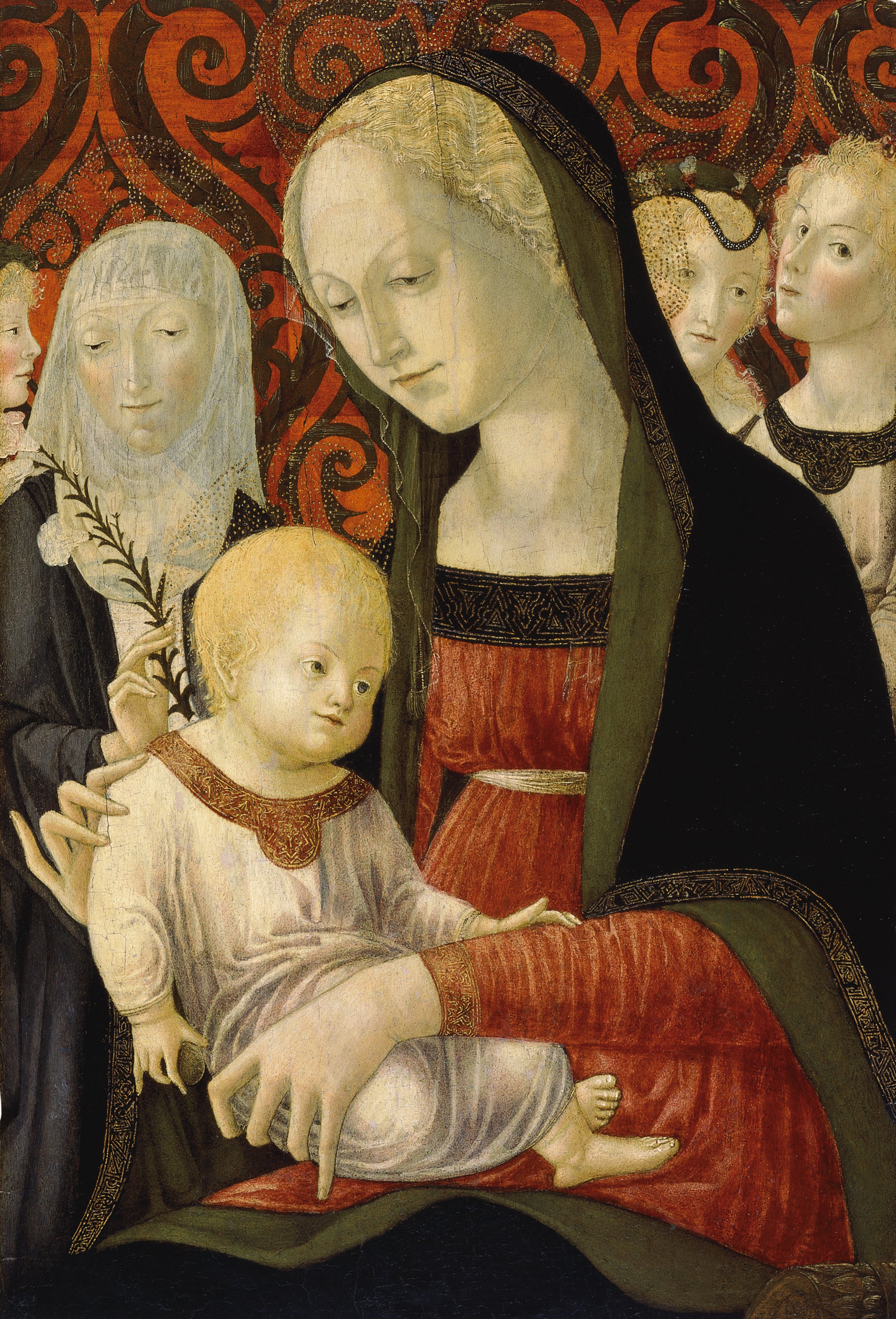
The virgin and the Child with Saint Catherine of Siena and Angels
ca. 1490
Mixed media on panel.
62 x 42 cm
Thyssen-Bornemisza Collection, on deposit with the Museu Nacional d'Art de Catalunya (MNAC)
Inv. no.
149
(1965.8
)
Not exhibited
Level 2
Permanent Collection
Level 1
Permanent Collection
Level 0
Carmen Thyssen Collection and Temporary exhibition rooms
Level -1
Temporary exhibition rooms, Conference room and EducaThyssen Studio
The Sienese sculptor and architect Francesco di Giorgio Martini, whom Vasari included in his Lives, was also an illuminator of manuscripts, writer, theoretician and finally a painter, as can be seen in the present panel. Vasari noted that he practised sculpture more as a hobby and a distraction than for other reasons and that he experimented with painting, an art form in which he was never as talented as in sculpture and architecture. According to Vasari, if Francesco di Giorgio had solely devoted himself to sculpture, hisfame would have been eternal. The artist also had time to devote himself to administrative tasks in his native city and from 1480 was a member of the City Council of Siena.
The present panel, which was previously in a private Florentine collection, was unknown until its publication in 1969 in the catalogue of the Thyssen-Bornemisza collection with a commentary on the painting by Rudolf Heinemann. The attribution has not been questioned since that date, and there are written arguments in its favour by Federico Zeri and John Pope-Hennessy, set out in a letter by Zeri dated 1973 and now in the Museum’s archive, as well as by Ralph Toledano. The chronology of the work is less secure, however, and the panel has been dated to two different periods in the artist’s career: around 1470 and around 1490. The early date of 1470 was proposed by Heinemann and Toledano, and the former drew attention to models by Neroccio de’Landi used for the figure of Saint Catherine. The late dating of 1490 (Francesco di Giorgio Martini died in 1501) was suggested by Zeri, who detected the influence of Andrea del Verrocchio, particularly in the central group, a feature consistent with the artist’s late style. The painting was acquired for the Collection 1965. In the early1960s it seems to have been in poor condition. According to a report in the Museum’s archive the background had been repainted in black, covering all the cloth now visible behind the figures while the paint surface was not fully adhered to the panel in some areas. The panel was consequently restored in 1964.
The faces of the figures are typical of Francesco di Giorgio: pointed, with pallid, whiteish skin and a chin that emphasises their shape. This is particularly evident in the face of Saint Catherine on the left, holding a lily, whose veil further emphasises this triangular shape. Another typical stylistic feature is the execution of the hands, particularly the fingers, which are fine and elegant. The Virgin’s fingers gently support the Christ Child, while Saint Catherine’s hold the stem of lilies and the Christ Child’s rest delicately on the Virgin’s sleeve.
Mar Borobia
The present panel, which was previously in a private Florentine collection, was unknown until its publication in 1969 in the catalogue of the Thyssen-Bornemisza collection with a commentary on the painting by Rudolf Heinemann. The attribution has not been questioned since that date, and there are written arguments in its favour by Federico Zeri and John Pope-Hennessy, set out in a letter by Zeri dated 1973 and now in the Museum’s archive, as well as by Ralph Toledano. The chronology of the work is less secure, however, and the panel has been dated to two different periods in the artist’s career: around 1470 and around 1490. The early date of 1470 was proposed by Heinemann and Toledano, and the former drew attention to models by Neroccio de’Landi used for the figure of Saint Catherine. The late dating of 1490 (Francesco di Giorgio Martini died in 1501) was suggested by Zeri, who detected the influence of Andrea del Verrocchio, particularly in the central group, a feature consistent with the artist’s late style. The painting was acquired for the Collection 1965. In the early1960s it seems to have been in poor condition. According to a report in the Museum’s archive the background had been repainted in black, covering all the cloth now visible behind the figures while the paint surface was not fully adhered to the panel in some areas. The panel was consequently restored in 1964.
The faces of the figures are typical of Francesco di Giorgio: pointed, with pallid, whiteish skin and a chin that emphasises their shape. This is particularly evident in the face of Saint Catherine on the left, holding a lily, whose veil further emphasises this triangular shape. Another typical stylistic feature is the execution of the hands, particularly the fingers, which are fine and elegant. The Virgin’s fingers gently support the Christ Child, while Saint Catherine’s hold the stem of lilies and the Christ Child’s rest delicately on the Virgin’s sleeve.
Mar Borobia