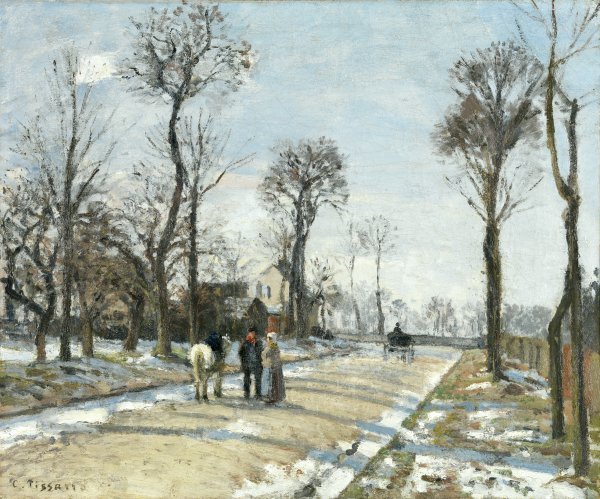
Route de Versailles, Louveciennes, Winter Sun and Snow
Camille Pissarro painted twenty-two canvas of the effects of light, seasonal weather, and movement on Route de Versailles in Louveciennes between the autumn of 1869 and the summer of 1872. He and his family had leased part of a substantial 18th-century house on that street. One friend and colleague, Claude Monet, who lived in the nearby town of Bougival for much of that same period, seems to have spent several days with the Pissarros and painted with him on the Route de Versailles in the snowy winter of 1869-1870. Both men were to move from suburban Paris to the environs of London in 1870 to escape the rigours of the Franco-Prussian War and the Commune in France. Pissarro returned to his house, to find it ransacked by the German troops during the period of the siege of Paris.
Surely the Carmen Thyssen-Bornemisza's wonderfully wintery view of the Route de Versailles was made in the winter of 1869-1870 and is, hence, one of the earliest works in the series of twenty-two canvases. It relates directly to a smaller canvas made at precisely the same point in the road and framing an identical view. This canvas (La Route de Versailles (effet de neige), PV 72) was surely made as a small-scale study for the Thyssen canvas and was dated on completion, 1870, therefore forcing us to date the undated Thyssen canvas to 1870. The reasons for this are obvious. To achieve a "plein-air" quality in the snow, one has to endure very cold conditions while painting. For this reason, Pissarro chose a vantage point almost precisely in the front of his house, so that he could go in and out easily during the process of painting. He also elected to render his sensations of this fleeting quality of light and weather on a canvas of comparatively small dimension that could serve as the model for a larger painting which was mostly like executed almost entirely in the warmth of the studio. Hence, the Carmen Thyssen-Bornemisza painting, for all its freshness, was probably painted indoors with the smaller and more direct work as the model.
Pissarro painted five snowy landscapes on the Route de Versailles during the winter of 1869-1870. In all probability the storm occurred in January of 1870, when Monet was staying with the Pissarros and when the younger artist painted three views of the same street. Hence, there are eight winter landscapes of the Route de Versailles produced by Monet and Pissarro early in 1870, of which the Carmen Thyssen-Bornemisza's is a principal masterpiece. The two largest paintings in the sequence are Monet's Route de Versailles, effet de neige (W 147) in a private collection in Chicago and Pissarro's La route par la neige, Louveciennes (PV 142) in a private collection. These are followed by three canvases by Pissarro of identical dimension, of which the Thyssen's is the most fully developed, perhaps largely because it is based on a painted study. Interestingly, Monet may have created a painting of the same street on the same days, but from a vantage point on the other side of the road. This canvas Route, effet d'hiver, soleil couchant, is also of almost identical dimension as the Pissarro and is today in the Musée des Beaux Arts, Rouen.
This small group of paintings by Pissarro and Monet occupy equivalent positions in the history of Impressionism as the better known sequence of paintings made by Renoir and Monet in the summer of 1869 at la Grenouillere in Bougival. The summer sequence was difficult because of the quantity of figures and boats on the water and the resulting "mobility" of the landscape motif, while the winter sequence posed problems of temperature and, of course, of the real difficulties of painting snow, which is at once reflective and less material than the paint that describes it. Monet had already attempted winter landscapes earlier in the 1860s and was, hence, more adept at this kind of painting. Pissarro had shown less interest in effects of light and atmosphere than in questions of pictorial construction and composition. It is, in fact, likely that the impetus of Monet effectively challenged Pissarro to a kind of pictorial duel of complex plein-air transcription. Indeed, he seems to have inaugurated the series of twenty-two canvases at Monet's prompting.
Richard R. Brettell