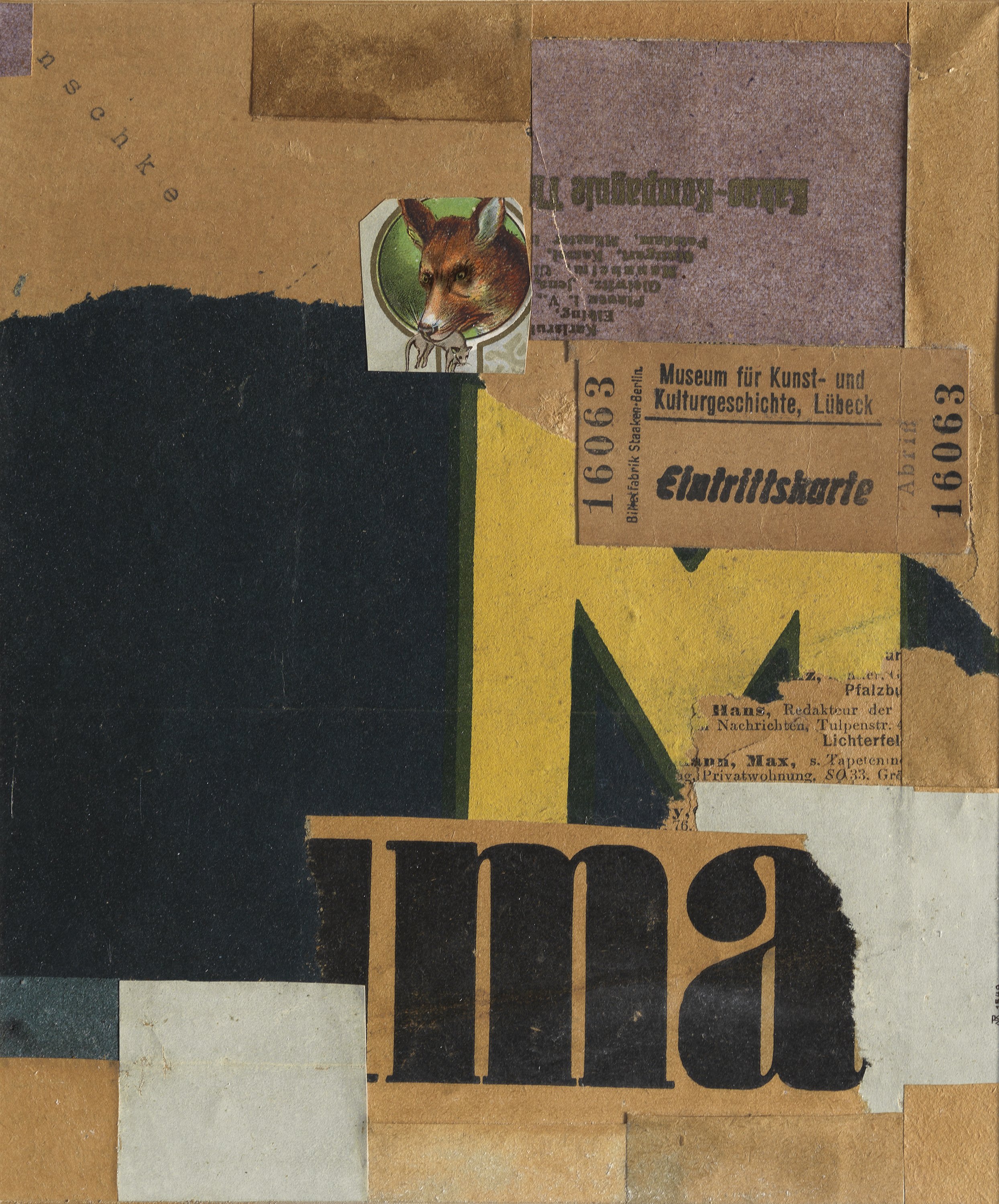
Entrance Ticket (Mz 456)
“Dada should be the point of convergence of abstract enemies and a party in permanent opposition to the major international art movements, ” proclaimed Richard Huelsenbeck. The Dadaists espoused modernism’s questioning of painting, which was begun by the Cubists and Futurists with their collages and by the Russian artists with their Utopian constructions. Like other Dadaists, Schwitters conceived art solely through collage (and slightly later, through assemblage.) His creative method consisted in choosing objects which he subsequently subjected to a certain arrangement and metamorphosis within his compositions. As Schwitters clearly stated in Merz, published in January 1921, he applied the concept of collage to both his poetry and his art works: “I have pasted poems from words and sentences so as to produce a rhythmic design. I have on the other hand pasted up pictures and drawings so that sentences could be read in them.”
In the present collage entitled Entrance Ticket (Mz 456), the artist has “pasted” several documents. One of them — which gives its name to the composition — is a ticket for the Museum für Kunstund Kulturgeschichte in Lübeck, which first opened in 1915 in the Gothic monastery of Saint Anne showing fifteenth- and sixteenth-century works. It also features the syllable “ma, ” an allusion to the avant-garde review MA to which Schwitters contributed in 1922 and 1923; a piece of blue paper bearing the number “1549, ” placed vertically, which Christopher Green interprets as an intentionally false signature in the form of a monogram; and a cut-out picture of a dog with a rat in its jaws, which symbolises the element of irrationality with which the artist wished to infuse his works. Lastly, the typed letters “nschke” in the upper left corner can be connected with the phonetic poems Kurt Schwitters experimented with following his trip to Prague with Hannah Höch and Raoul Hausmann in 1921, during which he attended the Dadaist performance in which the latter read his poem fmsbw. Nevertheless, although Schwitters’ contact with Huelsenbeck, Hausmann and Höch in 1918 had marked the start of his affiliation with Dada, the invention of the Merz artistic language and the creation of his phonetic poems, his lack of political commitment was never approved of by the Berlin Dadaists.
Paloma Alarcó