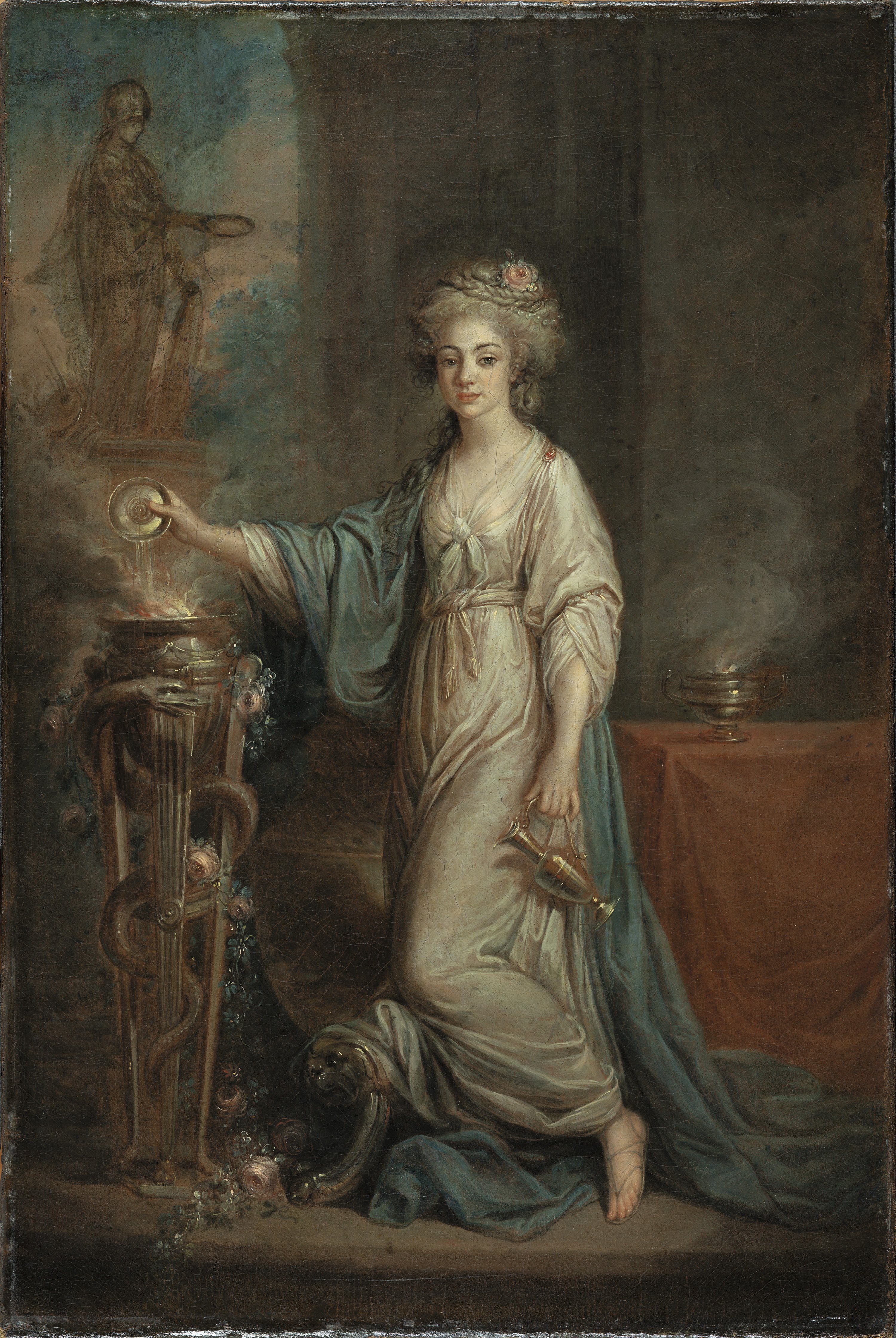
Portrait of a Lady as a Vestal Virgin
The Swiss-born artist Angelica Kauffmann trained with her father Joseph who specialised in mural decoration. A highly talented and precocious painter, her first independent works date from her teenage years. Kauffmann lived and worked throughout her life in Italy, moving to Florence in 1762. In Italy she absorbed the Neoclassical ideas that became widespread in artistic circles. During her early years in Rome from 1763 Kauffmann studied classical sculpture and perfected technical issues such as perspective while also dating from this period is her portrait of Johann Joachim Winckelmann, one of the theoreticians of Neo-classicism. In 1766 Kauffmann left for England in the company of Lady Wentworth and a few days after her arrival visited Joshua Reynolds’ studio. Kauffmann arrived in England at a fortuitous moment when the precepts of the new style had begun to take firm hold. Two years later she was involved in the foundation of the Royal Academy where she exhibited her works. Throughout her career Kauffmann worked as a history painter and on the decoration of interiors but she was primarily appreciated for her portraits.
The present canvas entered the Rohoncz collection in 1928 from a private German collection and was included in the 1930 exhibition at the Neue Pinakothek in Munich. In the catalogue of that exhibition it was correctly attributed and bore the present title. The catalogue entry also briefly recorded the opinions of C. F. Foerster, who dated the canvas to the 1780s.
The portrait follows a popular model of the day with the sitter presented as if recreating a moment from classical antiquity, in this case making a sacrifice to Minerva. The goddess of wisdom and one of the principal deities of the Roman pantheon is depicted as a sculpture in the background on the left, wearing a helmet and holding a shield. The foot of the fine bronze burner on which the sitter makes her sacrifice is decorated with a serpent — another symbol of Minerva — and has a garland of real flowers twined around it. The background planes are executed with an extremely free brushstroke and highly diluted pigment used to depict the interior walls and a garden on the left. The handling is tighter in the figure, particularly on her face and hair. The present composition is based on a canvas by Joshua Reynolds now in the Art Institute of Chicago of Lady Sarah Bunbury offering a Sacrifice to the Three Graces, dating to 1775. The overall approach, the position of Sarah Bunbury and other details are all closely followed in the present canvas.
Mar Borobia