Varieté
1911
Oil on canvas.
119.4 x 110.2 cm
Carmen Thyssen Collection
Inv. no. (
CTB.1994.4
)
Room H
Level 0
Carmen Thyssen Collection and Temporary Exhibition Room
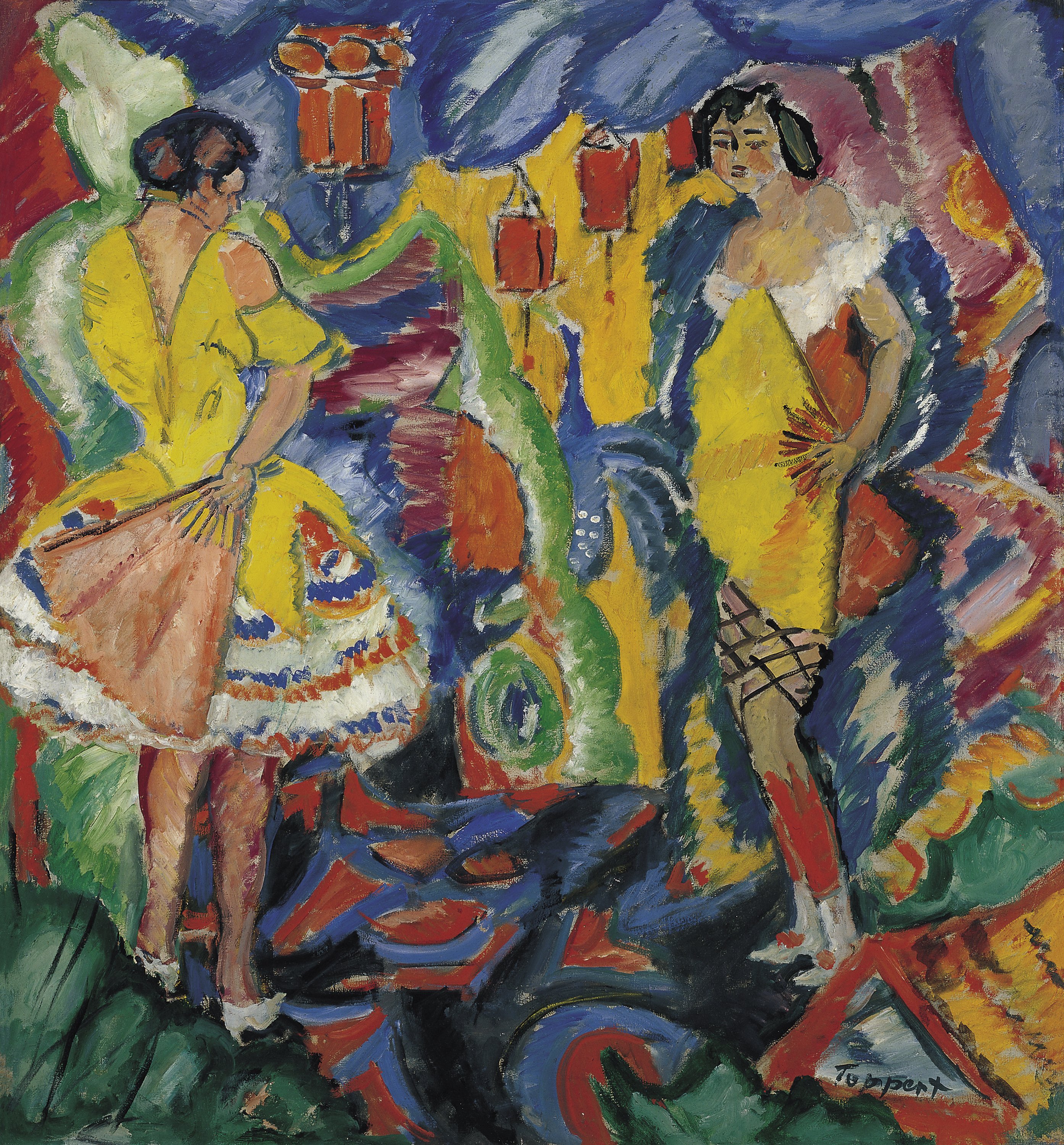
Varieté of 1911 is among the artist's finest and most important works, as well as one of his largest. Its subject matter, inspired by a common urban spectacle in the artist's day, is one to which Tappert returned on numerous occasions in paintings, drawings and prints which repeat the subject with variations and transformations. The unusual presence of a complete inscription on the back of the painting that includes the artist's name, and also the painting's title, date, and the name of the place where it was painted, all serve as a reliable indicator of the importance that the painter attributed to this work.
In the still relatively young capital city of Berlin, the Wintergarten-the largest variety theatre in pre-war Germany-had been inaugurated as recently as 1886. Among its many habitual patrons was Tappert, who found the inspiration for his painting there. This composition depicts two dancers in different costumes, each with a fan, performing on stage. The dancer on the left is shown from behind, the one on the right in a frontal pose. There are signed nude drawings of these same dancers naked except for the fans. The significance of this accessory, which both covers up and reveals something about Tappert's women, was evoked with considerable empathy by the poet Georg Däubler (1876-1934) in his essay on the painter, published in 1919. The lanterns hanging between the dancers allude to stage lighting and suggest spatial depth. The colours used are generally pure, unmixed ones. Their effect, particularly their overall intensity, is unusual and provocative in the context of contemporary taste. The remainder of the picture surface is filled with abstract ornamental patterns with strong chromatic contrasts, found in other pictures by Tappert of around this time. These patterns document the artist's precocious interest in the budding Cubist movement. The striking figure of the dancer on the right also inspired other paintings as well as later prints of his favourite model, Betty, who is documented up to 1914. This fact confirms the importance Tappert accorded to this subject, a work which draws from both the artist's own experience and from the contemporary art of the period. Like his prostitutes, clowns, and other circus performers, Tappert painted these figures with hardly any temporal or historical referents so as to symbolise a new individual freedom. His unique works of this type, emblematic of his time and painted with an expressive intensity, reveal the painter as both one of the innovative figures of modern German art in the newly metropolitan city of Berlin and as an artist who affirmed the new style of German Expressionism. A photograph in the artist's estate, showing him in front of this picture after it was rediscovered having been banned for 20 years, is a further testimonial to the importance that Tappert attached to this particular picture within his own oeuvre.
Gerhard Wietek
In the still relatively young capital city of Berlin, the Wintergarten-the largest variety theatre in pre-war Germany-had been inaugurated as recently as 1886. Among its many habitual patrons was Tappert, who found the inspiration for his painting there. This composition depicts two dancers in different costumes, each with a fan, performing on stage. The dancer on the left is shown from behind, the one on the right in a frontal pose. There are signed nude drawings of these same dancers naked except for the fans. The significance of this accessory, which both covers up and reveals something about Tappert's women, was evoked with considerable empathy by the poet Georg Däubler (1876-1934) in his essay on the painter, published in 1919. The lanterns hanging between the dancers allude to stage lighting and suggest spatial depth. The colours used are generally pure, unmixed ones. Their effect, particularly their overall intensity, is unusual and provocative in the context of contemporary taste. The remainder of the picture surface is filled with abstract ornamental patterns with strong chromatic contrasts, found in other pictures by Tappert of around this time. These patterns document the artist's precocious interest in the budding Cubist movement. The striking figure of the dancer on the right also inspired other paintings as well as later prints of his favourite model, Betty, who is documented up to 1914. This fact confirms the importance Tappert accorded to this subject, a work which draws from both the artist's own experience and from the contemporary art of the period. Like his prostitutes, clowns, and other circus performers, Tappert painted these figures with hardly any temporal or historical referents so as to symbolise a new individual freedom. His unique works of this type, emblematic of his time and painted with an expressive intensity, reveal the painter as both one of the innovative figures of modern German art in the newly metropolitan city of Berlin and as an artist who affirmed the new style of German Expressionism. A photograph in the artist's estate, showing him in front of this picture after it was rediscovered having been banned for 20 years, is a further testimonial to the importance that Tappert attached to this particular picture within his own oeuvre.
Gerhard Wietek