Composition in Colours / Composition No. I with Red and Blue
Piet Mondrian was the foremost representative of the geometrical trend in abstract art at the Cubism and Abstract Art exhibition staged in 1936 by Alfred Barr, the first director of New York’s Museum of Modern Art. Barr defined this trend as “the shape of the square confronts the silhouette of the amoeba” and distinguished it from the other, more biomorphic and organic abstract current represented by artists such as Kandinsky and Miró. Although his links to the Dutch Neo-Plasticist group De Stijl were severed in 1925 owing to disagreements with Van Doesburg, Mondrian devoted his whole life and oeuvre to investigating the balance between orthogonal forms and primary colours. This impassioned pursuit of the plastic equivalent of a universal truth makes him one of the most prominent figures of the modern movement. During the course of this process of stripping plastic language to its bare essentials, to a simple weave of verticals and horizontals, the grid structure appeared in his work and, as Rosalind Krauss has pointed out, thereafter became an emblem of modern desires in the field of the visual arts.
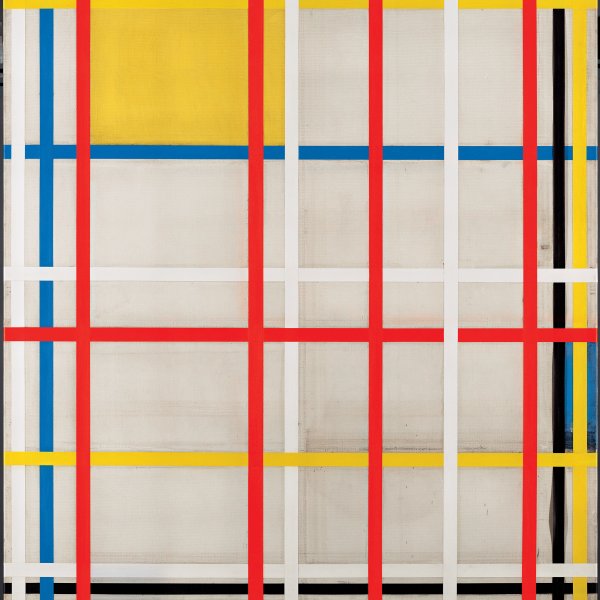
To Mondrian geometry was a spiritual principle, a manner of establishing a new universal order vis-à-vis the chaos of nature. Executed in 1931, Composition in Colours / Composition No. I with Red and Blue is a good example of the extreme asceticism of his geometric forms. It also illustrates his pared down artistic vocabulary, which was by then fully defined following his return from Paris, when he published his manifesto on Neo-Plasticism. The grid structure based on flat squares in white or primary colours (in this case only red and blue), separated by thick black lines, follows the principle of dynamic equilibrium which foreshadows the compositions of the late 1930s.
In order to arouse a spiritual feeling of harmony in the viewer, as advocated by Neo-Plasticism, Mondrian believed that the artist should conceal his personality as far as possible. However, paradoxically, the geometrical structure of his paintings was not dictated by mathematical laws but by his own intuition. Indeed, when examined under infra-red light, the painting in the collection displays various hidden lines drawn in charcoal, which are proof of the changes he made to the composition before deciding on the final arrangement.
The painting’s exhibition history is very long and, as can be seen in the photograph of the installation of the exhibition at Paul Citroen’s Nieuwe Kunstschool held in Amsterdam in 1935, its original white frame is still in place.
Paloma Alarcó