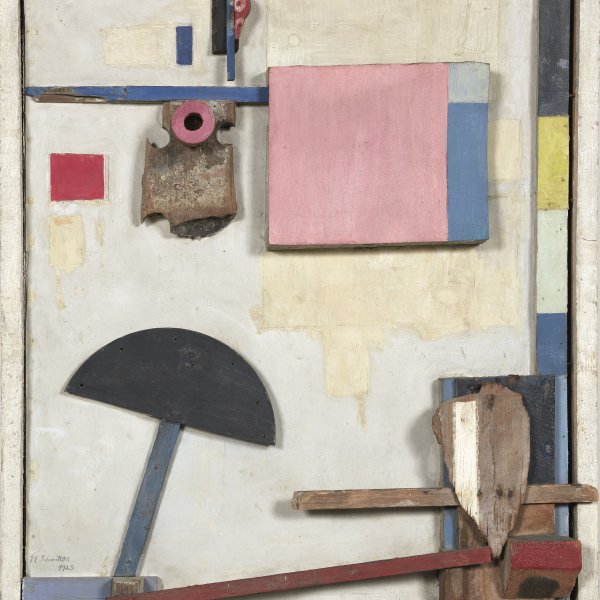
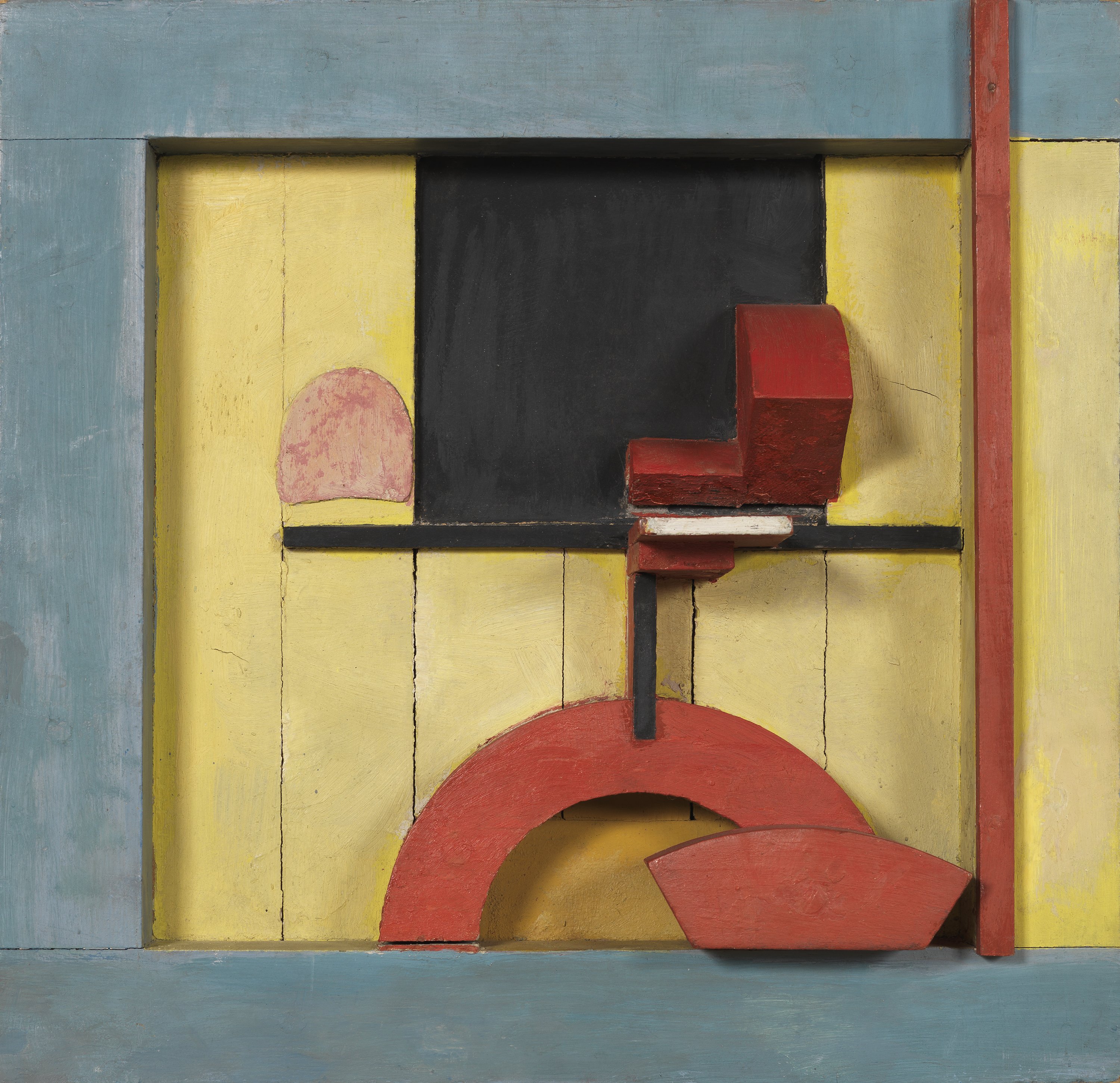
Merz 1925, 1. Relief in Blue Square
Although he might seem by temperament antipathetic to any constructive rule, for a time Kurt Schwitters embraced the idealistic formalism of Constructivism. In 1923, as a result of his contact with the members of the Dutch De Stijl group and the Russian artist El Lissitzky, who visited him in Hanover for the first time in 1922, his works gradually became geometricised. During 1923 and 1924 Schwitters had much more contact with El Lissitzky and the two artists even signed a joint manifesto in July 1924. As John Elderfield has pointed out, this relationship led to the appearance of the grid in the constructions Schwitters produced during those years. “Little by little my study of the materials and the laws of painting bore fruit, ” wrote the artist in 1927, “so that in 1924 I made my first attempts at a greater rigour, simplification and more universal expression.”
Merz 1925, 1. Relief in Blue Square is an assemblage created from geometrically shaped pieces of wood on a base of lengthwise boards and surrounded by a crude wooden frame. Schwitters has heightened the relief effect by means of the contrast between the red pieces and the large black square against the light background which, coupled with the thick blue frame, recalls a theatre stage set. The only odd element in the composition is the sole of a shoe, which strikes a dissonant note.
Whereas in earlier constructions the various pieces were affixed with nails, which Schwitters introduced from the front so that the heads were visible and formed part of the work, in the present relief the nails have been introduced from behind and cannot be seen. The materials thus appear to be part of a unitary whole and create a balanced picture space with a special intuitive freedom.
Paloma Alarcó