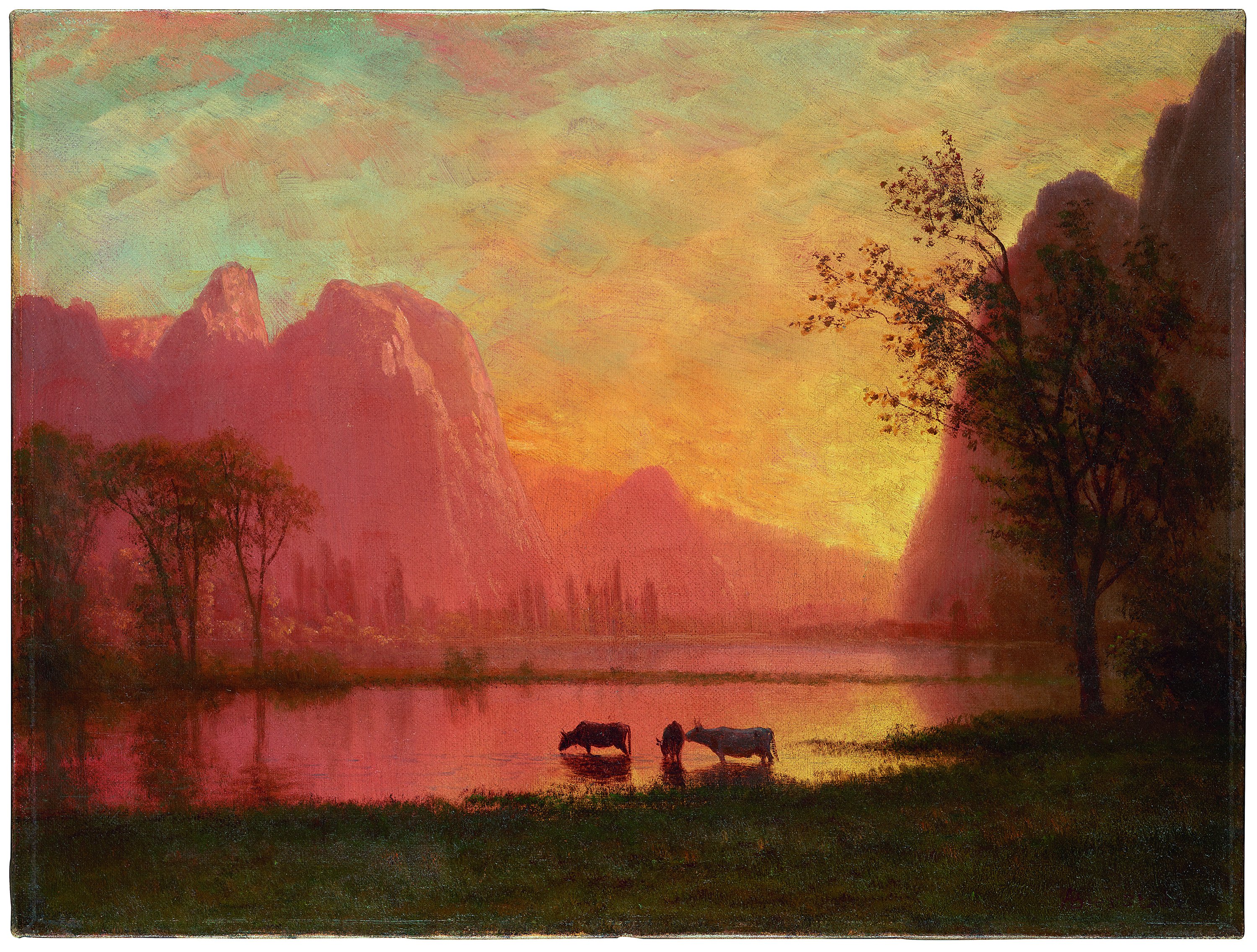
Sundown at Yosemite
"If report was true, we were going to the original site of the Garden of Eden", wrote Fitz Hugh Ludlow of his excursion with Bierstadt to Yosemite Valley, the primary objective of the artist's second Western journey in 1863. First reached by tourists in 1855, the sublime scenery of the "Great Yosemite" had inspired several travel accounts. The most vivid was Thomas Starr King's series of letters to the Boston Evening Transcript from December 1860 to February 1861. Descending into the Valley, surrounded by serrated precipices and thundering waterfalls, he exulted, "Every rod of the ride awakens wonder, awe, and a solemn joy." King, a Unitarian minister who had moved to California from Boston, met Bierstadt and Ludlow when they arrived in San Francisco in July and originally had planned to accompany them to Yosemite.
Ludlow was dazzled by the Valley: "Far to the westward, widening more and more, it opens into the bosom of great mountain-ranges-into a field of perfect light, misty by its own excesses-into an unspeakable suffusion of glory created from the phoenix-pile of the dying sun." These were the effects Bierstadt sought to capture in small, quickly-worked oil sketches such as Sundown at Yosemite made during his seven weeks in the Valley. As Ludlow recorded: "Sitting in their divine workshop.our artists began to labour in that only method which can ever make a true painter or a living landscape -colour- studies on the spot."
The flaming sunset breaking through granite walls in Sundown at Yosemite and in large compositions based on these studies, such as Sunset in Yosemite Valley (1868, Pioneer Museum and Haggin Galleries, Stockton, CA) was a popular symbol of the millenial destiny of the West. Two decades before tourists discovered the Valley, a writer argued: "This western world had not been preserved unknown through so many ages, for any purpose less sublime, than to be opened, at a certain stage of history, to become the theatre wherein better principles might have their action and free development." Revealed during the dark years of the Civil War, the sublime landscape of Yosemite roused this rhetoric to a new pitch. King, an ardent Unionist, invoked the prophecy of Habakkuk to describe Yosemite Valley: "Thou didst cleave the earth with rivers."
Elizabeth Garrity Ellis