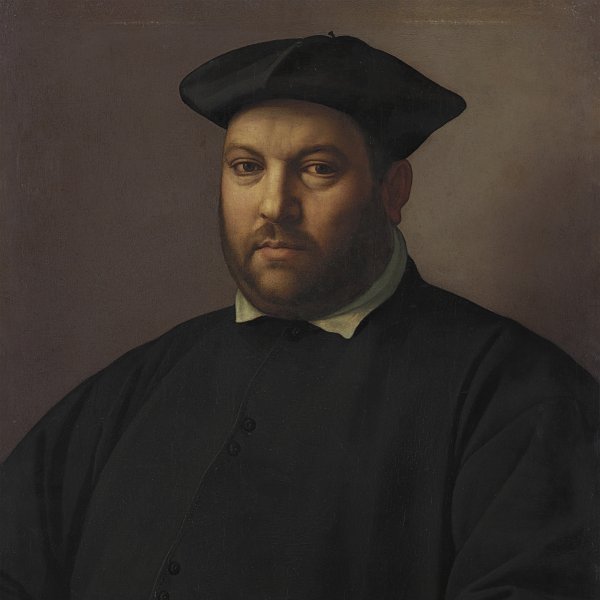
Ridolfo Ghirlandaio
Florence, 1483-1561
Son of the important Florentine painter Domenico Ghirlandaio, Ridolfo first trained with his father and then with his uncles Benedetto and Davide Ghirlandaio. On Domenico’s death in 1494 the latter took charge of the family workshop. Ridolfo’s first documented work is a Virgin painted in 1507 for Prato cathedral, in which the influence of Domenico is evident, as well as the more innovative style of Fra Bartolommeo, with whom Ridolfo studied, according to Vasari. His earliest works reveal an interest in the work of Piero di Cosimo, and it is also known that he was acquainted with and admired the work of Leonardo. This is evident in Christ on the Route to Calvary (National Gallery, London), which reveals similarities with Leonardo’s cartoons for The Battle of Anghiari. Ridolfo Ghirlandaio was a personal friend of Raphael, with whom he had most contact during Raphael’s last period in Florence between 1504 and 1508 and who influenced his work. Vasari recounts that Raphael even allowed him to add the finishing touches to one of his paintings, namely The Virgin and Child with the Infant Saint John the Baptist, according to Milanesi (Musée du Louvre, Paris). In 1515 the artist received his first important official commission to decorate the Cappella dei Papi in the monastery of Santa Maria Novella. He was assisted in this project by Jacopo Feltrini and Jacopo da Pontormo. Among Ghirlandaio’s most important works are The Miracle of Saint Zenobius and The Translation of the Body of Saint Zenobius (monastery of San Salvi, Florence), both painted in 1517 for the confraternity of that saint. Ghirlandaio was also active as a portraitist and designed temporary decorations for the Medici, such as those to celebrate the marriage of Lorenzo de’Medici, Duke of Urbino, in 1518.