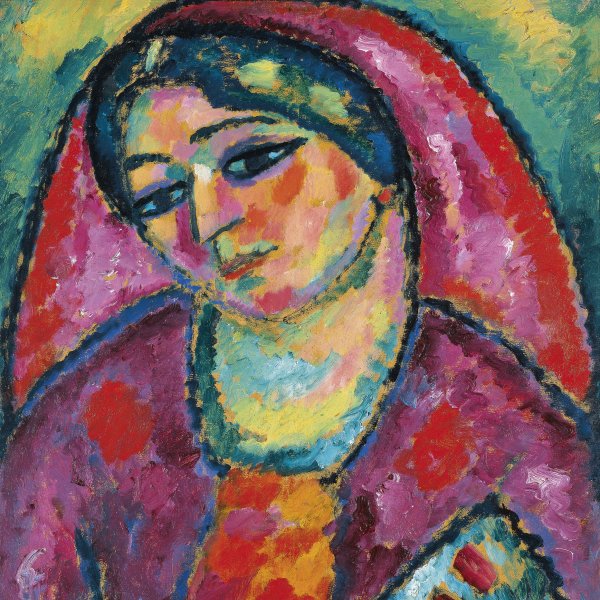
Alexej von Jawlensky
Torsok, 1864-Wiesbaden, 1941
An artist of Russian origin, Alexej von Jawlensky pursued most of his career in Germany, where he collaborated closely with his compatriot Wassily Kandinsky and other German artists. He moved to Munich in 1896 to further his training there, disappointed with the teaching methods at the Saint Petersburg Academy. He attended the classes of Anton Azˇbé, at whose school, in 1907, he met Kandinsky, who was to be his friend and artistic collaborator.
In 1905 Jawlensky made his first trip to France, where he became acquainted with the works of Paul Gauguin and Vincent van Gogh. He also had the chance to meet Henri Matisse and to view the work of the Fauve painters, with whom he exhibited at the Salon d’Automne that year. After returning to Munich he spent several summers in Murnau with Kandinsky, Gabriele Münter and Marianne von Werefkin, a Russian painter with whom Jawlensky had arrived in Germany. Together they established the Munich Neue Künstlervereinigung in 1909, to which Jawlensky belonged until 1912, the year he joined the Expressionist group Der Blaue Reiter (The Blue Rider). Jawlensky’s spiritual and artistic destiny, like that of most of his Munich colleagues, was marked by the musical sense of colour and a mystic conception inspired by theosophy. In 1917 he started on his well-known series of Mystic Heads and the following year Abstract Heads, which combined Fauvist and Expressionist notes with the tradition and spirituality of Russian art.
Following the First World War, during which he was forced to emigrate to Switzerland, Jawlensky settled in Wiesbaden. In 1924 he established the group called Die Blaue Vier (The Blue Four) with Paul Klee, Lyonel Feininger and Wassily Kandinsky and exhibited with them in America and Europe on many occasions. At the end of the 1920s Jawlensky was afflicted with serious arthritis that gradually restricted his mobility and eventually prevented him from painting. He began to dictate his memoirs in 1938.
In 1905 Jawlensky made his first trip to France, where he became acquainted with the works of Paul Gauguin and Vincent van Gogh. He also had the chance to meet Henri Matisse and to view the work of the Fauve painters, with whom he exhibited at the Salon d’Automne that year. After returning to Munich he spent several summers in Murnau with Kandinsky, Gabriele Münter and Marianne von Werefkin, a Russian painter with whom Jawlensky had arrived in Germany. Together they established the Munich Neue Künstlervereinigung in 1909, to which Jawlensky belonged until 1912, the year he joined the Expressionist group Der Blaue Reiter (The Blue Rider). Jawlensky’s spiritual and artistic destiny, like that of most of his Munich colleagues, was marked by the musical sense of colour and a mystic conception inspired by theosophy. In 1917 he started on his well-known series of Mystic Heads and the following year Abstract Heads, which combined Fauvist and Expressionist notes with the tradition and spirituality of Russian art.
Following the First World War, during which he was forced to emigrate to Switzerland, Jawlensky settled in Wiesbaden. In 1924 he established the group called Die Blaue Vier (The Blue Four) with Paul Klee, Lyonel Feininger and Wassily Kandinsky and exhibited with them in America and Europe on many occasions. At the end of the 1920s Jawlensky was afflicted with serious arthritis that gradually restricted his mobility and eventually prevented him from painting. He began to dictate his memoirs in 1938.