Percy Wyndham Lewis
Amherst, 1882-London, 1957
A painter and writer, Percy Wyndham Lewis was a key figure in spreading the modern movement in the United States. He studied painting at the Slade School of Art and spent from 1902 to 1908 travelling around Europe, where he visited many museums. On returning he settled in London, where his compositions began to incorporate Cubist elements in 1910. By 1912 Lewis had shaped a language of his own based on a reinterpretation not only of Cubism but also of Expressionism, Futurism and Japanese woodblock prints.
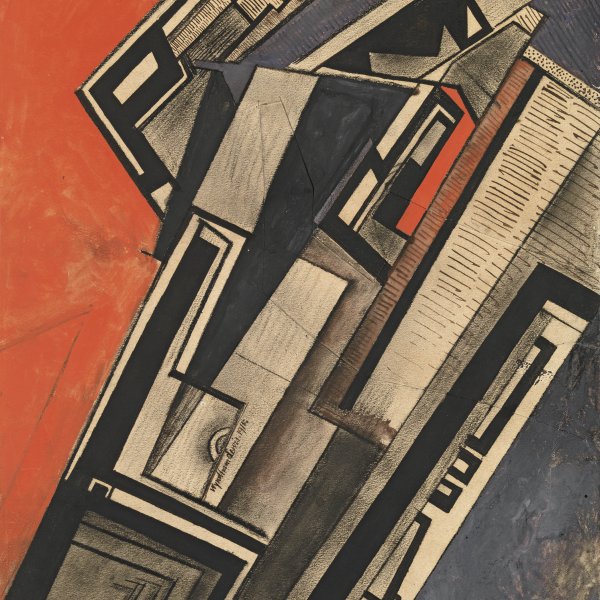
Lewis worked at the Omega workshops for a brief spell but soon left owing to his clashes with Roger Fry. Following an unsuccessful attempt to establish a Rebel Art Centre, together with Edward Wadsworth, Henri Gaudier-Brzeska and others he developed a semi-abstract, geometric style called Vorticism, based on architectural forms and the structure of machines. The vehicle for disseminating the theory that underpinned the movement was the magazine Blast, in which Lewis, as director, expressed his interest in politics and its implications for art.
In the First World War years, during which Lewis was involved in a Canadian project to portray the battle front, despite returning to a representative style his works retained their typically Vorticist angular appearance. When the war ended he attempted to breathe new life into the art scene by promoting the Group X exhibition in 1920 and setting up the magazine The Tyro, a name he also gave to several of his works. In the 1920s, a period in which his paintings were influenced by the Dadaist and Surrealist movements, he stood out chiefly as a writer, producing novels and publications on politics, philosophy and literature that brought him into conflict with most of the British intelligentsia. During the Second World War he lived in various parts of the United States and Canada and, after returning to London, he worked as an art critic in 1945 owing to an illness that gradually reduced his sight and left him totally blind in 1951.
Lewis worked at the Omega workshops for a brief spell but soon left owing to his clashes with Roger Fry. Following an unsuccessful attempt to establish a Rebel Art Centre, together with Edward Wadsworth, Henri Gaudier-Brzeska and others he developed a semi-abstract, geometric style called Vorticism, based on architectural forms and the structure of machines. The vehicle for disseminating the theory that underpinned the movement was the magazine Blast, in which Lewis, as director, expressed his interest in politics and its implications for art.
In the First World War years, during which Lewis was involved in a Canadian project to portray the battle front, despite returning to a representative style his works retained their typically Vorticist angular appearance. When the war ended he attempted to breathe new life into the art scene by promoting the Group X exhibition in 1920 and setting up the magazine The Tyro, a name he also gave to several of his works. In the 1920s, a period in which his paintings were influenced by the Dadaist and Surrealist movements, he stood out chiefly as a writer, producing novels and publications on politics, philosophy and literature that brought him into conflict with most of the British intelligentsia. During the Second World War he lived in various parts of the United States and Canada and, after returning to London, he worked as an art critic in 1945 owing to an illness that gradually reduced his sight and left him totally blind in 1951.