Roy Lichtenstein
New York, 1923-1997
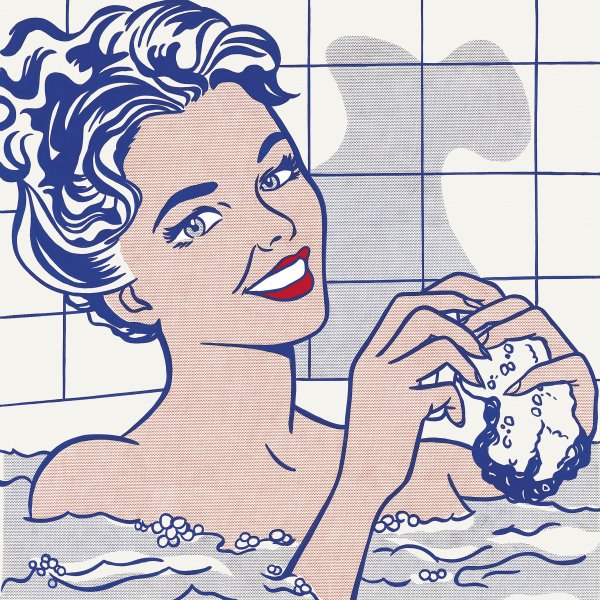
Roy Lichtenstein was one of the foremost practitioners of American Pop Art. He depicted themes relating to the consumer society, daily life and mass culture, which he borrowed from advertising, comics and popular magazines. Through these apparently simple compositions painted almost exclusively in primary colours, he expressed a personal criticism of the contemporary world.
Lichtenstein studied painting at the Art Students League from 1939 to 1940 and later at Ohio State University in Columbus, where he was greatly influenced by Hoyt Sherman’s ideas that art is a system of organized perception. At the beginning of his career he earned a living as an art teacher and window designer and his first paintings depicted typically American themes, rendered in a style influenced by Cubism and Expressionism. His first ne-man show in Cleveland in 1951 was not a great success. Between 1957 and 1960 his work succumbed to the influence of the prevailing movement in American art of the time: Abstract Expressionism. Later on, after experimenting with a personal version of Cubism and Constructivism, he again turned his attention to everyday reality, which was then dominated by the prefabricated images of mass culture. He gave rise to a new type of painting — which came to be called Pop — inspired by the themes and images of the new society that was emerging in the United States. In 1961 he produced his first works in large format featuring images taken from comic books, which became the hallmark of his subsequent oeuvre. His characteristic technique imitated the Benday dots, an industrial printing process employed in comic books to create colour variations in a very schematic manner using small coloured dots.
Lichtenstein’s first exhibition at the Leo Castelli gallery in 1962 bewildered viewers, who were unaccustomed to seeing their everyday world transformed into art. His oeuvre became progressively more complex in the 1980s and he also began to dabble in sculpture at the end of his life.
Lichtenstein studied painting at the Art Students League from 1939 to 1940 and later at Ohio State University in Columbus, where he was greatly influenced by Hoyt Sherman’s ideas that art is a system of organized perception. At the beginning of his career he earned a living as an art teacher and window designer and his first paintings depicted typically American themes, rendered in a style influenced by Cubism and Expressionism. His first ne-man show in Cleveland in 1951 was not a great success. Between 1957 and 1960 his work succumbed to the influence of the prevailing movement in American art of the time: Abstract Expressionism. Later on, after experimenting with a personal version of Cubism and Constructivism, he again turned his attention to everyday reality, which was then dominated by the prefabricated images of mass culture. He gave rise to a new type of painting — which came to be called Pop — inspired by the themes and images of the new society that was emerging in the United States. In 1961 he produced his first works in large format featuring images taken from comic books, which became the hallmark of his subsequent oeuvre. His characteristic technique imitated the Benday dots, an industrial printing process employed in comic books to create colour variations in a very schematic manner using small coloured dots.
Lichtenstein’s first exhibition at the Leo Castelli gallery in 1962 bewildered viewers, who were unaccustomed to seeing their everyday world transformed into art. His oeuvre became progressively more complex in the 1980s and he also began to dabble in sculpture at the end of his life.