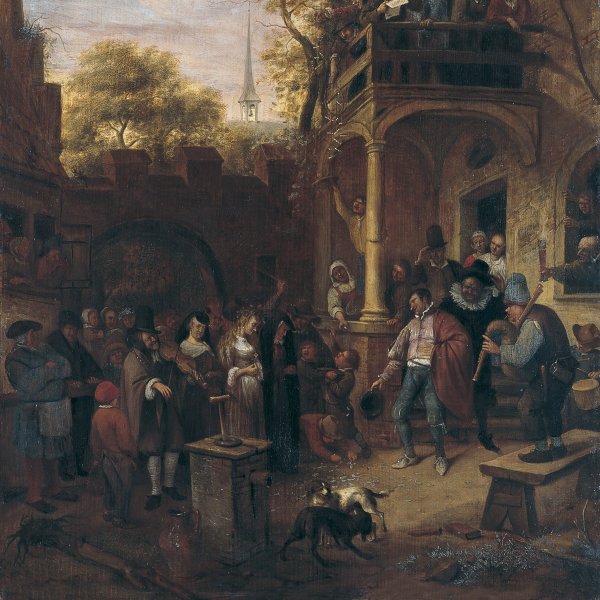
Jan Havicksz. Steen (attributed to)
Son of a brewer, Jan Havicksz. Steen studied in the Latin School and at the University of Leyden, remaining there only one year in 1646. He possibly trained as a painter in the studios of Nicolaus Knüpfer and Adriaen van Ostade and in 1648 he entered the Guild of Painters of Leyden. In The Hague in 1649 he married Margriet van Goyen, the daughter of the painter Jan van Goyen, who has at times also been suggested to be Steen´s teacher.
The artist worked as a painter of low-life genre scenes in The Hague until 1654, the period in which he painted his Peasant Wedding (1653) which has a marked narrative character. In 1654, affected by the crisis in the art market caused by the war with England, Steen and his father leased a brewery in Delft. Around 1658 he moved to Warmond near Leyden where he once again devoted his full attention to painting. The paintings from this period have a minute finish and frequently employ complex spatial constructions. One notable example is The Card Players (c. 1660).
During the 1660s Steen moved to Haarlem where he painted his most popular genre scenes, which are filled with life though the expressive characterisation of their numerous figures -joined together in complex networks of gestures and looks- and which possess a theatrical concept of space. Among the various subjects found in Steen´s oeuvre, all of them showing a strongly moralising bent, are scenes of daily life, amorous intrigues, and cycles dedicated to criticisms of the vices of drinking, luxury and covetousness. Among these are The Dancing Couple (1663) and While the Old One Sings, the Young One Smokes, (c. 1663-1665). In the late 1660s Steen also painted religious and mythological subjects such as Samson and Delilah (1668) and the Marriage of Tobias and Sara (1667-1668), as well as some portraits.
Following the death of Steen´s wife in 1669 and that of his father the following year -from whom Steen inherited a house in Leyden- the artist moved to his native city in 1670. Despite his reputation as an artist, Steen once more suffered during the crisis in the art market brought on by the third war against England, a fact which encouraged him to open a tavern in 1672. In 1673 he took as his second wife Maria van Egmond. His late works -such as The Country Festival (1677)- use brighter colours and a more nervous brushstroke than the previous ones. Steen died in Leyden at the beginning of 1679, aged 53.
J A L M