Andrew Wyeth
Chadds Ford, 1917-2009
The American painter Andrew Wyeth, who hailed from a family of artists, suffered from fragile health during his childhood. On account of this, his father, a famous illustrator, was his main tutor and introduced him to the world of drawing. In 1933Wyeth became acquainted with the watercolours of Winslow Homer and the powerful impression they had on him prompted him to emulate the Old Master and to adopt watercolour as his favourite medium during his early years as a painter.
His work was first exhibited at The Wyeth Family, a show organised by the Philadelphia Art Alliance in 1936, and his first one-man exhibition took place the following year. It was such a resounding success that it sold out on the first day. Determined to devote himself to painting, in 1943 he was offered a contract to produce the cover illustrations for The Saturday Evening Post, as his father had done, but turned it down.
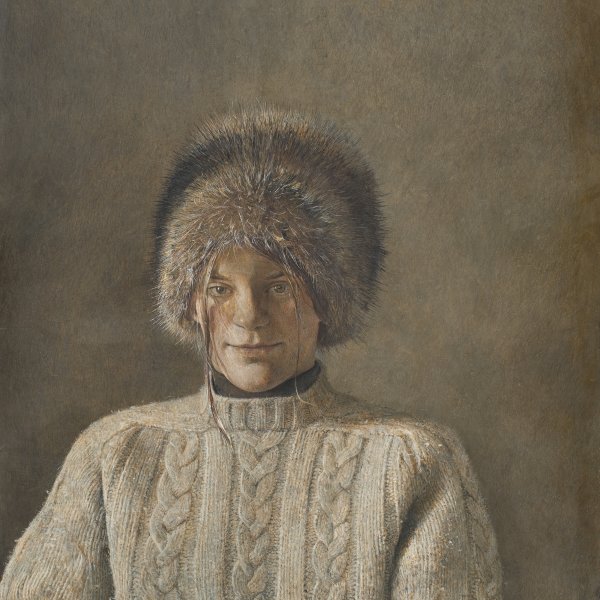
Wyeth led a quiet life, seldom travelled and spent most of his time in the states of Maine and Pennsylvania. His style hardly varied throughout his career. His fondness for expressing the instantaneous inclined him towards swift execution, which was counterbalanced by his desire to capture the tiniest details. His range of colour was characterised by a tendency towards austerity, with predominant earth shades. During the 1940s he incorporated the egg tempera technique learned from his brother-in-law, which enabled him to create highly matte surfaces.
The equally changeless themes of his works are related to those of the painters of the American Scene, who were interested in representing the essence of America. In addition to Maine landscapes, he also liked to depict the human figure. Two female models played a prominent role in his career, featuring in many of his works. One was Christina Olson, whom he portrayed until 1969, the year she died, and who is depicted in the work that catapulted Wyeth to fame: Christina’s World, 1948 (New York, The Museum of Modern Art). The other was Helga Tesford, a neighbour whom he secretly painted between 1971 and 1985.
Andrew Wyeth was greatly admired in the United States and was the first living artist to have the New York Metropolitan Museum of Art organise a retrospective of his work in 1976. However, his popularity with the public was not accompanied by the approval of critics, who were less unanimous in their opinions of his work.
His work was first exhibited at The Wyeth Family, a show organised by the Philadelphia Art Alliance in 1936, and his first one-man exhibition took place the following year. It was such a resounding success that it sold out on the first day. Determined to devote himself to painting, in 1943 he was offered a contract to produce the cover illustrations for The Saturday Evening Post, as his father had done, but turned it down.
Wyeth led a quiet life, seldom travelled and spent most of his time in the states of Maine and Pennsylvania. His style hardly varied throughout his career. His fondness for expressing the instantaneous inclined him towards swift execution, which was counterbalanced by his desire to capture the tiniest details. His range of colour was characterised by a tendency towards austerity, with predominant earth shades. During the 1940s he incorporated the egg tempera technique learned from his brother-in-law, which enabled him to create highly matte surfaces.
The equally changeless themes of his works are related to those of the painters of the American Scene, who were interested in representing the essence of America. In addition to Maine landscapes, he also liked to depict the human figure. Two female models played a prominent role in his career, featuring in many of his works. One was Christina Olson, whom he portrayed until 1969, the year she died, and who is depicted in the work that catapulted Wyeth to fame: Christina’s World, 1948 (New York, The Museum of Modern Art). The other was Helga Tesford, a neighbour whom he secretly painted between 1971 and 1985.
Andrew Wyeth was greatly admired in the United States and was the first living artist to have the New York Metropolitan Museum of Art organise a retrospective of his work in 1976. However, his popularity with the public was not accompanied by the approval of critics, who were less unanimous in their opinions of his work.