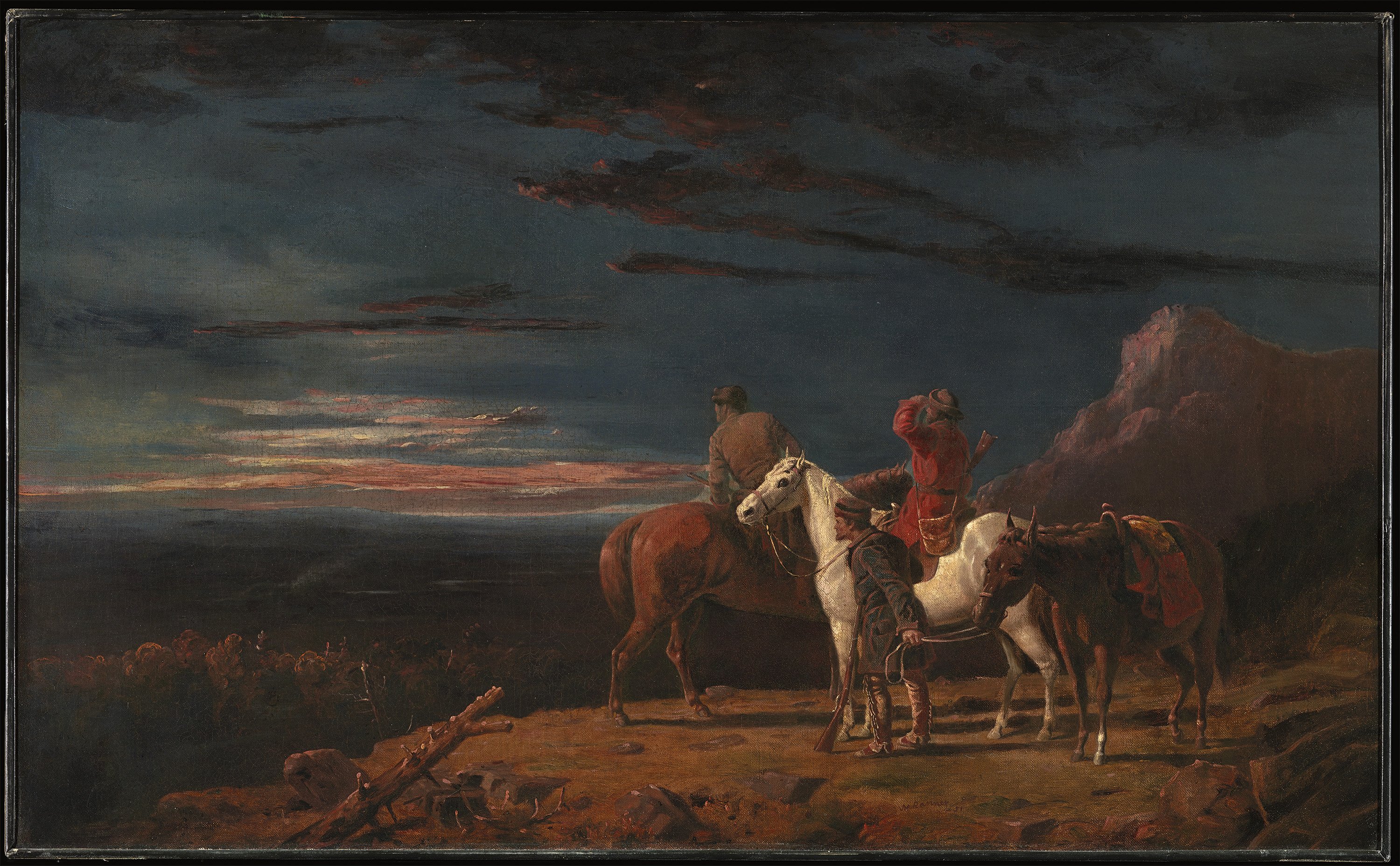
The Scouting Party
1851
Oil on canvas.
55.8 x 91.4 cm
Carmen Thyssen Collection
Inv. no. (
CTB.1981.78
)
Room B
Level 0
Carmen Thyssen Collection and Temporary exhibition rooms
More than a decade after his visit to Ranney's suburban New Jersey studio Henry T. Tuckerman recalled the guns, saddles and cutlasses crowding its walls "which might lead a visitor to image he had entered a pioneer's cabin or border chieftain's hut." They were props for the Western genre pictures that established the artist's reputation in the late 1840s and were inspired by his adventures as a volunteer in the Texas War of Independence in 1836. "He had caught the spirit of border adventure", wrote Tuckerman, "and was enamoured of the picturesque in scenery and character outside the range of civilisation; and to represent and give them historical interest was his artistic ambition."
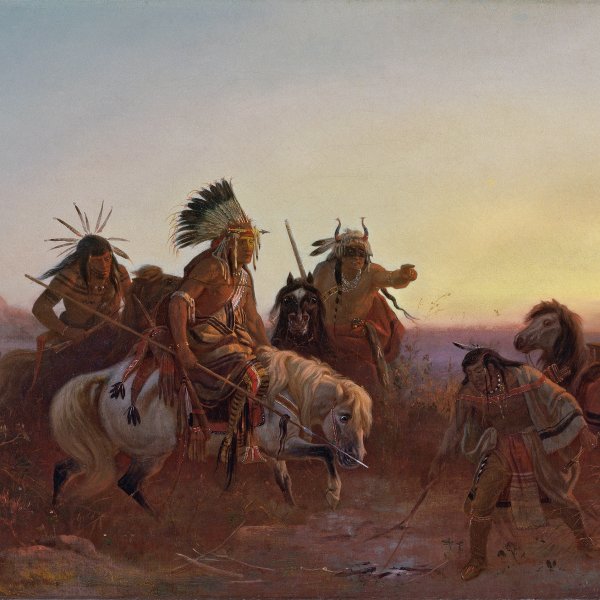
The Scouting Party is one of series of images of trappers and mountain men painted by Ranney between 1849 and 1853 in which he evocatively depicted the remote Western frontier. The barren prairie setting and the brilliant last rays of sunset throw his scouts into relief as they watch the fires of the Indians camping below. The sublime scale and isolation of the plains -long mistaken for desert- fascinated Americans during the 1830s and 1840s. A popular tale of a journey to Texas recorded that "the idea of straying upon a Prairie [...] had ere this presented itself to my imagination, was a gloomy and indeed a very dangerous and horrid thing." Washington Irving hurried to the Great Plains upon returning from Europe in 1832 and described their "inexpressive loneliness" in A Tour on the Prairies: "The loneliness of a forest is nothing to it. There the view is shut it by trees, and the imagination is left free to picture some livelier scene beyond. But here we have an immense extent of landscape without a sign of human existence."
Yet these descriptions, like the Western expeditions, took possession of the landscape. Irving was praised "for turning these poor barbarous steppes into classical land." Ranney imposed classic order on the scene, abstracting and carefully modelling the figures of the scouts and horses.
Tuckerman wrote that Ranney's works "won the common eye and heart, and have a genuine American scope and tone." Unlike the exotic figures depicted by Alfred Jacob Miller and Charles Deas (although Deas's Jacques (The Mountain Man) of 1844 may have influenced Ranney's work), Ranney's scouts were ordinary men. They appealed to the democratic tastes of the members of the American Art-Union which during the 1840s championed native subject matter and genre scenes through a system of lotteries and auctions. Between 1845 and 1853 the Art-Union distributed 26 of Ranney's paintings. The Scouting Party was reproduced as a woodcut engraving in the Bulletin of the American Art-Union in September 1851 and sold to a member the following year.
Elizabeth Garrity Ellis
The Scouting Party is one of series of images of trappers and mountain men painted by Ranney between 1849 and 1853 in which he evocatively depicted the remote Western frontier. The barren prairie setting and the brilliant last rays of sunset throw his scouts into relief as they watch the fires of the Indians camping below. The sublime scale and isolation of the plains -long mistaken for desert- fascinated Americans during the 1830s and 1840s. A popular tale of a journey to Texas recorded that "the idea of straying upon a Prairie [...] had ere this presented itself to my imagination, was a gloomy and indeed a very dangerous and horrid thing." Washington Irving hurried to the Great Plains upon returning from Europe in 1832 and described their "inexpressive loneliness" in A Tour on the Prairies: "The loneliness of a forest is nothing to it. There the view is shut it by trees, and the imagination is left free to picture some livelier scene beyond. But here we have an immense extent of landscape without a sign of human existence."
Yet these descriptions, like the Western expeditions, took possession of the landscape. Irving was praised "for turning these poor barbarous steppes into classical land." Ranney imposed classic order on the scene, abstracting and carefully modelling the figures of the scouts and horses.
Tuckerman wrote that Ranney's works "won the common eye and heart, and have a genuine American scope and tone." Unlike the exotic figures depicted by Alfred Jacob Miller and Charles Deas (although Deas's Jacques (The Mountain Man) of 1844 may have influenced Ranney's work), Ranney's scouts were ordinary men. They appealed to the democratic tastes of the members of the American Art-Union which during the 1840s championed native subject matter and genre scenes through a system of lotteries and auctions. Between 1845 and 1853 the Art-Union distributed 26 of Ranney's paintings. The Scouting Party was reproduced as a woodcut engraving in the Bulletin of the American Art-Union in September 1851 and sold to a member the following year.
Elizabeth Garrity Ellis