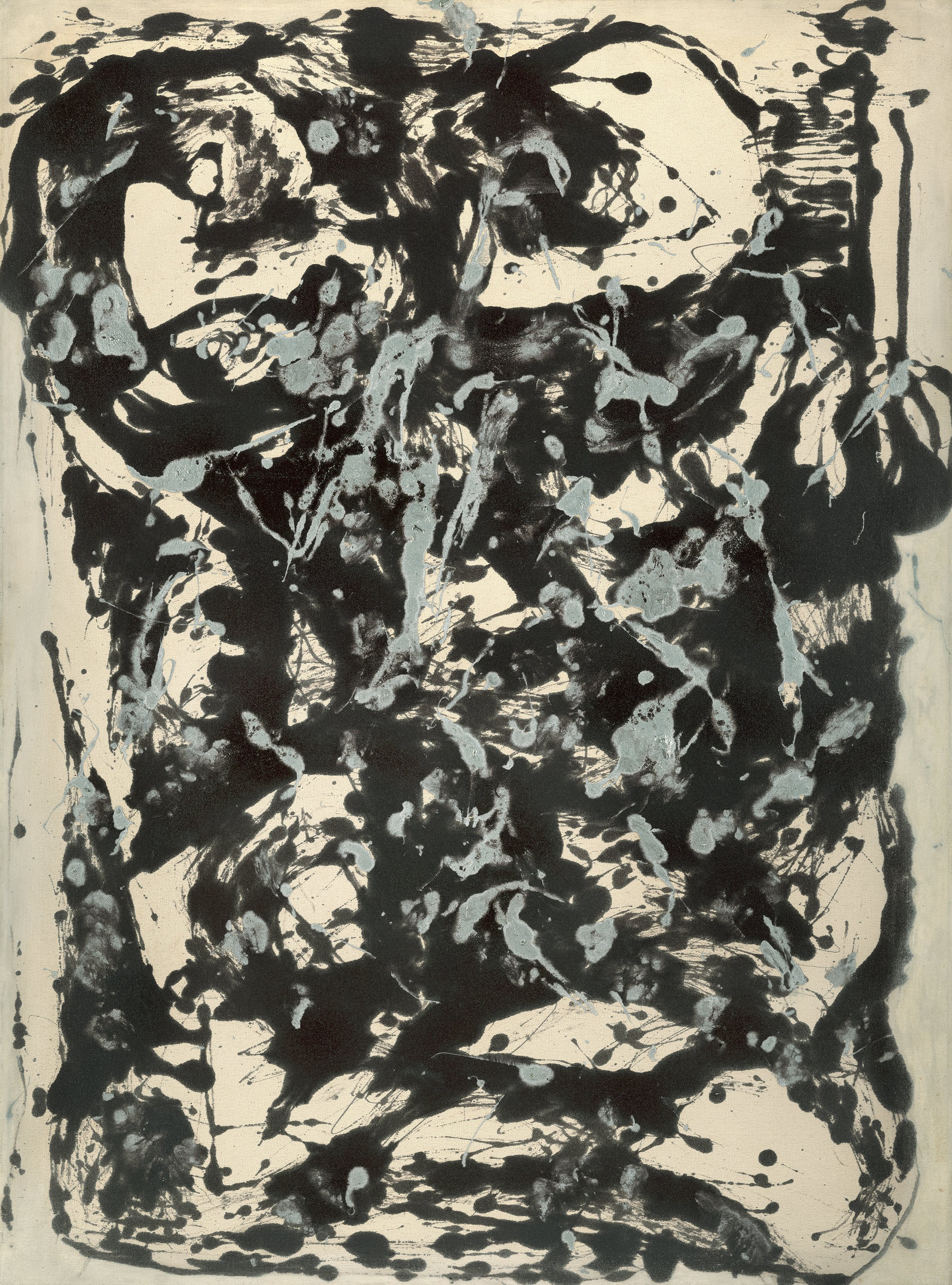
Brown and Silver I
Jackson Pollock, one of the foremost practitioners of Action Painting, began to work on his first drip paintings in the winter of 1947‒48. Thenceforward he firmly espoused the idea of automatism, an automatism derived largely from Surrealism. “When I’m in the painting I’m not aware of what I’m doing, ” he stated in 1947.What is more, with the invention of the drip technique, Pollock eschewed easel painting and for the first time avoided any direct contact between the artist and the canvas: “I continue to move further and further away from the painter’s usual tools like easels, palettes, brushes and so on. I prefer sticks, spoons, knives, flowing paint that I drip or a thick paste with sand, ground glass and other unusual materials.”
After his legendary exhibition at the Betty Parsons Gallery in New York in November 1950, which established him as an abstract artist, Pollock decided to give a new turn to his painting. In June 1951 he wrote to his friends, the painter Alfonso Ossorio and the dancer Ted Dragon, “I’ve had a period of drawing on canvas in black — with some of my early images coming thru — think the non-objectivists will find them disturbing — and the kids who think it simple to splash a Pollock out.” The emphasis on drawing and the intention to return to the black line, which had defined his first works, gave way to the series of Black Paintings of the early 1950s.
Brown and Silver I, the only work by Pollock in the Museo Thyssen-Bornemisza collection, belongs to this series of Black Paintings executed between 1950 and 1953 using a tin of black enamel paint and unprimed canvases. A photograph of Pollock’s studio taken by Hans Namuth in 1951 shows Brown and Silver I together with Brown and Silver II, painted alongside each other on the same roll of fabric which the artist then cut into two. As neither is signed, it is not possible to ascertain their correct position, although Francis Valentine O’Connor and Eugene Victor Thaw propose they should be taken to be vertical, as this is how they appear in the aforementioned photograph.
In both compositions Pollock replaced pure black with brown, splashed with various patches of silver. The artist’s technique is not very different to that of the previous drip paintings since, as can be seen, he has applied the paint straight from the tin, using sticks and dry paintbrushes — now adding syringes — and has also approached the composition from all four sides. As with all the Black Paintings, where Brown and Silver differs from his previous works is in the theme. Pollock rescues certain anthropomorphic notes from his early period, recalling Picasso and Masson, and the open space and all-over effect of his drip paintings is no longer present.
Paloma Alarcó