US Art and Literature of the 19th and 20th Centuries
With the collaboration of:

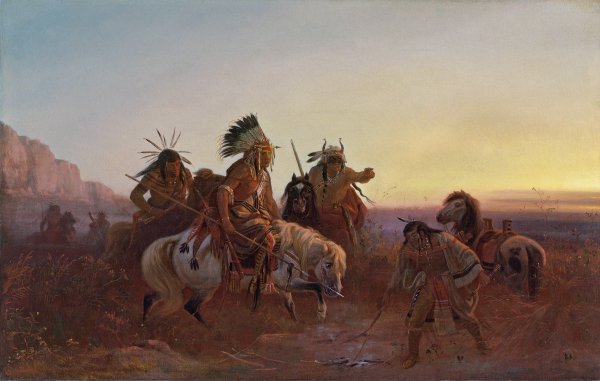
The Lost Trail
At the age of fifteen, Charles Ferdinand Wimar (1828–1862) moved with his family from his native Germany to the United States of America. They settled on the outskirts of St Louis, Missouri, where the young Charles came into close contact with the indigenous peoples living in the area and developed a fondness for the historical novels of James Fenimore Cooper (1789–1851).
The most famous of these, The Last of the Mohicans (1826) – partly based on events that took place in 1757 during the French and Indian War or Seven Years’ War (1756–63) – was one of the main literary sources of inspiration for Wimar, who was also influenced by painters such as George Catlin (1786–1872) and Karl Bodmer (1809–1893). All their works vividly illustrate the indigenous North American peoples’ struggle for survival in a hostile natural environment, which inexorably led to the disappearance of their traditional ways of life. These nineteenth-century artists, eager to document civilisations they considered to be on the verge of extinction, came to enjoy great commercial success and popularity by disseminating romanticised images of a population no longer perceived as a real threat to mainstream US society. In addition, the ways in which they portrayed the country’s recent past and imagined the frontier of the Far West decisively influenced how indigenous peoples were subsequently characterised in westerns, comics and graphic novels of the twentieth and twenty-first centuries.
Wimar painted The Lost Trail around 1856, before becoming acquainted with various Sioux tribes during his travels around the Upper Missouri region in 1858 and 1859. Although this oil painting does not reflect a specific episode from The Last of the Mohicans, it could be linked to a scene in chapter XIII where the Native Americans lose track of the fugitives following a search that proves unsuccessful due to the lack of light. Wimar’s scene is drawn from a stereotype-ridden imaginary that still prevails today. In this almost exclusively male world, the men are not usually shown peacefully performing the typical daily tasks portrayed in genre painting of the time. Instead, they are depicted as intrepid buffalo hunters or fierce warriors, half-naked, adorned with body paint and always dressed in the traditional attire of the nomadic peoples of the Great Plains.
Teresa Gibert
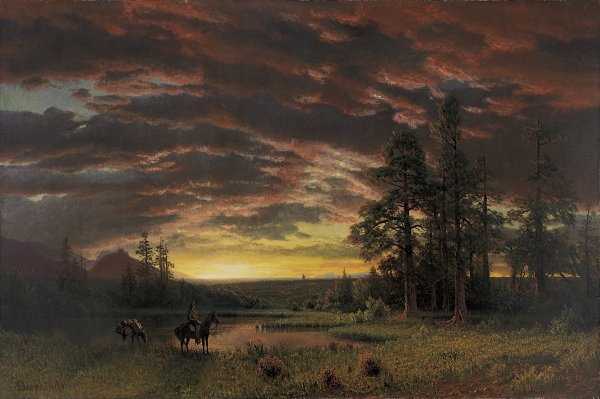
Near the Black Hills
In Evening on the Prairie, the fading light of day seems to show a lone rider the way westward beyond the frontier of civilisation across the Midwestern plain, the icon of American expansionism. Willa Cather (1876–1947) writes in My Ántonia (1918) that the prairie is ‘not a country at all, but the material out of which countries are made’.
Just as the term ‘frontier’ concealed the imperialist appropriation of the territory, so the depiction of the empty prairie legitimised the colonisation of a space previously inhabited by indigenous peoples.
Cather authored a wide variety of works, although her most popular ones celebrate the spirit of the male and female pioneers who shaped the frontier as a unifying myth of national identity and destiny. The so-called ‘prairie trilogy’ (O Pioneers!, 1913, The Song of the Lark, 1915, and My Ántonia, 1918) nostalgically evokes the pioneering spirit and persevering nature of the people of Slavic, Scandinavian or Central European origin (such as Bierstadt himself) who created a new social ecosystem in interaction with an often-hostile natural environment. Cather herself was a pioneer in shifting the focus away from Anglo-centric expansion to write about immigrants who redefined the identity discourses of the time, while Americanising the pastoral and epic elements of the classical tradition, as illustrated by her trilogy set wholly or partly on the plains of the Midwest.
In addition, in her novels she challenged the nineteenth-century American imaginary that feminised the land beyond the frontier – a world that was either ‘virgin’ and conquerable or ‘maternal’ and welcoming. Unlike in Bierstadt’s picture, the plots of her novels on territorial expansion do not focus on the traditional lone hero but on women endowed with the virtues of resilience and determination traditionally attributed to the pioneers, settlers or cowboys of the mythical American West.
María García Lorenzo
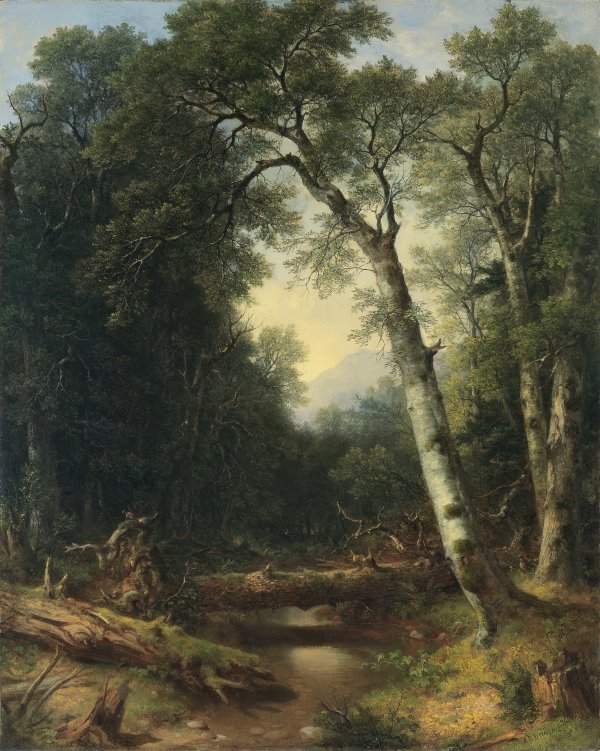
A Creek in the Woods
In A Creek in the Woods, painted in 1865, Asher B. Durand (1796–1886) offers us much more than a simple landscape: he invites us into a space steeped in symbolic and spiritual resonances that can be interpreted in the light of nineteenth-century American literary and philosophical tradition. The composition is structured around a striking contrast in luminosity: golden light filters through the treetops, the stream glistens with golden sparkles, and the sky gently illuminates the upper reaches of the forest, while dense shadows cloak the undergrowth in a halo of mystery. This interplay of light and shadow lends the landscape an essential ambiguity: it is at once a space of revelation and of enigma.
The sacredness of a forest dominated by monumental trees, whose verticality recalls a cathedral’s arches, brings to mind the transcendentalist views of Ralph Waldo Emerson, who regarded nature as the visible manifestation of divinity. In Nature (1836), Emerson asserts that the individual finds both reason and faith in intimate encounters with nature (and especially with the forest). In contact with nature, humans recognise themselves to be particles of the absolute, lovers of sacred immortality merged with the perpetuity of the cosmos.
However, as Emerson himself also warns, nature shares with human beings its mutability, its ability to harbour both light and darkness. From a more unsettling perspective, then, the painting also engages with the Gothic tradition of authors such as Nathaniel Hawthorne (1804–1864). In Hawthorne’s story ‘Young Goodman Brown’ (1835), the forest becomes a setting for something sinister: a place where reason vanishes and the protagonist confronts the evil lurking both in his community and within himself. The trees take on ghostly forms, the sounds of the night resemble demonic omens, and the path becomes a descent into moral chaos.
The painting thus brings us to the threshold between the sacred and the ominous. The forest embodies the profound ambivalence of nature. It is a backdrop both to spiritual epiphany and to the most deep-seated human anxieties; a place where the infinite and the abyss coexist.
Inés Ordiz
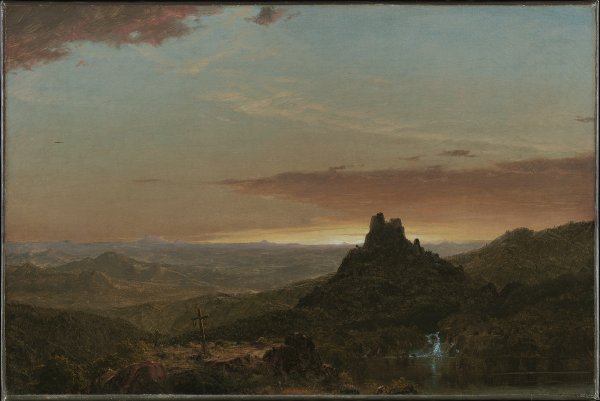
Cross in the Wilderness
In Cross in the Wilderness (1857), Frederic Edwin Church (1826–1900) depicts a landscape dominated by the light of dusk, where the slowly languishing day tinges the horizon with melancholy. In the foreground, barely illuminated by the last rays of sun, a cross emerges: a serene yet inexorable reminder of death, which, like the night, is comforting in its inevitability.
This visual dialogue between death and nature is intimately reflected in ‘Thanatopsis’ (1817), a poem by William Cullen Bryant (1794–1878). Bryant discovered his literary vocation through reading the Graveyard Poets, an eighteenth-century British pre-Romantic group who captured in verse their sombre meditations on mortality, inspired by their visits to cemeteries. A later encounter with the work of William Wordsworth renewed and heightened his poetic sensibility. ‘Thanatopsis’, likely begun around 1811, is Bryant’s most celebrated poem. In it, he constructs a text in which death, rather than inspiring terror, becomes an inexorable certainty that is an integral part of the vast cycle of nature.
In its verses, nature in its entirety is presented as the majestic tomb of humanity. Death, far from being a rupture, becomes a dissolution and a merging with the whole. The body returns to the elements and is integrated into the cosmic continuum, where individual existence is diluted in the totalising organism of nature. This imaginary foreshadows the later tenets of Transcendentalists such as Ralph Waldo Emerson (1803–1882) and Henry David Thoreau (1817–1862), who viewed nature as a living, sacred and vast being of which human beings are but a fleeting particle.
Church’s painting and Bryant’s poem thus engage in dialogue in the same Romantic and pantheistic tone: both invite us to contemplate death not as an abrupt end but as a transformation towards the whole, in nature’s endless whisper.
Inés Ordiz
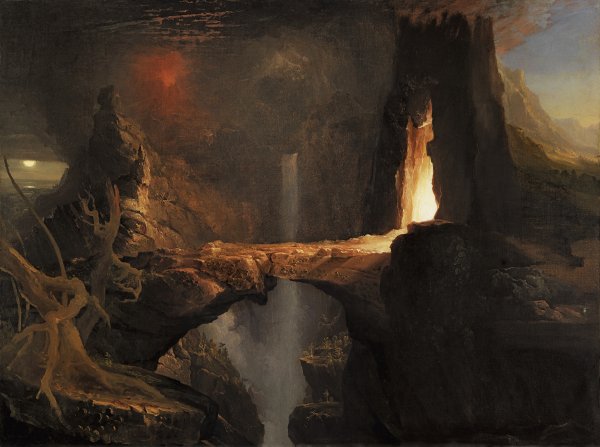
Expulsion. Moon and Firelight
Expulsion. Moon and Firelight (1828) by Thomas Cole (1801–1848) reinterprets the scene of the loss of Eden, albeit dispensing with Adam and Eve: the landscape is the main feature. Light illuminates a natural paradise on the right, while shadow engulfs the world after the Fall on the left. The contrast between the illuminated arch separating the two spaces and the surrounding gloom heightens the sublime nature of the overall painting.
In nineteenth-century US art and literature, the sublime is an experience that goes beyond the aesthetic realm, becoming a spiritual encounter in which the subject is brought face-to-face with forces that inspire both fear and wonder. Expulsion accordingly arouses ambivalent emotions, in which awe at the grandeur of the natural elements merges with grief.
A similar use of the sublime underlies other key works of the century. In The Last of the Mohicans (1826) by James Fenimore Cooper (1789–1851), nature is portrayed with overwhelming grandeur: cliffs, forests and rivers are described with the Romantic intensity of the immeasurable. However, the scenery is not merely a source of beauty, but also a backdrop to violence and the cultural disintegration of the indigenous nations. The sublime thus symbolises a double loss: of nature’s virginity and of primaeval cultures. The landscape, as on the left-hand side of Cole’s canvas, looms with a tragic beauty that heightens the experience of being uprooted.
In Walden (1854), Henry David Thoreau (1817–1862) transforms the experience of the sublime into a moral quest. The book reflects an attempt to reconnect with the natural world, to recover a lost inner Eden. In Thoreau’s vision, nature transcends aesthetic contemplation and is presented as a haven from unstoppable modernity. As in the right-hand section of Cole’s painting, it reveals itself as a source of spiritual clarity.
In these works, the use of the sublime inhabits the liminal or transitional space of a world that is vanishing in the face of imperial industrial expansion, sustained by the (sometimes vain) hope of recovering it. It is a language that positions the viewer between the serene and the terrifying and shapes the emotions of an ever-changing future.
Inés Ordiz
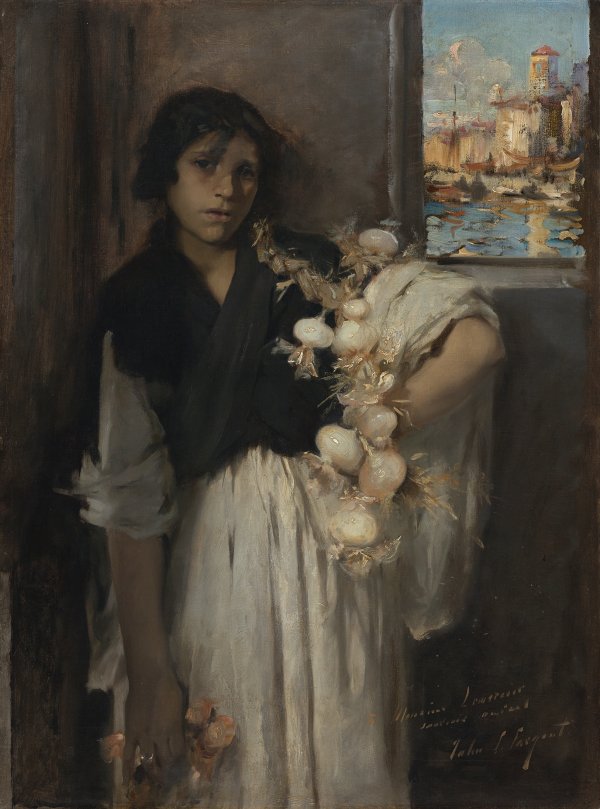
Venetian Onion Seller
In the late nineteenth century, the European dream became a keenly felt aspiration for a sector of the educated American public who sought in the Old World a cultural, historical and aesthetic depth that they could not find in their own country. This yearning was expressed in a refined manner in the literary works of Henry James (1843–1916) and powerfully depicted in the paintings of John Singer Sargent (1856–1925). Both men, united by a long friendship, also shared a similar outlook: cosmopolitan, ambiguous and fascinated by old Europe, especially Italy, where the picturesque merged with the decadent, and beauty with history.
In Sargent’s Venetian Onion Seller, painted around 1880–82, the female figure – a street vendor – stands with calm dignity. Her demeanour, the restrained expression on her face, and the balance between realism and idealisation despite her humble origins make her a symbol of the Europe that people of the US imagined: a continent steeped in tradition, mystery and charm. She is not just a woman selling onions; she is a living embodiment of Venice, a city that James depicts as beauty frozen in time; art transformed into a setting for moral and emotional introspection.
Some of James’s best-known works, such as Daisy Miller (1879), Portrait of a Lady (1881) and The Aspern Papers (1888), recount the inner conflicts of Americans in Europe, dazzled by the continent’s cultural richness, and their naivety regarding social complexities. The visitor’s gaze upon Italy is neither innocent nor neutral: it is a projection of desire, as well as a search for a lost authenticity. Sargent, himself a US expatriate, portrays this Venetian woman with a mixture of idealisation and direct observation. She is at once a real figure and a source of aesthetic fascination: the Europe dreamt of from the other side of the Atlantic.
The representations created by both artists – one literary, the other pictorial – reveal more about the observer than about what is observed. It is in this play of mirrors between the United States and Italy, between desire and experience, that the essence of the ‘European dream’ lies: Italy seems to offer a lost authenticity, yet always returns an image steeped in history and beauty, albeit one whose meaning is ambiguous.
Adriana Kiczkowski
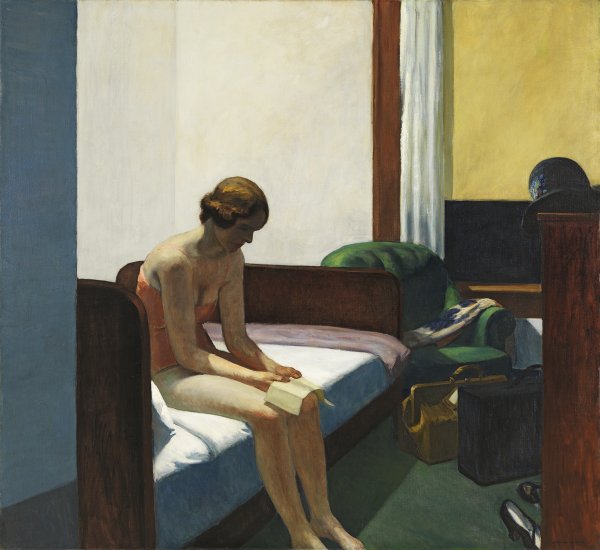
Hotel Room
The oeuvre of Edward Hopper (1882–1967) constitutes an indisputable icon of American culture. His paintings, which capture human loneliness and alienation in urban scenes and Cape Cod landscapes, embody what has come to be known as ‘the American imagination’. The painter’s subject matter and style are so recognisable and his influence so undeniable that, as John Updike ironically points out, all US prose written after him could be considered ‘Hopperesque’.
Hotel Room, painted in 1931, is a portrait of a woman sitting in her underwear on an unmade bed in a hotel room reading from a piece of paper. It brings to mind the novels in the New York Trilogy (1985–87) of Paul Auster (1947–2024). Gazing at this woman, we wonder what she is doing there and what she is reading. This places us in the same position as the detective Blue in Auster’s Ghosts (1986), unable to see from the distance of the building opposite what Black, the man he is watching, is writing.
For Updike, who draws inspiration from the Thyssen Hotel Room and Girl at a Sewing Machine, dating from around 1921, what matters in his poem ‘Two Hoppers’ (1993) is the active role the painter gives us. In these paintings, just as in Girl reading a Letter at an Open Window, c. 1657–1659, by Johannes Vermeer, we observe ‘The slanting light / the woman alone and held amid the planes / of paint by some mysterious witness / we’re invited to breathe beside’.
This vision of the woman and the aura of mystery surrounding her inspired Victoria Chang’s (1970) poem ‘Edward Hopper Study: The Hotel Room’ (2004), in which a woman waits for her lover, a married man. The author highlights her identification with the woman: ‘That is all / the artist left us with, / knowing we would turn / the woman’s stone into ours, / a thirst for the self / in everything’.
Similarly, Kris Nelscott – the pseudonym of Kristine Kathryn Rush (1960) – also offers a feminist rewriting of the painting in her short story ‘Still Life, 1931’ (2016). She imagines the story of Lurleen, a widow travelling with a briefcase full of money inherited from her late husband, in the context of the Great Depression, a time of racism and lynchings. In all these cases, Hopper’s painting sparks our imagination, piques our curiosity, and makes us wonder what is happening to this woman in a hotel room.
Cristina Garrigós
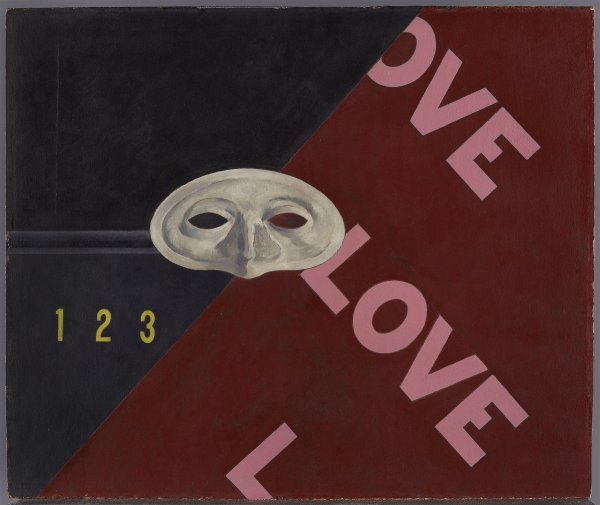
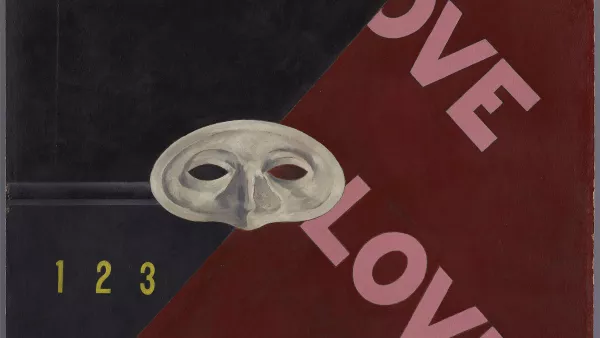
Love, Love, Love. Homage to Gertrude Stein
During his second trip to Europe in 1912, Charles Demuth (1883–1935) met Marsden Hartley (1877–1943), who introduced him to Gertrude Stein’s circle in Paris. From 1912 to 1914, he became a regular at the salon on 27 Rue de Fleurus, where he came into contact with European modernism and was able to socialise in a permissive and diverse environment that accepted his homosexuality as a matter of course.
Love, Love, Love – Homage to Gertrude Stein, executed in 1928, is a complex visual synthesis of literary language and Gertrude Stein’s artistic goal of bringing Cubism to literature. The painting features three typographical repetitions of the word ‘Love’ alongside the numbers ‘1, 2, 3’, bringing to mind the musical and poetic rhythms that Stein incorporates into her experimental narrative structures. Its style is repetitive and musical and its language clear and simple, the aim being – beyond semantic and syntactic concerns – to create an effect of complex wholeness, an instant, an emotional reaction.
We find this rhythmic pattern in Three Lives (1909), a work by Gertrude Stein (1874–1946) telling of three women, Anna, Melanctha and Lena, who live in the fictional town of Bridgepoint (inspired by Baltimore). With her characteristic prose, which critics have deemed ‘anti-patriarchal’ due to its groundbreaking style, Stein presents the relations of power, sex, gender and race that permeate the lives and love stories of these women from humble backgrounds. Stein had recently translated Gustave Flaubert’s Three Tales (1877), whose influence is evident: the Anna in Three Lives is an Americanised version of Félicité in A Simple Heart, the main character of one of the three tales. In Demuth’s painting, the mask, the ternary rhythm and the repetition of the word ‘Love’ serve as a reminder of the life and work of Gertrude Stein; as a vital metaphor for appearances, in contrast to the hidden reality of her three female characters. Stein and Demuth himself gaze at us from behind the mask that conceals both forbidden love and shared freedom.
Ana Zamorano
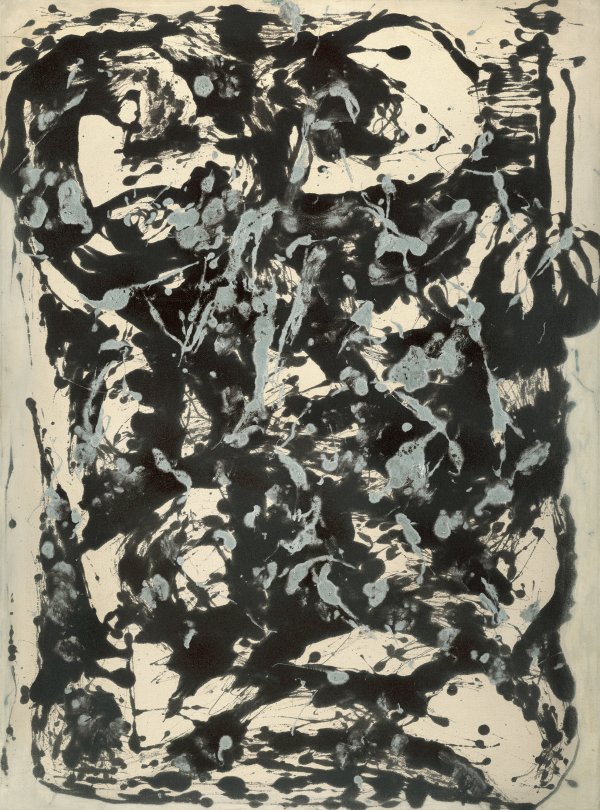
Brown and Silver I
The all-over technique employed by Jackson Pollock (1912–1956) foreshadows other postmodern techniques such as collage, cut-up and hypertext. For Ben Lerner (1979), a contemporary American writer, the plot is scattered like a splash of anecdotes, quotations and digressions to be explored with no pre-established map.
In his novels Leaving the Atocha Station (2011) and 10.04 (2014), Lerner explores the distance between ‘sublime experience’ and social ‘performance’. The main character in the first novel has never felt a genuine aesthetic emotion, but instead experiences art through stories about other people. Jackson Pollock does not appear as a character in this novel, but his logic is present in the impossibility of defining the aesthetic fact. In the documentary Jackson Pollock 51 (1951), Hans Namuth’s camera placed a pane of glass between the painting and the viewer, in the same way that in Lerner’s work, screens stand between the narrator and reality. In the poem ‘Didactic Elegy’ (2009), Lerner reflects on the images and representations of 9/11, particularly on the difficulty of distinguishing between the actual collapse of the twin towers and the image of the towers collapsing. The same thing happens with Pollock’s art: the influence of audiovisual images proves stronger than the influence of the events themselves.
Pollock breaks with centred composition, while Lerner breaks with linear syntax through fragmented verse lines, poetic prose, and sentences that dissolve before their meaning is fully realised. Both share the ‘whole page’ logic whereby each individual gesture matters less than the cumulative rhythm.
Cultural memory is shaped by various forms of mediation. When Lerner states in his poem that the image of Pollock we are all familiar with cannot be separated from the famous three-minute documentary, he is pointing to two things at once: a specific fact and an emotion. He draws attention to a shift in the way we write about art, which is no longer limited to describing the painting but analyses the means and mechanisms – catalogues, museums or social media – that influence how we see and understand art.
Adriana Kiczkowski
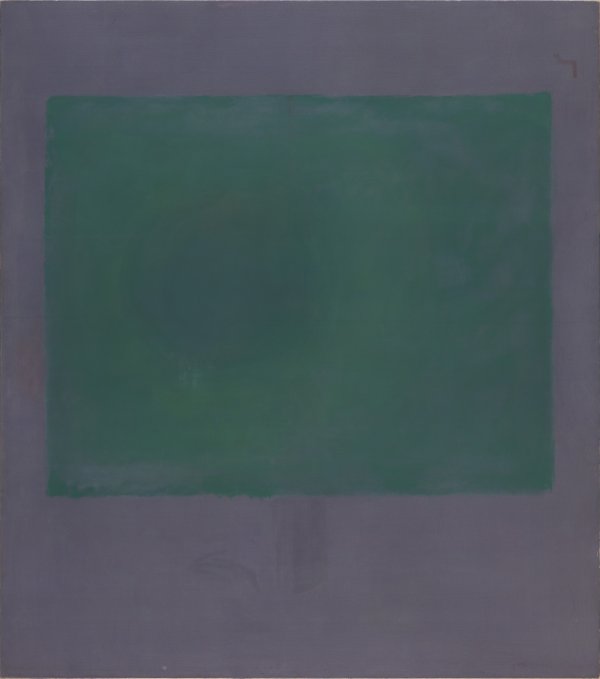
Untitled (Green on Maroon)
Mark Rothko’s (1903–1970) paintings are based on using colour to express emotions. As the painter himself admitted: ‘I am not interested in relationships of color or form or anything else: I am interested only in expressing the basic human emotions – tragedy, ecstasy, doom and so on’. For Don DeLillo (1936), as for his Latvian-born American counterpart, a painting makes you feel alive. In Delillo’s novel Cosmopolis (2003), the billionaire Eric Packer tells his lover, Didi Fancher, that he does not want the Rothko painting she is offering him; what he wants is to own the Rothko Chapel, which is not for sale: ‘It’s mine if I buy it’. Packer believes that money can buy anything.
Rothko and DeLillo share a critical view of the consumption-driven system that dominates the world. Both artists despise art as a market and the idea that money is more powerful than any moral value. Didi insists that Eric cannot buy the chapel, but that he needs the Rothko painting as a reminder that he is alive. Green on Purple could be that painting. Or one of those Eric Packer has in his flat: ‘The art that hung was mainly color-field and geometric, large canvases that dominated rooms’. The emotion elicited by abstract art cannot be clearly put into words, but it is felt. Packer needs art to feel and know that he is not dead.
DeLillo described the process of writing his novel Underworld (2009) as follows: ‘I began to think almost in the abstract patterns of an expressionist painter, such as Pollock or Rothko… there would not just be characters and locations, there would be a kind of style, a kind of colour to it, in an abstract manner’. DeLillo’s language, like Rothko’s, is easily recognisable. They share an aesthetic concept and an existential stance on life and death in which only art can make us see beyond, leading us towards the divine, the immortal.
Cristina Garrigós
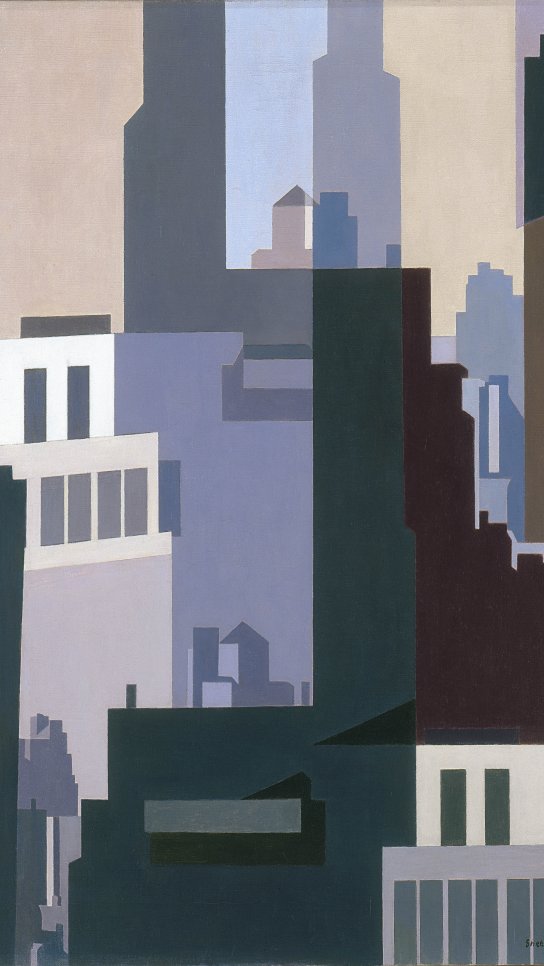
Canyons
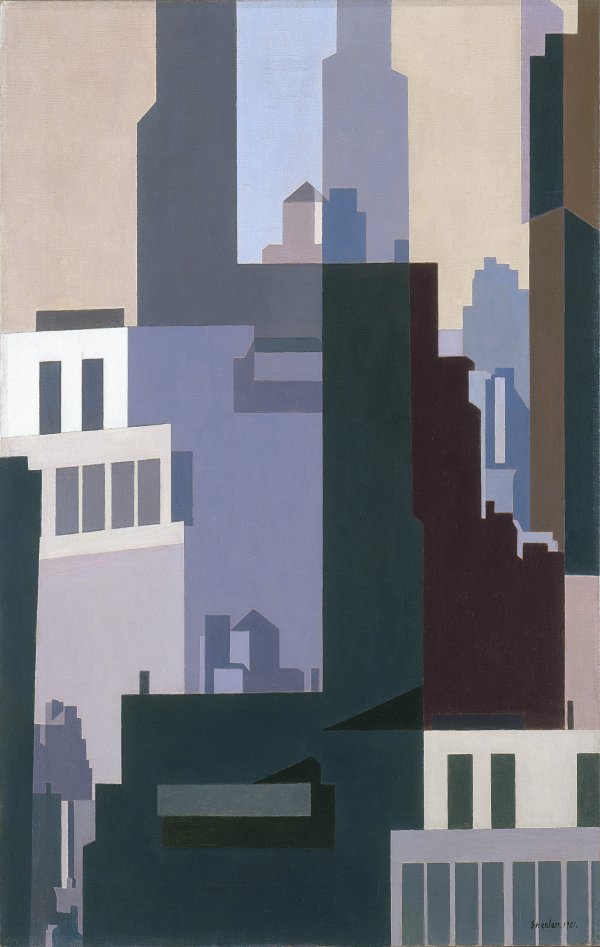
Charles Sheeler (1883–1965) was born and trained in Philadelphia. He came into contact with the avant-garde movements during his trips to Europe and eventually settled in New York in 1919, where he later pursued his career as a photographer and painter. Canyons (1951) – a title that contains a geographic metaphor – opens a window onto a landscape of skyscrapers of varying heights, styles and, probably, decades, creating an effect of superimpositions and transparencies that could be considered photographic.
Sheeler’s fascination with New York was evident in a film lasting some ten minutes that he shot with Paul Strand (also a photographer) in 1921, Manhatta. This is the name Native Americans gave to the settlement from which the city developed. It is also the title of a poem by Walt Whitman (1819–1892), included in his Leaves of Grass (a collection of poems first published in 1855 and revised and expanded throughout more than thirty years). Whitman, who lived in Brooklyn, witnessed New York’s growth and was a pioneer in turning it into subject matter for poetry. Like his poems, his city seemed to provide a foretaste of the twentieth century.
In the style of silent pictures, Sheeler and Strand’s film alternates moving images with text from the poem ‘Mannahatta’ (1860). In Canyons, as well as skyscrapers, we see steamships sailing along the Hudson River and bridges spanning it, railways, crowds strolling through the city streets or arriving by ferry. In Whitman’s poem, the skyscrapers are described as ‘growths of iron’ and the streets are not canyons but ‘rivers’. The succession of poetic images, many of which Sheeler and Strand incorporated into their film, can be considered a good example of Whitman’s famous ‘catalogues’. Almost in the guise of a photographer, the poet portrays the landscape and its inhabitants, not forgetting the fifteen or twenty thousand immigrants who arrived every week.
We can therefore trace a line of modernity, represented by the urban theme, that runs from the poem ‘Mannahatta’ (1860), through the eponymous film (1921), to Canyons (1951)
Dídac Llorens
Sunday After Sermon
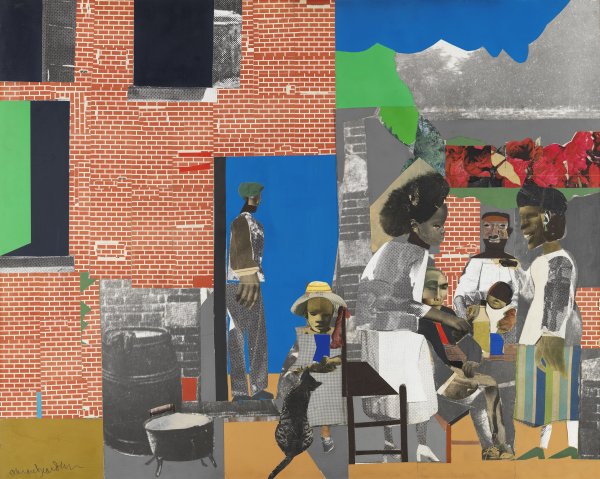
Sunday after Sermon, executed by Romare Bearden (1911–1988) in 1969 using his vibrant, fragmented collage technique, reflects African American community life with the same sensory intensity as the writer Toni Morrison (1931–2019) in Jazz (1992).
The novel is a narrative collage, a polyphonic structure in which Morrison weaves together voices, times and memories. The centrality of the church as a spiritual and social hub is the starting point of the story, which takes us back to the murder of the young Dorcas by Joe Trace and the reaction of Trace’s wife, Violet, who bursts into the funeral and slashes Dorcas’s face upon learning that she was her husband’s lover. This systemic and structural violence is symbolised in Bearden’s picture by the figure of the faceless child held by the man on the right-hand side.
African American tradition emphasises music, ritual and the body as vehicles for resistance and cultural expression. Jazz draws attention to the difficulties the characters have rebuilding their lives because their future is rooted in a past of enslavement, a burden that weighs heavily on their future prospects. The past is present in the novel through characters such as Golden Gray, whom we are reminded of in Bearden’s collage by the figure who seems to be watching from the doorway and, with his clothing and oversized hand, could symbolise the revolutionary past and present of the 1960s in the United States.
Likewise, the bond between women – who appear in the foreground of Bearden’s painting, chatting and shielding the rest of the figures in the scene – is a symbolic metaphor for the important role played by sisterhood in personal reconstruction within the African American community. In Morrison’s novel, Aunt Alice is the only person who manages to listen to Violet, despite the harm she inflicted on her niece Dorcas. The two women meet and talk until they connect. This bond transcends blood ties and becomes a source of strength, resilience and unity – a self-affirmation that the seemingly distracted girl sitting on the left in the collage observes attentively. The urban community and the African American Harlem of Morrison and Bearden are presented as spaces of mourning, celebration and reconstruction.
Ana Zamorano
Telephone Booths
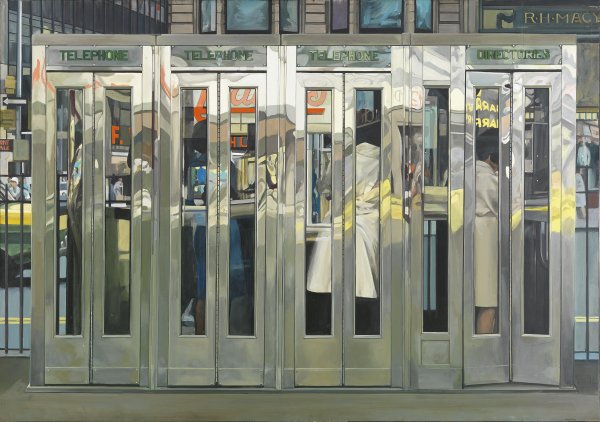
The four booths depicted in this work by Richard Estes (1932) present us with a hyperrealist image in an urban setting (New York). Some people, viewed from behind (two women and two men?), can be made out in the distorted reflections on the metal and glass surfaces and the interplay of perspectives. John Updike wrote an essay praising the artist’s mastery and technique.
Updike (1932–2009) is characterised by his realistic and observational stories set in urban environments, which reflect the existentialism of the period and the problems of domestic life, particularly those of the middle class. Updike, like Estes, is interested in human relationships and secrets and always leaves questions unanswered, despite the apparent clarity and realism of the scene. The booths, which bring to mind a period characterised by isolation from the outside world and communication with other humans, also suggest moments of solitude, tension or change. Updike’s novels – such as The Centaur (1963), Couples (1968), and the Rabbit series (1960–90) – abound in themes related to secrets, extramarital affairs, sex, and the relationship between lies and truth. This painting could be considered to illustrate the same themes.
There are also echoes of the realistic writing style, an urban setting and the theme of telephone booths in J. D. Salinger’s (1919–2010) novel The Catcher in the Rye (1951). Wandering around New York on his own, the teenage Holden Caulfield makes several phone calls that symbolise his interest in, and difficulty with, connecting with others. We can also find parallels between this painting and the literature of writers such as John Cheever (1912–1982) and Philip Roth (1933–2018), whose styles and themes are akin to Estes’s aesthetic, or, even later, with Raymond Carver (1938–1988), in whose stories, such as ‘Where I’m Calling From’ (1982) or ‘A Small, Good Thing’ (1983), the telephone becomes a symbol of the characters’ loneliness and the difficulty of establishing deep relationships and truly connecting with others.
Cristina Garrigós
Smyrna Greek (Nikos)
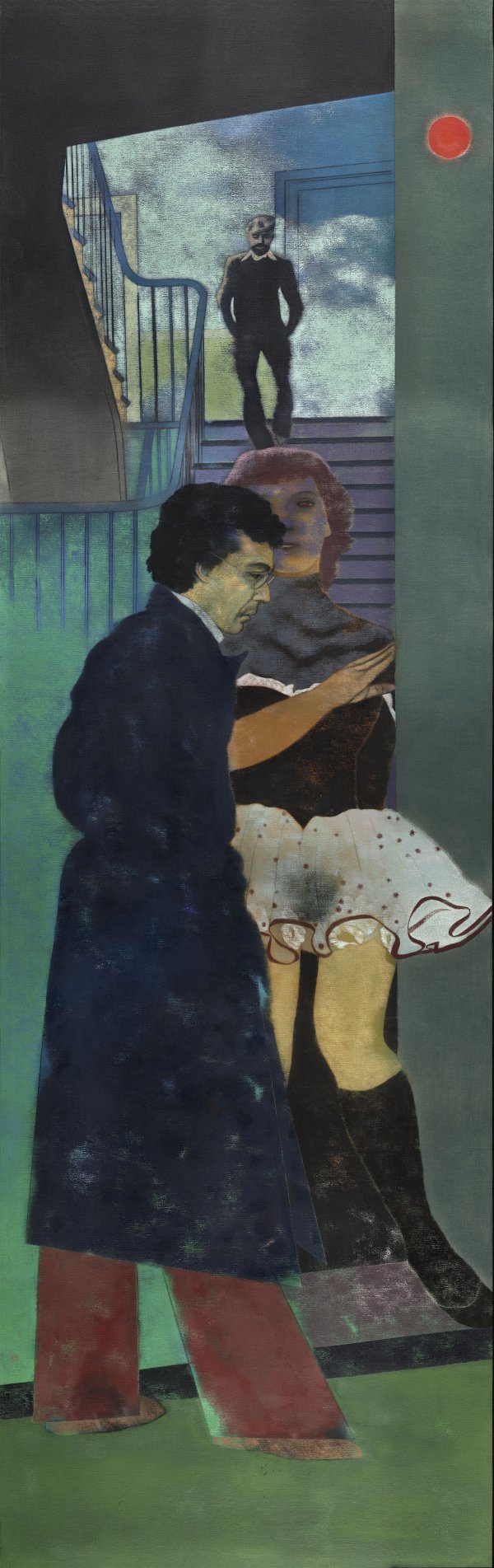
Ronald B. Kitaj (1932–2007) set the scene of Smyrna Greek (Nikos) in a brothel like those that the Greek poet Constantine Cavafy (1863–1933) came across in the vicinity of the port of Alexandria. The painting shows Kitaj himself descending the stairs and, in the foreground, his friend Nikolas (Nikos) Stangos (1936–2004) – a poet and publisher of poetry and art books – talking to a prostitute. A homosexual Greek writer, Stangos is presented as a reincarnation of Cavafy.
However, neither Stangos nor Cavafy were Greeks from Smyrna (in present-day Turkey), and it is more than likely that the title of this painting contains an allusion to The Waste Land (1922) by T. S. Eliot (1888–1965), a key example of modern poetry. Mr Eugenides, a Smyrna merchant, wanders through one of the poem’s settings, the ‘Unreal City’ (a portrait of post-war London, Dante’s città dolente and any city ravaged by disasters or conflicts). Unshaven, with currants in his pockets and speaking in ‘demotic’ French, Eugenides invites the narrator to lunch and even suggests that they spend a weekend together at the Hotel Metropole. Whereas Kitaj associates Stangos with Cavafy, Eliot suggests in his notes to The Waste Land that all the male characters in the poem are incarnations of a single figure.
Kitaj revered the great Anglo-American modernist poets Ezra Pound (1885–1972) and T. S. Eliot. Interestingly, Stangos was introduced to publishing by another poet, Stephen Spender, a follower of Eliot. Like Eliot’s, Kitaj’s style is rich in allusions, both artistic and literary. Another example is the painting If Not, Not (1975–1976), which drew inspiration from The Waste Land to denounce the Jewish Holocaust. Although Kitaj admired Eliot, his ardent defence of his Jewish identity and heritage ultimately led him to reject the poet, considering him anti-Semitic. Despite this ambivalent relationship, the title, the sordid urban atmosphere, the story that is merely hinted at, and the many faces of the characters allow us to link Smyrna Greek with The Waste Land.
Dídac Llorens
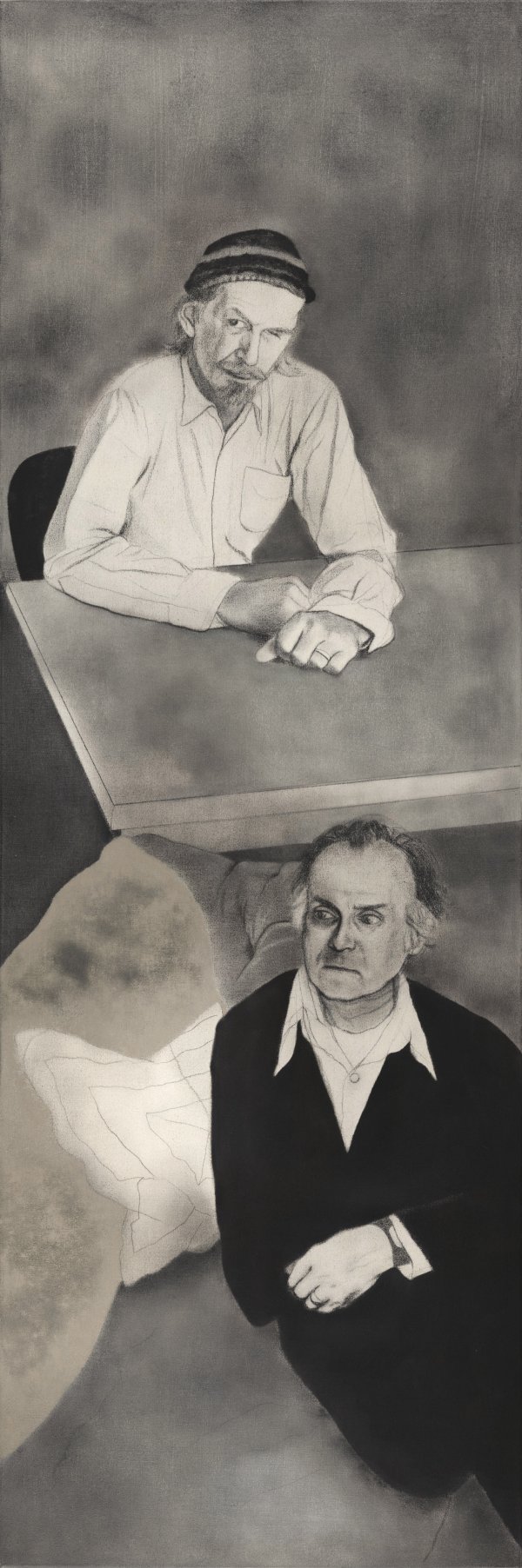
A Visit to London (Robert Creeley and Robert Duncan)
A Visit to London (Robert Creeley and Robert Duncan) is an ambiguous title. The canvas could be considered a portrait of two of the greatest American poets of the second half of the twentieth century, although, in a way, they appear to be two separate portraits, one on top of the other. However, Kitaj seems to prioritise the event over the subjects; two compatriots visiting the city where the artist lives and where he has become a prominent member of the so-called London School.
Robert Creeley (1926–2005) and Robert Duncan (1919–1988) met while attending Black Mountain College, a liberal institution specialising in the arts. Under the leadership of another key poet, Charles Olson, they cultivated a form of poetry freed from traditional metrical constraints and subject to physical conditions such as breathing, auditory perception and the sensation of movement. The poem thus becomes fertile ground for exploration and discovery. Duncan was a cultured poet, particularly fascinated by the figure of Psyche in mythology and art – the opening stanzas of his ‘A Poem beginning with a Line from Pindar’ (1960) allude to Goya’s Allegory of Love, Cupid and Psyche (1798–1805). For Duncan, Psyche is a symbol of knowledge, experience and imagination, the driving forces behind his poetry. Creeley’s poetics, in contrast, belong in a comparable realm of reflection on everyday feelings, which he enters through ‘The Door’ (1959), the title of one of his most memorable poems (which, interestingly, is dedicated to Duncan).
In 1968 and 1969, while staying in the United States, Kitaj spent time with Creeley, Duncan, and the latter’s partner Jess Collins, an artist also associated with the revival of figurative art and Pop Art. During those years, Kitaj, who was almost as interested in literature as he was in art, worked on a series of lithographs entitled Some Poets (1966–1969), which included Olson, Creeley and Duncan. We are lucky enough to be able to view the last two together in the Thyssen A Visit to London, a unique portrait.
Dídac Llorens
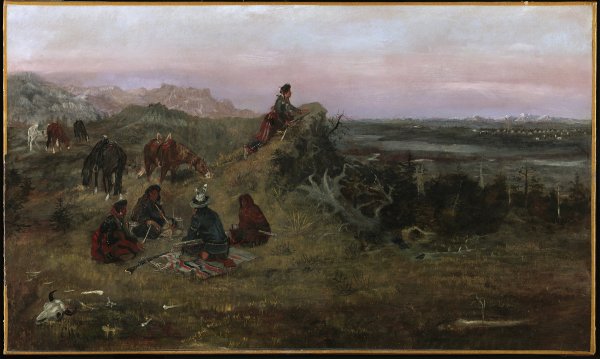
The Piegans preparing to Steal Horses from the Crows
For Native Americans, horses were an extremely valuable asset. They were essential to their survival on the Great Plains during the nineteenth century and useful for transport, warfare and bison hunting.
Enemy tribes frequently stole horses from one another. Rather than being considered morally reprehensible, horse theft was viewed as a common military tactic and a practice that brought prestige to the thieves, as it boosted their people’s wealth and power. This heroic act was sometimes topped off with a gesture of generosity, such as giving a horse to someone in need.
In twentieth-century literature, the act of stealing horses was idealised and even elevated to the status of quintessentially American myth. William Faulkner (1897–1962) praised it enthusiastically in his novel A Fable (1954) as ‘the affirmation of a creed, a belief, the declaration of an undying faith, the postulation of an invincible way of life: the loud strong voice of America itself out of the westward roar of the tremendous and battered yet indomitably virgin continent, where nothing save the vast unmoral sky limited what a man could try to do, nor even the sky limit his success and the adulation of his fellow man; even the defence he would employ would be in the old fine strong American tradition of rapine’.
Sherman Alexie (1966) of the Spokane Reservation recalls this important aspect of his ancestors’ culture in the poem ‘I Would Steal Horses’ (1992), when he tells his beloved Keri that he would ‘for you, if there were any left / give a dozen of the best / to your father’. He also recounts an amusing anecdote in his collection of short stories The Lone Ranger and Tonto Fistfight in Heaven (1993): eager to emulate their tribe’s ancient warriors but with no horses to steal, two boys take a car, park it in front of the police station in the neighbouring town and then hitchhike back to the reservation, where their friends joyfully celebrate their feat, and their parents’ eyes glow with pride.
Teresa Gibert
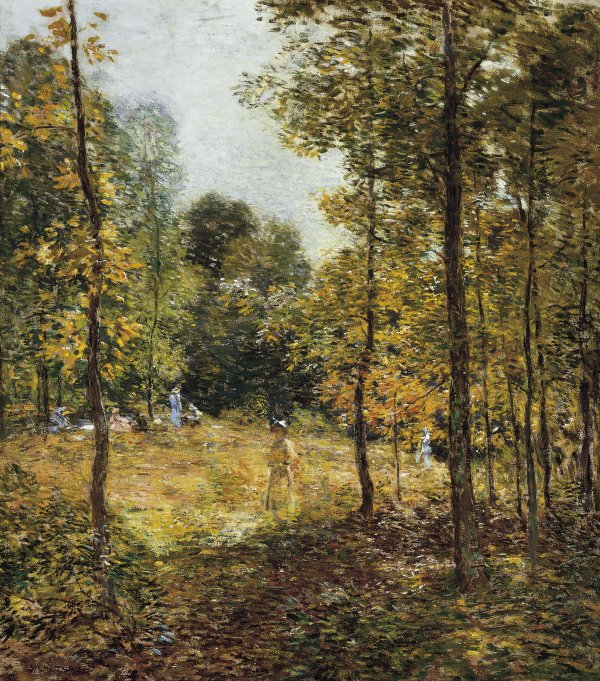
The Picnic
This painting by Metcalf (1858–1925), with its predominant golden hues, has the appearance of a jewel; a wild treasure for the melancholic recreation of the figures that inhabit it. But Robert Frost (1874–1963), the farmer-poet who transformed the landscapes of New England into verse, warns that it will not last, for, in his view, nothing golden can endure.
Frost devoted his career to reconciling science and religion, two worldviews in conflict since the publication of Charles Darwin’s On the Origin of Species in 1859. Nineteenth-century American Romantic Transcendentalism, led by Ralph W. Emerson, coexisted with Darwinian evolutionary biology in the poet’s portrayal of the natural world. Frost did not romanticise nature. In his poems, the relationship between nature and the observer is not holistic but discontinuous, because evolution has separated primordial matter with no apparent possibility of reunification. Frost sought an immutable divine reality that transcended time and space.
However, in contrast to the sense of permanence that underpins transcendentalism, Frost encountered uncertainties in matter, which, lacking design or purpose, is not a metaphor for the divine. For this reason, despite the avant-garde milieu in which he began writing, he was meticulously careful about the rhythm and rhyme of his poems, seeking with his careful prosody to provide a fleeting order amid the chaos.
‘Nothing Gold Can Stay’ was published in the collection New Hampshire (1923), where we observe that rural life is running out. For Frost, time, like the cycles of nature, is circular, though modernity tinges it with decay and extinction. This poem straddles both perspectives, the regenerative and the entropic or disorder-oriented: green becomes a leaf, dawn becomes midday. Dying becomes another birth, but the purest and most innocent, the primaeval and pre-Fall state of humanity, as precious as gold, does not last. Perhaps that is why Metcalf's foreground figure, herself golden, turns her back on the forest and gazes at us.
María García Lorenzo