Thyssen-Bornemisza Museo Nacional Search Ir al contenido principal

Navegación superior (EN)

About Us Support Friends Shop Tickets
Español
Visit Collection Exhibitions Activities Education Search
  • Visit
  • Collection
  • Exhibitions
  • Activities
  • Education

Thyssen - Navegación superior (EN)

About Us Support Friends Shop Tickets
Español
©
The Pollock-Krasner Foundation, VEGAP, Madrid
Jackson Pollock

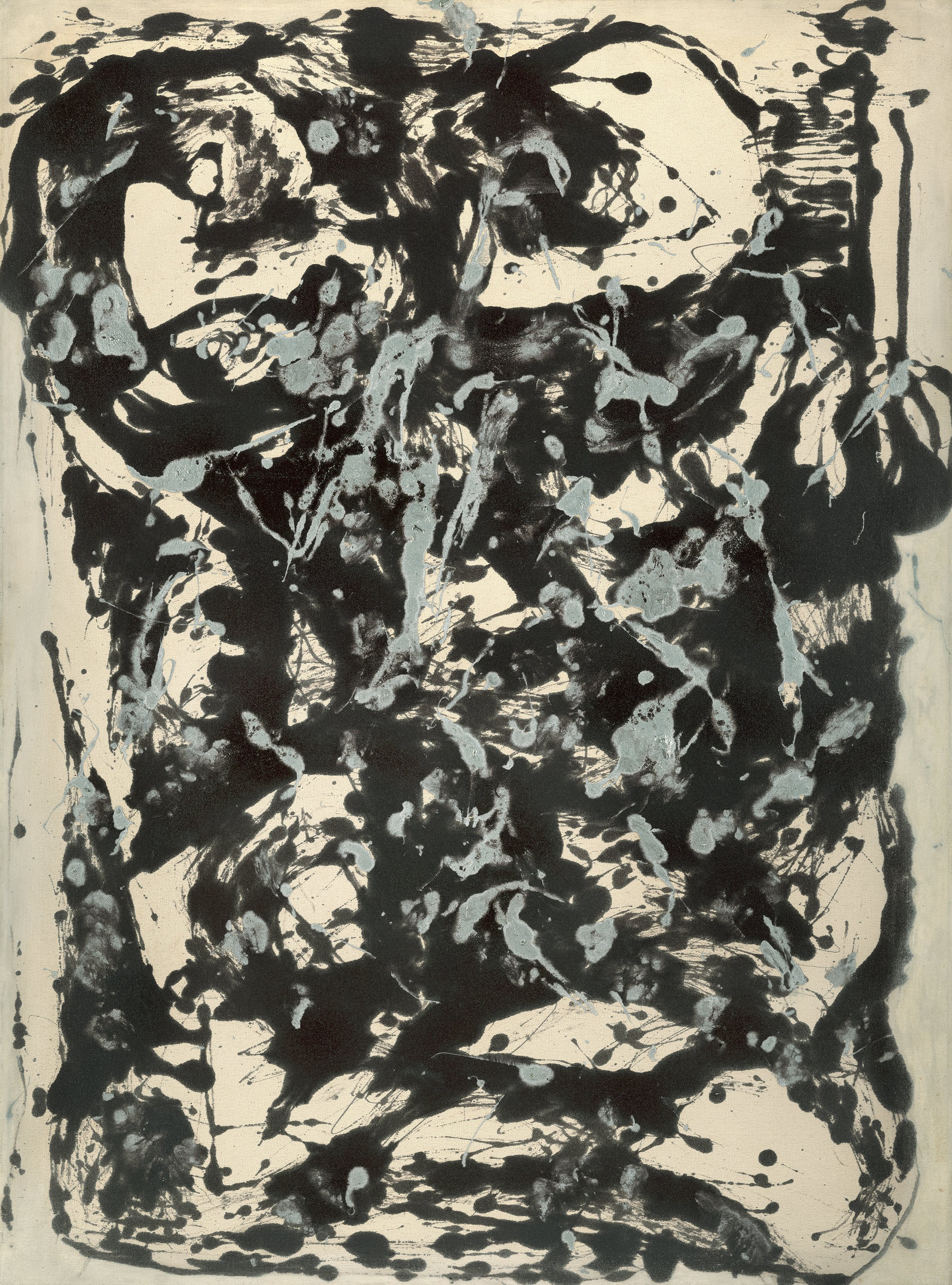
Brown and Silver I

ca. 1951
Enamel and silver paint on canvas.
144.7 x 107.9 cm
Museo Nacional Thyssen-Bornemisza, Madrid
Inv. no.
713
(
1963.1
)
Room 46
Level 1
Permanent Collection
30 31 32 33 34 35 36 37 38 39 40 41 42 43 44 45 46 47 48 49 50 51 52 53 54 55 56 Postpop rooms Rodin room
30 18th and 19th Centuries. Transatlantic Relations 31 19th Century. American Landscape and Environmental Awareness 32 19th Century. American Landscape and Urban Life 33 19th Century. The Impressionist Period 34 20th Century. Expressionist Landscapes 35 20th Century. Expressionist Portraits 36 20th Century. The Language of the Body 37 20th Century. Urban unrest 38 20th Century. Flowers 39 20th Century. Pioneers of abstraction 40 20th Century. Popular flavor 41 20th Century. The Cubist Tradition I 42 20th Century. The Cubist Tradition II 43 20th Century. Abstract Utopias 44 20th Century. Dada and Surrealism 45 20th Century. Interwar Realisms 46 20th Century. American Abstraction I 48 20th Century. Post-ward American Art 49 20th Century. Post-ward European Figurative Art 50 20th Century. Informalisms 51 20th Century. Homo Ludens 52 20th Century. Pop Art 53 Postpop rooms 54 Postpop rooms 55 Postpop rooms 56 Postpop rooms • Exhibition room
View gigapixel
Discover some of the secrets and details invaluable to the human eye in this work.

Jackson Pollock, one of the foremost practitioners of Action Painting, began to work on his first drip paintings in the winter of 1947‒48. Thenceforward he firmly espoused the idea of automatism, an automatism derived largely from Surrealism. “When I’m in the painting I’m not aware of what I’m doing, ” he stated in 1947.What is more, with the invention of the drip technique, Pollock eschewed easel painting and for the first time avoided any direct contact between the artist and the canvas: “I continue to move further and further away from the painter’s usual tools like easels, palettes, brushes and so on. I prefer sticks, spoons, knives, flowing paint that I drip or a thick paste with sand, ground glass and other unusual materials.”

After his legendary exhibition at the Betty Parsons Gallery in New York in November 1950, which established him as an abstract artist, Pollock decided to give a new turn to his painting. In June 1951 he wrote to his friends, the painter Alfonso Ossorio and the dancer Ted Dragon, “I’ve had a period of drawing on canvas in black — with some of my early images coming thru — think the non-objectivists will find them disturbing — and the kids who think it simple to splash a Pollock out.” The emphasis on drawing and the intention to return to the black line, which had defined his first works, gave way to the series of Black Paintings of the early 1950s.

Brown and Silver I, the only work by Pollock in the Museo Thyssen-Bornemisza collection, belongs to this series of Black Paintings executed between 1950 and 1953 using a tin of black enamel paint and unprimed canvases. A photograph of Pollock’s studio taken by Hans Namuth in 1951 shows Brown and Silver I together with Brown and Silver II, painted alongside each other on the same roll of fabric which the artist then cut into two. As neither is signed, it is not possible to ascertain their correct position, although Francis Valentine O’Connor and Eugene Victor Thaw propose they should be taken to be vertical, as this is how they appear in the aforementioned photograph.

In both compositions Pollock replaced pure black with brown, splashed with various patches of silver. The artist’s technique is not very different to that of the previous drip paintings since, as can be seen, he has applied the paint straight from the tin, using sticks and dry paintbrushes — now adding syringes — and has also approached the composition from all four sides. As with all the Black Paintings, where Brown and Silver differs from his previous works is in the theme. Pollock rescues certain anthropomorphic notes from his early period, recalling Picasso and Masson, and the open space and all-over effect of his drip paintings is no longer present.

Paloma Alarcó
20th Centurys. XX - Expresionismo abstracto norteamericanoPaintingEnamel and silver paintcanvas
Listen
Download image Print page

Restaurabits

Bastidor de la obra de Jackson Pollock, "Marrón y plata I"
Restaurabit
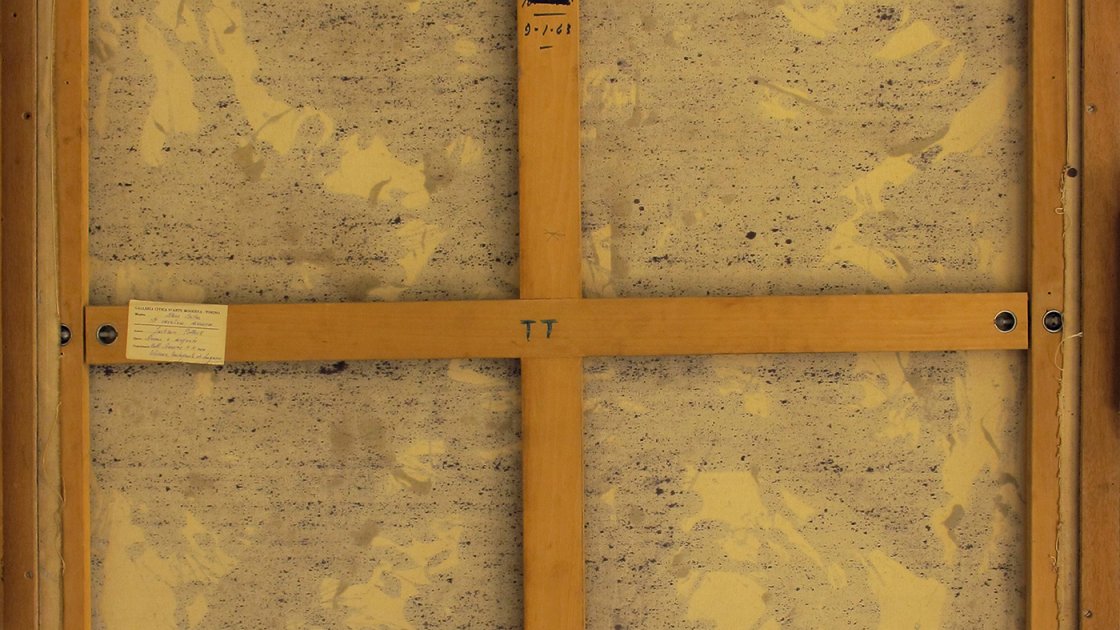
An expansion-bolt stretcher

Brown and Silver I by Jackson Pollock is mounted on a type of stretcher not commonly found in the Thyssen-Bornemisza collection: an expansion-bolt stretcher, a system that differs from those generally found in artworks. 

Tours to find it

En línea
Tours
En línea
Con esta propuesta de visita autónoma invitamos a explorar el museo y a conocer siete obras de la colección permanente poniendo el ojo en un elemento esencial del dibujo: la línea.

Related content

Video
Discover the Thyssen Museum with Alaska: Brown and Silver I by Jackson Pollock
Alaska presents another highlight of the collection; Brown and Silver I by Jackson Pollock, a legend of American art.

Products and publications

Pollock Pendant

Pollock Pendant

125,00 €

Pollock dangle earrings

Pollock dangle earrings

125,00 €

Brown and silver I

Brown and silver I

17,00 €

Isabel Quintanilla. Exhibition catalogue. Hardcover, Spanish.

Isabel Quintanilla. Exhibition catalogue. Hardcover, Spanish.

39,00 €

Visit online shop

More from the collection

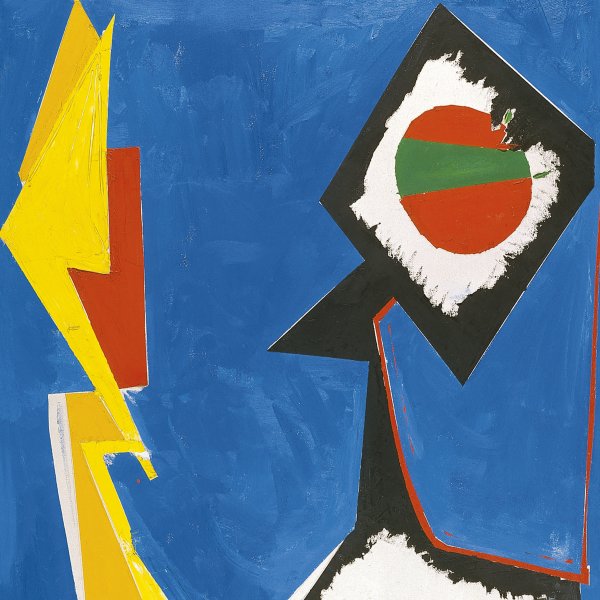
Hans Hofmann
Hans Hofmann
Blue Enchantment
1951
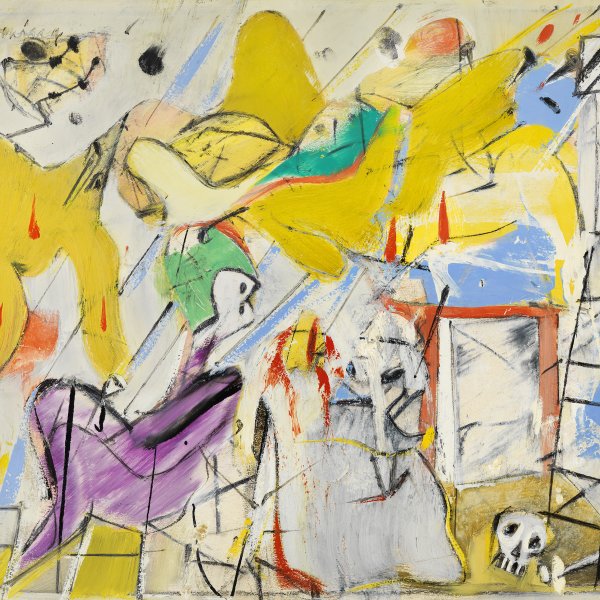
Willem de Kooning
Willem de Kooning
Abstraction
1949 - 1950
Josef Albers
Josef Albers
Structural Constellation. Alpha
1954
Arshile Gorky
Arshile Gorky
Last Painting
1948
  • Private and/or didactic use
  • Commercial use
Private and/or didactic use
Brown and Silver I. Jackson Pollock
Brown and Silver I
Jackson Pollock

©

The Pollock-Krasner Foundation, VEGAP, Madrid

Terms of Use

The exploitation rights of the images correspond to the Fundacion Coleccion Thyssen-Bornemisza, F.S.P. The Fundación authorizes the downloading of high-resolution images from its website for private use, use for educational and research purposes and non-commercial uses.

However, photographed works are protected by copyright. Therefore, regardless of the terms of use of the images set out below by the Foundation, it will be necessary to obtain a license from VEGAP (www.vegap.es), or from the corresponding collective management organization in the country where the work is going to be used or, where appropriate, from the holder of their rights in order to reproduce or exploit the work.

Use for educational and research purposes is understood as the non-commercial or advertising use of images in presentations, conferences, school or university work, in classes at regulated education institutions, as well as in academic publications, with a circulation of less than 1,000 copies, provided that it is non-profit.

Non-commercial use is understood as the use of the images in a context where no profit, monetary or commercial, is generated, directly or indirectly.

Any use other than those indicated above will require the prior written authorization of the Fundación.

Any request for educational and research use or for non-commercial use (including academic publications), should be directed by email to the Museum Photo Library through the email address archivo.fotografico@museothyssen.org. This department manages the worldwide distribution of the images of the works of the Museo Nacional Thyssen-Bornemisza and the management of their reproduction rights for those uses.

The user agrees to use the image of the website solely and exclusively for the purposes described above and in accordance with the following terms of use, which, however, do not apply to the reproduction of the works included in the photographs, as they are protected by Copyright.

Terms of use

  • If the image is used for reproduction, the work must be reproduced in its entirety. The image may not be manipulated, deformed, modified or altered in any way. In particular, no superposition (of images or texts) on the reproduction is allowed.
  • The reproduction of a detail or part of the work may only be made with the prior written authorization of the Fundación In this case, the credit line must include the following mention: “detail”.
  • Any total or partial reproduction of the images of the Fundación that has been previously authorized must be accompanied by the copyright text indicated by the owners or their copyright holders as well as the following mention: Provenance: Museo Nacional Thyssen-Bornemisza, Madrid”.
  • The user will send free of charge to the Museum Photo Library one (1) free copy of the edition, publication or reproduction to the following address: Archivo Fotografico, Museo Nacional Thyssen-Bornemisza, Paseo del Prado, 8 28014 Madrid, Spain.
Download image
Commercial use
Brown and Silver I. Jackson Pollock
Brown and Silver I
Jackson Pollock

©

The Pollock-Krasner Foundation, VEGAP, Madrid

Terms of Use

The Photo Library of the Museo Nacional Thyssen-Bornemisza offers sale and rental service of photographic material of all the works on its Permanent Collection.

To request images or permits for commercial use in academic or research publications, that is, catalogues of other institutions, monographs and other specialized publications, you should contact the Museum's Photo Library by email at the e-mail @email.

To request images or permits for other commercial or advertising uses (general publications, merchandising, exhibitions, audio-visual works, web pages, etc.), you should contact the Museum's Commercial Archive by email at the e-mail @email.

The Photo Library and the Museum's Commercial Archive manage the worldwide distribution of images of the Museo Thyssen-Bornemisza works, as well as their reproduction rights. The applicable rates are calculated based on the nature and proposed use of the images, as well as the availability of the requested image.

Requests for scans or new photographs will be reviewed on a case-by-case basis. Once approved, an additional fee will apply. Re-photographing a work will require a minimum of six weeks to complete.

However, photographed works are protected by copyright. Therefore, regardless of the terms of use of the photographs set out below by the Foundation, it will be necessary to obtain a license from  VEGAP (Visual Entidad de Gestión de Artistas Plásticos www.vegap.es) or from the corresponding collective management organizations in the country where the work is going to be used or, where appropriate, from the holder of their rights in order to reproduce or exploit the work.

Download image
Thyssen-Bornemisza Museo Nacional

Navegación secundaria (EN)

  • #Thyssenmultimedia
  • Press
  • Corporate events
  • Tourism
  • Join our team
  • Newsletter
Instagram
Facebook
X
Youtube
TikTok
iVoox
LinkedIn

The Museo Nacional Thyssen-Bornemisza would like to thanks for the collaboration of:

Fundación Mutua Madrileña Master Card Comunidad de Madrid
©2026 Thyssen-Bornemisza National Museum

Menú al pie (EN)

  • Legal terms
  • Public tenders
  • Transparency site
  • Whistleblower channel
  • Use of images
  • Accessibility and quality
  • Environment, Sustainability & 2030 Agenda
  • Contact
Ministry of Culture España es cultura | Spain is culture. The website promoting Spanish culture Paisaje de la Luz | Paseo del Prado y Buen Retiro. Paisaje de las Artes y las Ciencias
Certificación de Conformidad con el Esquema Nacional de Seguridad. Categoría Media. RD 311/2022