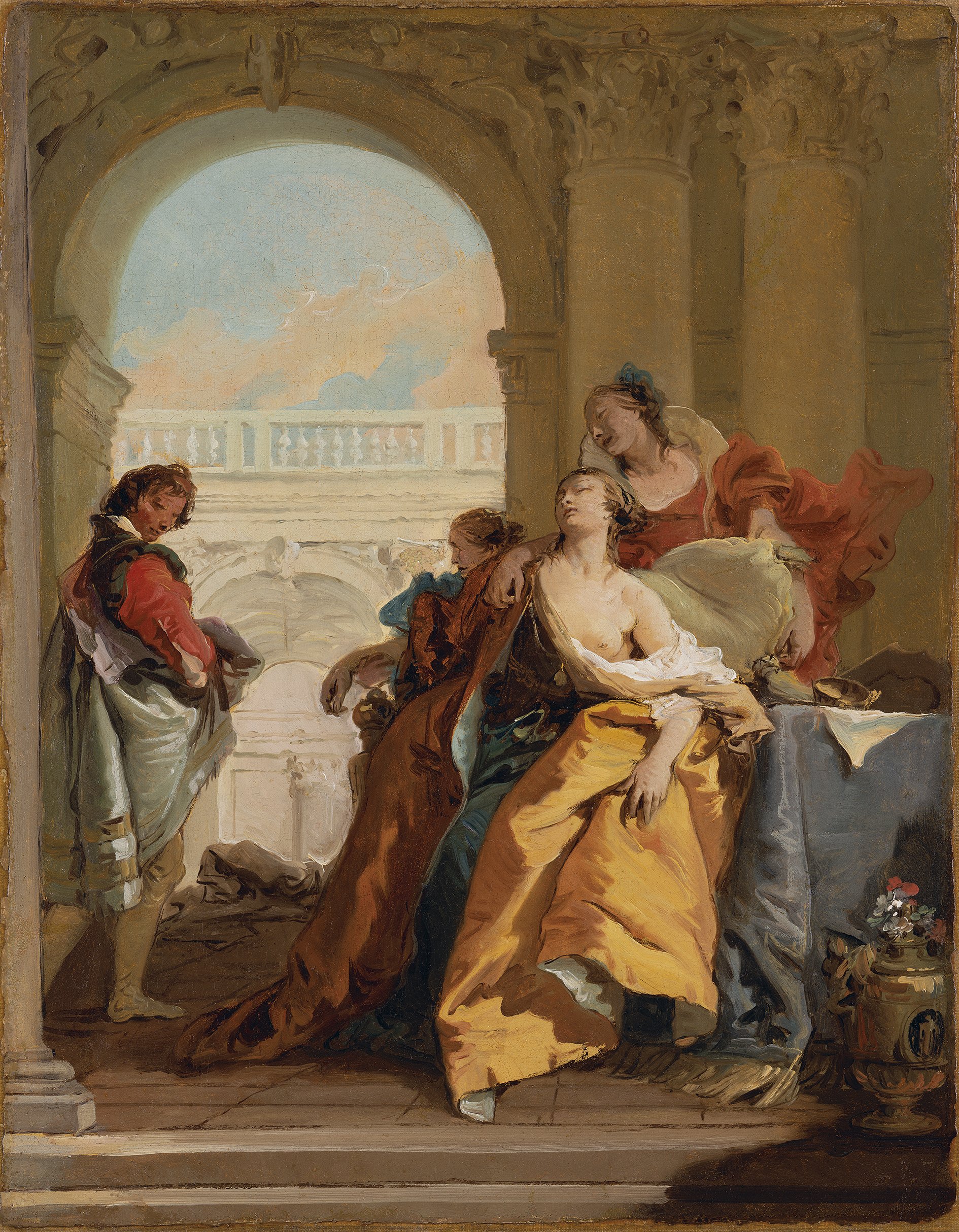
The Death of Sophonisba
ca. 1760
Oil on canvas.
48.3 x 38.2 cm
Museo Nacional Thyssen-Bornemisza, Madrid
Inv. no.
396
(1975.33
)
Room 16
Level 2
Permanent Collection
The death of Sophonisba was a relatively common subject in art from the 17th century onwards. The literary source for this episode, which dates to the end of the Second Punic War, is Livy’s History
of Rome (XXX, 14–15). Sophonisba, who lived from 235 to 203BC, was Queen of Numidia and daughter of the Carthaginian general Hasdrubal. She married one of the Numidian chiefs, Syphax, an ally of Rome, but succeeded in dissuading him against his commitments to the Republic. Syphax was defeated at the battle of Utica by Masinissa, another Numidian chief, whom Sophonisba married, having been betrothed to him before her marriage to Syphax. Worried that this new union would also result in the defection of an ally from the Roman side, Scipio Africanus ordered Masinissa to hand over Sophonisba in order to take her as a prisoner to Rome. Unable to enter into conflict with the Roman general but determined to avoid dishonour, Masinissa sent his wife a cup of poison which she drank.
This small canvas, whose provenance is known from the late 19th century, was formerly in a number of English and French collections. The first reference to it dates from the time that it belonged to Gibson Craig in London, after which it was auctioned in 1887. It was in the collections of Camille Groult and Antenor Patiño in Paris, finally entering the collection at the Villa Favorita in 1975 via the art market.
The Death of Sophonisba is painted with a notably free, rapid brushstroke and has consequently been considered to be one of the numerous preparatory oil sketches executed by the artist as preliminary works for more ambitious compositions. However, no finished canvas by Tiepolo is known on this subject. In order to present this dramatic story the artist used a vertical format, setting the scene against a monumental architectural backdrop. The principal motif is located on the right where Sophonisba is to be seen dying in the foreground, having drunk the poison from the vessel lying on the table next to her. She is shown with her breast bare, assisted by her maids, of which the one directly behind her wears a striking red gown and has a bright blue bow in her hair. She supports Sophonisba, placing a large cushion behind her back. The other, located further into the pictorial space, looks towards the standing figure of a page located on the left who acts as a balancing element to the three female figures on the right. As is habitual with Tiepolo, the figures wear rich garments of brightly coloured cloth that produce elegant chromatic contrasts such as the yellow, red and blue of the principal group. The setting recalls Veronese, while the intense lighting of the background creates a second focus of interest in the rear courtyard, contrasting with the shadowy darkness of the foreground. Anna Pallucchini dated the canvas to around 1760, a date accepted by Gemin and Pedrocco.
Mar Borobia
This small canvas, whose provenance is known from the late 19th century, was formerly in a number of English and French collections. The first reference to it dates from the time that it belonged to Gibson Craig in London, after which it was auctioned in 1887. It was in the collections of Camille Groult and Antenor Patiño in Paris, finally entering the collection at the Villa Favorita in 1975 via the art market.
The Death of Sophonisba is painted with a notably free, rapid brushstroke and has consequently been considered to be one of the numerous preparatory oil sketches executed by the artist as preliminary works for more ambitious compositions. However, no finished canvas by Tiepolo is known on this subject. In order to present this dramatic story the artist used a vertical format, setting the scene against a monumental architectural backdrop. The principal motif is located on the right where Sophonisba is to be seen dying in the foreground, having drunk the poison from the vessel lying on the table next to her. She is shown with her breast bare, assisted by her maids, of which the one directly behind her wears a striking red gown and has a bright blue bow in her hair. She supports Sophonisba, placing a large cushion behind her back. The other, located further into the pictorial space, looks towards the standing figure of a page located on the left who acts as a balancing element to the three female figures on the right. As is habitual with Tiepolo, the figures wear rich garments of brightly coloured cloth that produce elegant chromatic contrasts such as the yellow, red and blue of the principal group. The setting recalls Veronese, while the intense lighting of the background creates a second focus of interest in the rear courtyard, contrasting with the shadowy darkness of the foreground. Anna Pallucchini dated the canvas to around 1760, a date accepted by Gemin and Pedrocco.
Mar Borobia