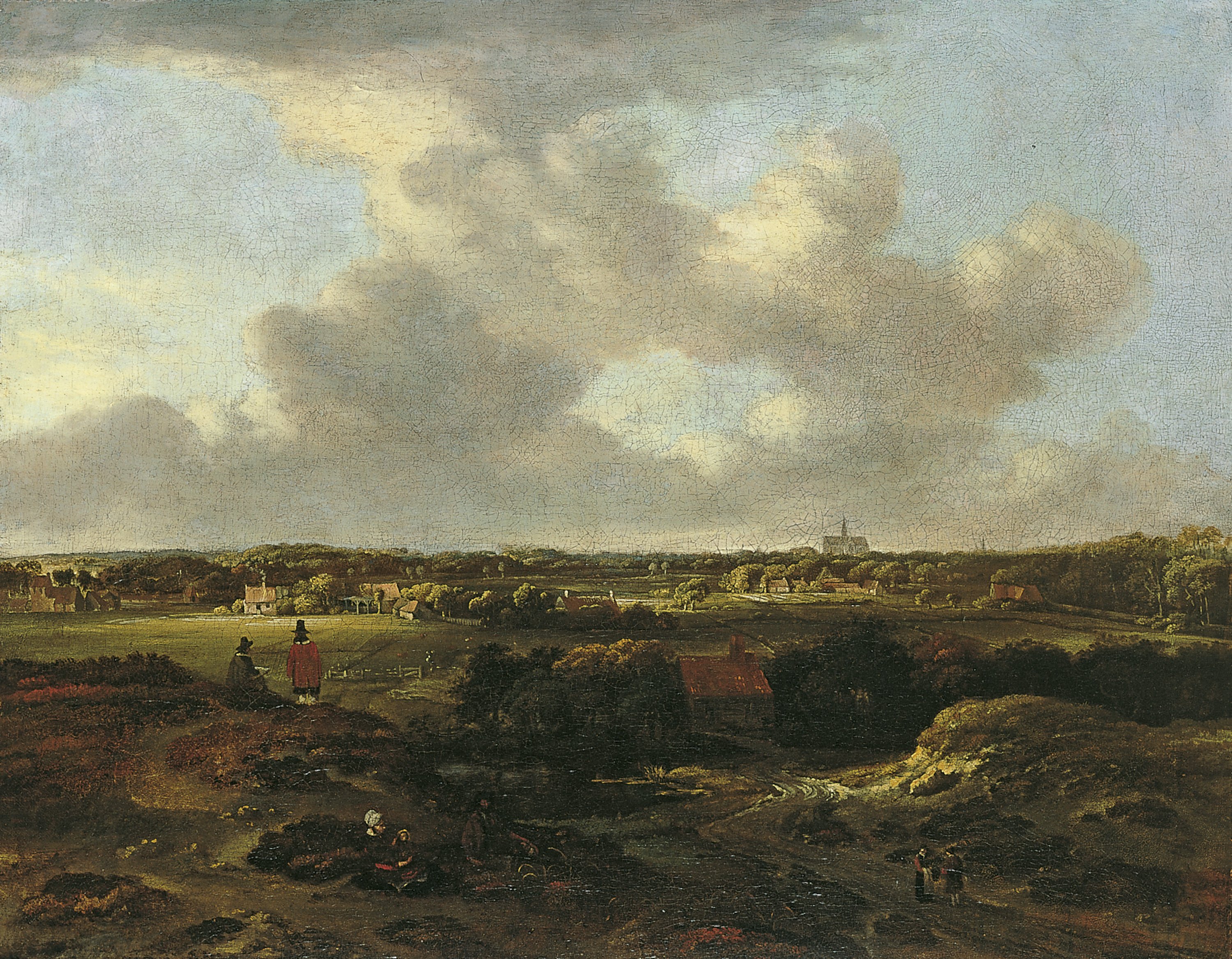
View of Haarlem from the Dunes
ca. 1660 - 1670
Oil on canvas.
65.3 x 84 cm
Museo Nacional Thyssen-Bornemisza, Madrid
Inv. no.
419
(1964.1
)
Room 28
Level 2
Permanent Collection
Jan Vermeer van Haarlem II belonged to the second generation of a family of painters that included at least five artists named Jan. In addition, he is known as “Van Haarlem” to differentiate him from the great master Vermeer of Delft. His father, Jan Vermeer van Haarlem I, was a merchant as well as a painter, specialising in landscape, the genre on which his son also focused. The present artist began as an apprentice in the studio of Jacob de Wet and produced panoramic views, which are his finest works, as well as marine compositions and pastoral scenes. His style reveals the influence of two of the great landscape painters: Jacob van Ruisdael and Philip Koninck.
The present canvas was in the collection of Louis Viardot in Paris in the second half of the 19th century and was previously attributed to Jacob van Ruisdael and to Philip Koninck, the latter attribution rejected by Gerson. Hofstede de Groot examined the painting and attributed it to Vermeer van Haarlem, considering it to be of high quality. In general the artist was inspired in his views of dunes with cloudy skies by various works by his contemporary Jacob van Ruisdael. During a later phase Van Haarlem’s work manifests the influence of Koninck, particularly the latter’s panoramas with their broad sweeps of land, such as the example in the present Collection.
Van Haarlem’s view depicts the outskirts of his native city. In the distance on the right we can see the Gothic church of St. Bavo that breaks the soft, diffused horizon line. The extensive sweep of land is presented from a high viewpoint and is framed in the foreground on the left by a low hill with various figures. On the right the painter uses a winding path to create a sense of recession into the pictorial space. The path reaches the middle distance where it is truncated by a curtain of trees and a house. Van Haarlem organised the background planes through gentle alternations of light and shade created by the sunlight filtering through the clouds. On the outskirts of the city he included a detailed description of the activity of linen bleaching, one of Holland’s most profitable trades, with the lengths of cloth spread out in straight lines on the grass. The area closest to the viewer is used to locate a number of figures, which in some of Van Haarlem’s paintings were executed by other artists. Particularly visible is the pair on the left, most notably the young man seated and drawing, evoking the activities of an artist. This motif was a common one in landscapes of this type.
Mar Borobia
The present canvas was in the collection of Louis Viardot in Paris in the second half of the 19th century and was previously attributed to Jacob van Ruisdael and to Philip Koninck, the latter attribution rejected by Gerson. Hofstede de Groot examined the painting and attributed it to Vermeer van Haarlem, considering it to be of high quality. In general the artist was inspired in his views of dunes with cloudy skies by various works by his contemporary Jacob van Ruisdael. During a later phase Van Haarlem’s work manifests the influence of Koninck, particularly the latter’s panoramas with their broad sweeps of land, such as the example in the present Collection.
Van Haarlem’s view depicts the outskirts of his native city. In the distance on the right we can see the Gothic church of St. Bavo that breaks the soft, diffused horizon line. The extensive sweep of land is presented from a high viewpoint and is framed in the foreground on the left by a low hill with various figures. On the right the painter uses a winding path to create a sense of recession into the pictorial space. The path reaches the middle distance where it is truncated by a curtain of trees and a house. Van Haarlem organised the background planes through gentle alternations of light and shade created by the sunlight filtering through the clouds. On the outskirts of the city he included a detailed description of the activity of linen bleaching, one of Holland’s most profitable trades, with the lengths of cloth spread out in straight lines on the grass. The area closest to the viewer is used to locate a number of figures, which in some of Van Haarlem’s paintings were executed by other artists. Particularly visible is the pair on the left, most notably the young man seated and drawing, evoking the activities of an artist. This motif was a common one in landscapes of this type.
Mar Borobia