A River with Fishermen
1645
Oil on panel.
51.5 x 83.6 cm
Museo Nacional Thyssen-Bornemisza, Madrid
Inv. no.
360
(1930.102
)
Room 23
Level 2
Permanent Collection
Together with Jan van Goyen and Pieter de Molijn, Jacobsz. Van Ruysdael was one of the most important representatives of the socalled tonal painting, characterised by the use of a limited palette with an emphasis on grey, green, yellow, ochre and blue tones. These colours were used to experiment with atmospheric effects, resulting in advances that established a solid starting point for the following generation of artists who constituted the classic school of Dutch landscape painting. Like Van Goyen, in the 1630s Ruysdael used this tonal approach, painting river scenes in cool tones and constructed through the use of simple compositions based around riverbanks, sailing boats or roadsides, using these elements to create a pronounced diagonal. This formula was well received by clients in Holland and as a result Ruysdael repeated his motifs and subjects. In the mid-1640s, however, his style changed in a way that affected both his compositions and use of colour.
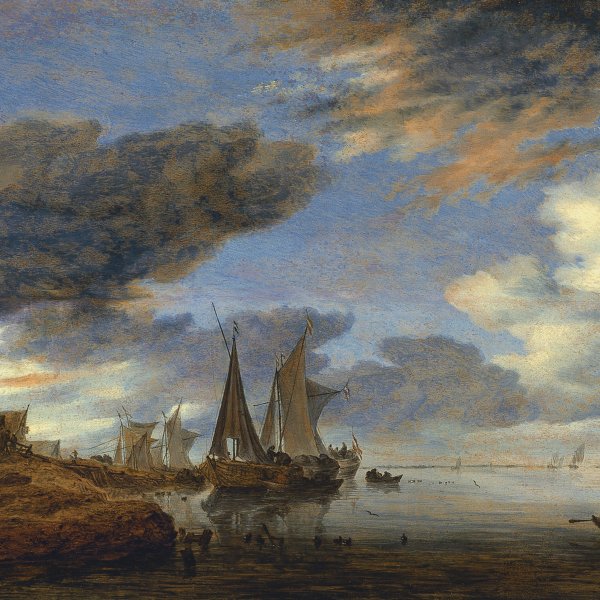
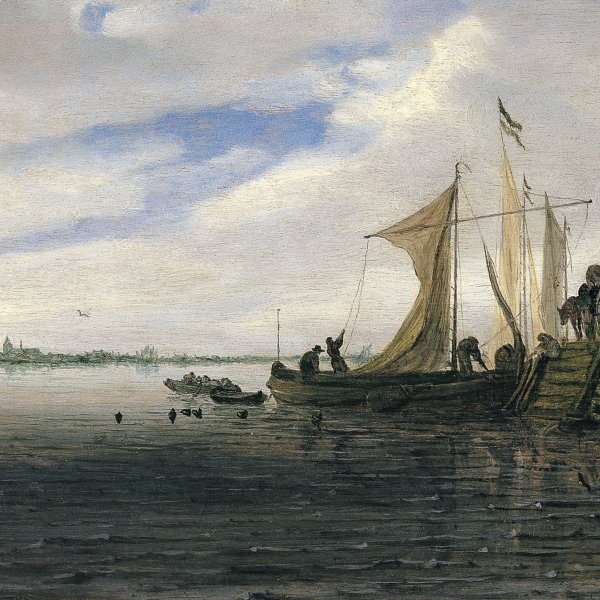
The present landscape is dated 1645 on the hull of the boat on the right and is signed with the painter’s initials. Ruysdael depicts a scene that he painted on numerous occasions throughout his career. However, comparing this panel with others of the 1630s, it is evident that his approach to these views has changed. The painter retains the diagonal composition typical of his earlier period but the line (which runs from left to right following the riverbank) is now reinforced with a series of additional elements that emphasise the sense of spatial depth. Ruysdael thus includes various boats parallel to the shoreline, while the roofs of a village lead our eye into the background. This device is also used in the water in which a series of boats and sailing ships leads the eye back to the faint outline of a city on the misty horizon. Ruysdael also used the treetops and the upper branches of the shrubs along the bank to reinforce the perspectival recession.
In addition to these linear elements, the painter made use of his soft colour range, employing dark green and brown tones for the riverbank and creating a lively contrast with the whites, blues and greys around the vanishing point. The colours in this work are brighter and more varied than those deployed in the 1630s. Ruysdael’s paintings of the 1640s have a unique atmosphere and feature striking effects in the sky and water. In this case the sky and clouds are particularly notable and create a sensation of rapid movement, painted with brushstrokes of different lengths and direction so that water and land fuse on the distant horizon.
The panel has been compared to two others by the artist, the first of one year earlier, 1642, in the Albright-Knox Art Gallery, Buffalo, with which it shares a number of features. The second is in the Hamburg Kunsthalle and is dated to the same year as the present work.
Mar Borobia
The present landscape is dated 1645 on the hull of the boat on the right and is signed with the painter’s initials. Ruysdael depicts a scene that he painted on numerous occasions throughout his career. However, comparing this panel with others of the 1630s, it is evident that his approach to these views has changed. The painter retains the diagonal composition typical of his earlier period but the line (which runs from left to right following the riverbank) is now reinforced with a series of additional elements that emphasise the sense of spatial depth. Ruysdael thus includes various boats parallel to the shoreline, while the roofs of a village lead our eye into the background. This device is also used in the water in which a series of boats and sailing ships leads the eye back to the faint outline of a city on the misty horizon. Ruysdael also used the treetops and the upper branches of the shrubs along the bank to reinforce the perspectival recession.
In addition to these linear elements, the painter made use of his soft colour range, employing dark green and brown tones for the riverbank and creating a lively contrast with the whites, blues and greys around the vanishing point. The colours in this work are brighter and more varied than those deployed in the 1630s. Ruysdael’s paintings of the 1640s have a unique atmosphere and feature striking effects in the sky and water. In this case the sky and clouds are particularly notable and create a sensation of rapid movement, painted with brushstrokes of different lengths and direction so that water and land fuse on the distant horizon.
The panel has been compared to two others by the artist, the first of one year earlier, 1642, in the Albright-Knox Art Gallery, Buffalo, with which it shares a number of features. The second is in the Hamburg Kunsthalle and is dated to the same year as the present work.
Mar Borobia