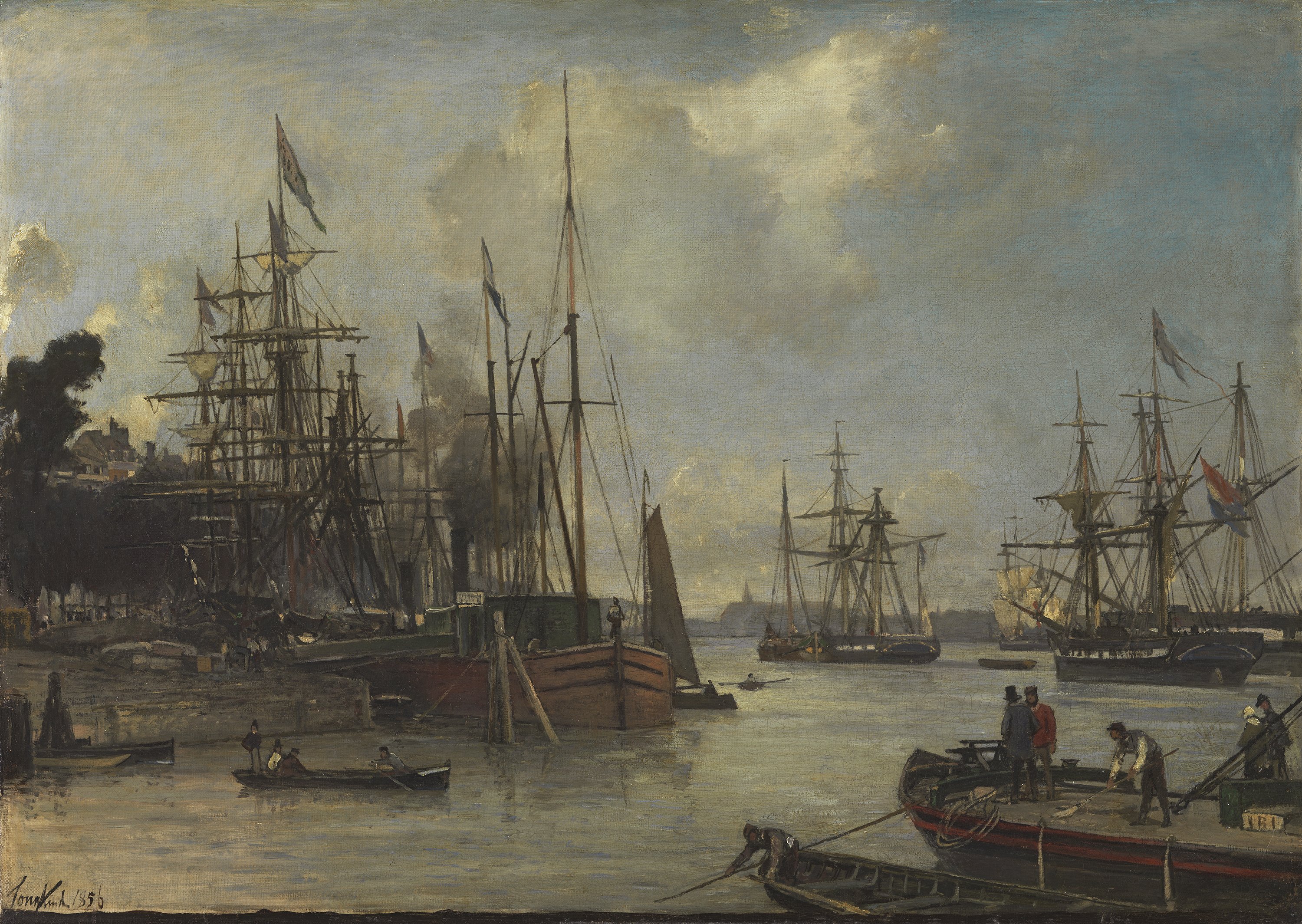
A View of the Harbour, Rotterdam
The Dutch painter Johan Barthold Jongkind spent most of his life in France, first as a protégé of the Prince of Orange and later as an independent artist. In 1855, disillusioned by the scant appreciation of his work at the Paris Salon and harassed by creditors, he abandoned the French capital and returned to his country of birth for a five-year period. Taking up residence in the port city of Rotterdam, where he remained in contact with his Parisian friends — particularly Corot, Rousseau and Daubigny, the members of the Barbizon School — and his Paris dealer, Firmin Martin, he concentrated almost solely on producing views of the surrounding landscape with its characteristic Dutch windmills and scenes of nearby harbours.
The Museo Thyssen-Bornemisza View of the Harbour, Rotterdam, dated 1856, was executed shortly after Jongkind’s return to the Netherlands. By then Rotterdam was the most important port in northern Europe, located in a privileged enclave that could be reached both from the North Sea and from inland via the deep waters of the river Meuse. As in many other similar works, the artist depicts the quays of the bustling Dutch port with numerous moored boats in the process of unloading their cargoes.
The arrangement of the picture space bears the mark of seventeenth-century Dutch seascape painting, with which Jongkind had been very familiar since his formative years with Andreas Schelfhout. Faithful to this tradition, the artist builds a balanced composition based on contrasts: the geometrised verticality of the masts raised to varying heights offsets the fluidity of the clouds; the dark tones of the vessels stand out against the luminosity of the sky and the gleam of the water; and the loose technique of the sky contrasts with the precise draughtsmanship of the boats. The present oil painting was most likely executed in the painter’s studio using earlier watercolour sketches taken from life, in which the painter hastily jotted down his impressions. Indeed, this was his usual procedure, as he wrote to his friend Smits on 22 November 1856: “I painted them from life, meaning that I made the watercolours from which I painted my pictures.”
Although this is a relatively early work, Jongkind, who, like Boudin, is considered a forerunner of Impressionism, already displays a keen interest in depicting atmospheric changes and in capturing the effects of light on water and the sky. As Edmond de Goncourt pointed out in 1882, Jongkind exerted considerable influence on the development of modern landscape art and Édouard Manet dubbed him the “father of the school of landscape painting.” For his part, Claude Monet stated that “Jongkind was my true master. I owe the education of my sight to him.”
Paloma Alarcó