Saint Jerome and the blessed Bartolo Buompedoni of San Gimignano
ca. 1464 - 1467
Tempera and gold on panel.
22.3 x 43.5 cm
Museo Nacional Thyssen-Bornemisza, Madrid
Inv. no.
168
(1928.8
)
Room 4
Level 2
Permanent Collection
Benozzo Gozzoli, whose life is recounted by Vasari in the Vite, worked with Fra Angelico, from whom he derived certain stylistic features, as can be seen in some of the frescoes in the convent of San Marco in Florence on which Gozzoli collaborated. Gozzoli, whose real name was Benozzo di Lese, accompanied Fra Angelico to Rome in 1477 to work on the decoration of the chapels of Saint Peter and Nicholas V in the Vatican. Vasari recorded various commentaries by contemporaries who considered Gozzoli to be “an artist of great inventive talent, particularly at painting animals, perspectives, landscape and ornament”. Aside from these positive opinions, Vasari also noted that: “he produced so many works in his time that he clearly paid little attention to other pleasures”. It is thus clear that Benozzo Gozzoli was one of the most active artists of his day and that he produced a large number of works, particularly in fresco.
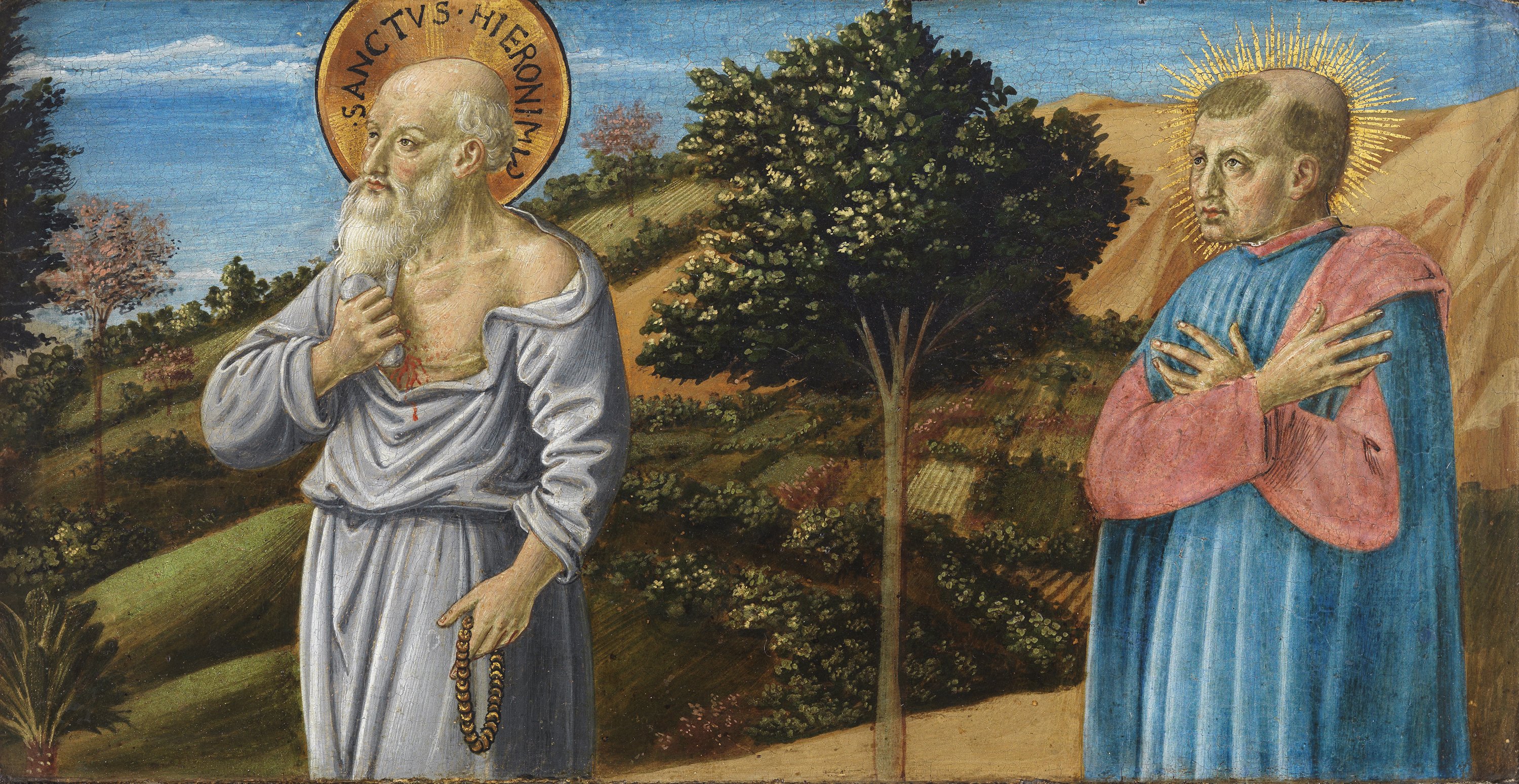
The figure who accompanies Jerome in this panel, and who has been identified in previous publications as simply a saint, is the blessed Bartolo Buompedoni. He was identified by Roberto Bartalani who also discovered other information on the origins of this panel. Bartolo Buompedoni was born around 1228 in San Gimignano. He was a leper and was director of the leper refuge in his native city until his death in 1300. He belonged to the Franciscan Order and was famous in life for his patience and resignation. Gozzoli represented this saint, with his name inscribed on his halo, in the choir of the church of Saint Augustine in San Gimignano. A series of parallels have been detected between the two depictions that allow the identity of the present saint to be more securely determined, as well as the date of this panel.
To judge from its design and format, the present panel belonged to a predella executed at the time that Gozzoli was in San Gimignano, where he produced various works including the life of Saint Augustine in the form of seventeen scenes for the titular church of that saint. The predella to which this panel belonged took the form of a single scene that was cut down at an unknown date. Part of it is now in the Musée du Petit Palais in Avignon. In that panel the Blessed Fina and Mary Magdalen are depicted in a landscape similar to the present one. It has been thought that the centre of the predella may have been a Pietà that could have been framed on either side by two groups of saints with a continuous landscape behind them. The model that Gozzoli followed for the whole predella was possibly similar to a composition by the artist in the Museo Civico in San Gimignano in which a Risen Christ, standing on his tomb, is framed symmetrically by the Virgin, Saint John and two saints. A panel by the artist now in the Galleria Brera in Milan depicting Christ, the Virgin and Saint John was proposed by Laclotte and Mognetti as the central part of the present predella, an idea rejected by Cola Ahl but accepted by Andrea di Lorenzo following the panel’s restoration. The present panel, whose attribution has never been questioned, is imbued with a tranquil atmosphere typical of this artist, to which elements such as the extensive and detailed landscape against which the two figures are set undoubtedly contribute.
Mar Borobia
The figure who accompanies Jerome in this panel, and who has been identified in previous publications as simply a saint, is the blessed Bartolo Buompedoni. He was identified by Roberto Bartalani who also discovered other information on the origins of this panel. Bartolo Buompedoni was born around 1228 in San Gimignano. He was a leper and was director of the leper refuge in his native city until his death in 1300. He belonged to the Franciscan Order and was famous in life for his patience and resignation. Gozzoli represented this saint, with his name inscribed on his halo, in the choir of the church of Saint Augustine in San Gimignano. A series of parallels have been detected between the two depictions that allow the identity of the present saint to be more securely determined, as well as the date of this panel.
To judge from its design and format, the present panel belonged to a predella executed at the time that Gozzoli was in San Gimignano, where he produced various works including the life of Saint Augustine in the form of seventeen scenes for the titular church of that saint. The predella to which this panel belonged took the form of a single scene that was cut down at an unknown date. Part of it is now in the Musée du Petit Palais in Avignon. In that panel the Blessed Fina and Mary Magdalen are depicted in a landscape similar to the present one. It has been thought that the centre of the predella may have been a Pietà that could have been framed on either side by two groups of saints with a continuous landscape behind them. The model that Gozzoli followed for the whole predella was possibly similar to a composition by the artist in the Museo Civico in San Gimignano in which a Risen Christ, standing on his tomb, is framed symmetrically by the Virgin, Saint John and two saints. A panel by the artist now in the Galleria Brera in Milan depicting Christ, the Virgin and Saint John was proposed by Laclotte and Mognetti as the central part of the present predella, an idea rejected by Cola Ahl but accepted by Andrea di Lorenzo following the panel’s restoration. The present panel, whose attribution has never been questioned, is imbued with a tranquil atmosphere typical of this artist, to which elements such as the extensive and detailed landscape against which the two figures are set undoubtedly contribute.
Mar Borobia