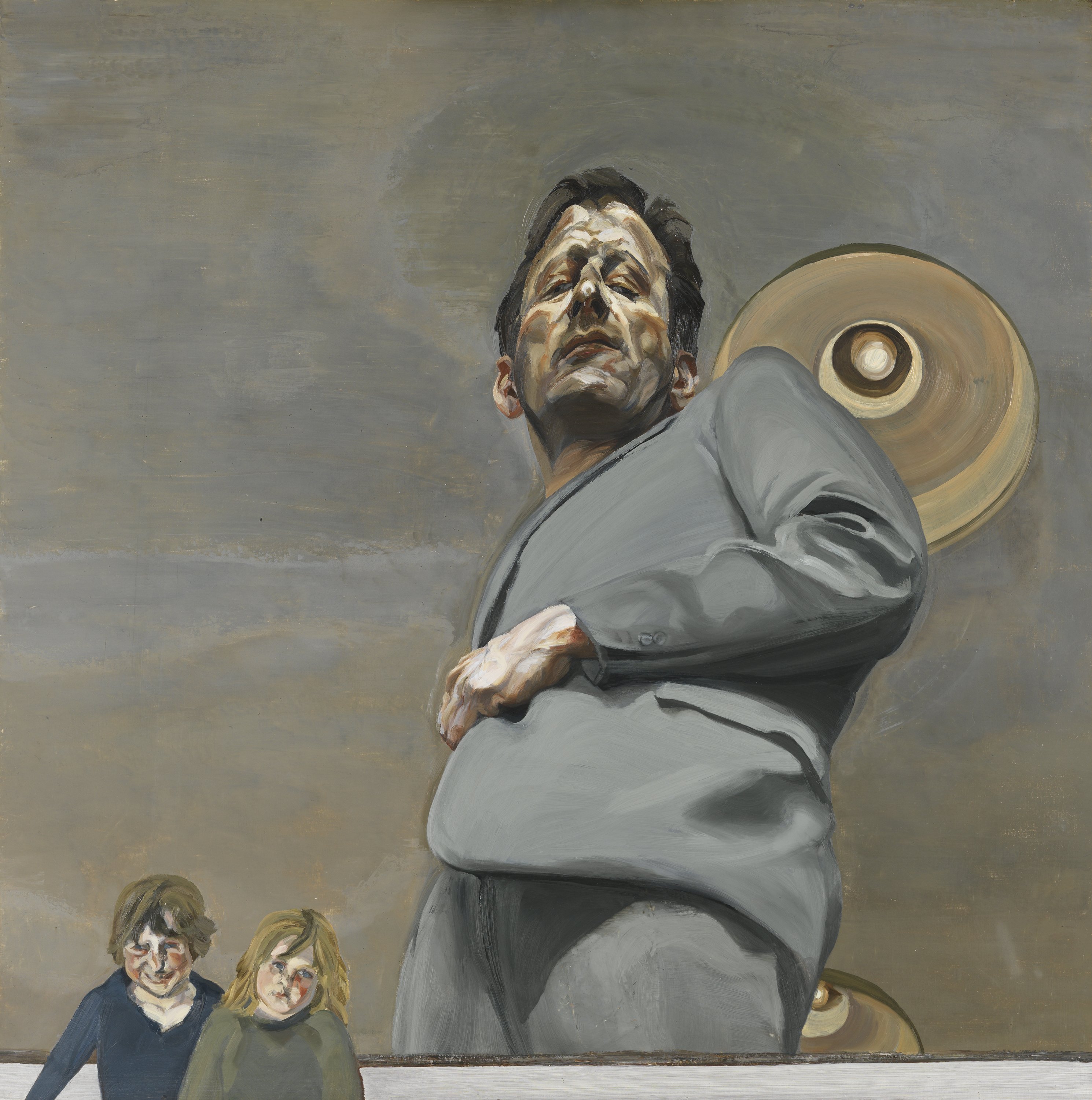
Reflection with Two Children (Self-Portrait)
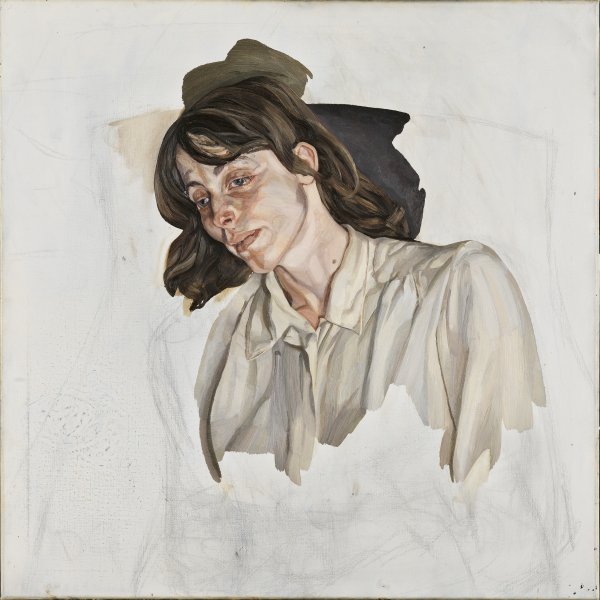
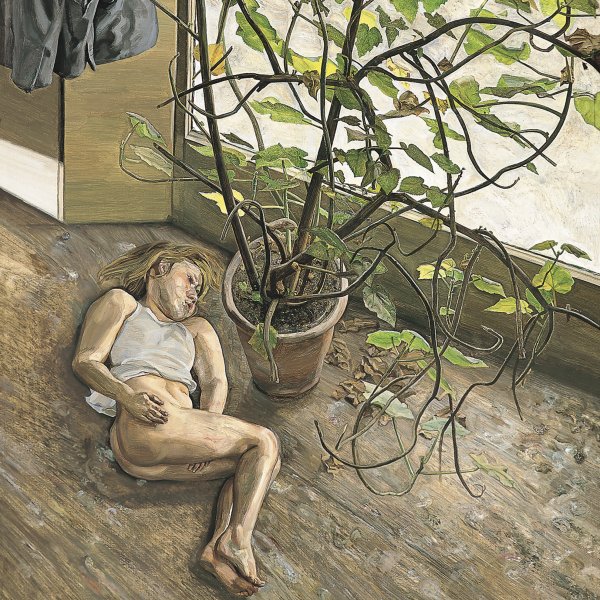
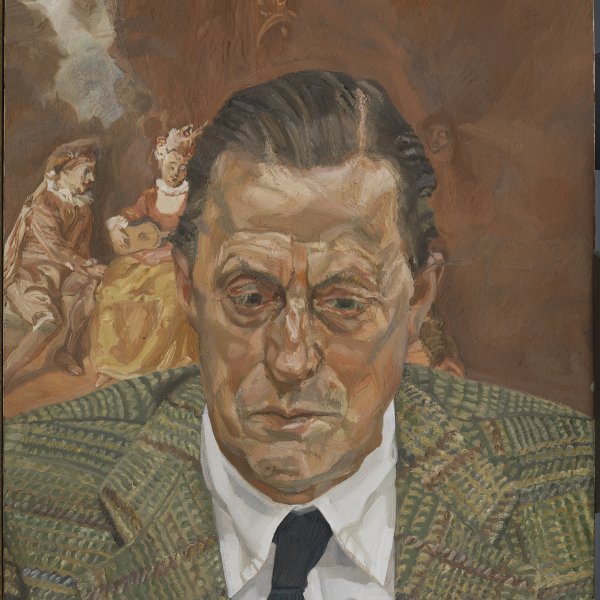
From his very first works, which display the painstaking detail of the Flemish primitives and a certain neo-romantic, surreal air, Lucian Freud took a stand for figurative art and against the prevailing abstract trends. Since then his work has been fuelled by the tension between reality and matter, between the visual and the tactile. His obsession with the human body has driven him to reinterpret the genre of portraiture in an original manner.
In his numerous self-portraits, the painter is always shown with a forced gesture, narrowing his eyes or peering downwards or sideways, with a gaze that evidences the effort involved in painting himself using a mirror. Reflection with Two Children (Self-Portrait), executed in 1965, combines an intense close-up of the artist, who twists his body in order to study his own reflection in a mirror at his feet on the floor, with the lamp positioned behind him, which he renders as a semiabstract form that hovers over the painter. As John Russell states, the viewer is unable to grasp the image at first glance, as it is one of the first self-portraits in which Freud experiments with a set of two mirrors, and, as Catherine Lampert notes, we are forced to run our eyes up the figure, coming face-to-face with the artist’s gaze. The idea of a mirror reflection is reinforced by the plain grey background that causes the touches of light concentrated on the face and hands to stand out even more powerfully. The image of Rose and Ali, the children Suzy Boyt bore him, in the lower left corner is inspired by the tomb of the dwarf Seneb and his family in the Cairo museum, reproduced in Geschichte Aegyptens, Freud’s inseparable companion throughout his long career as a painter.
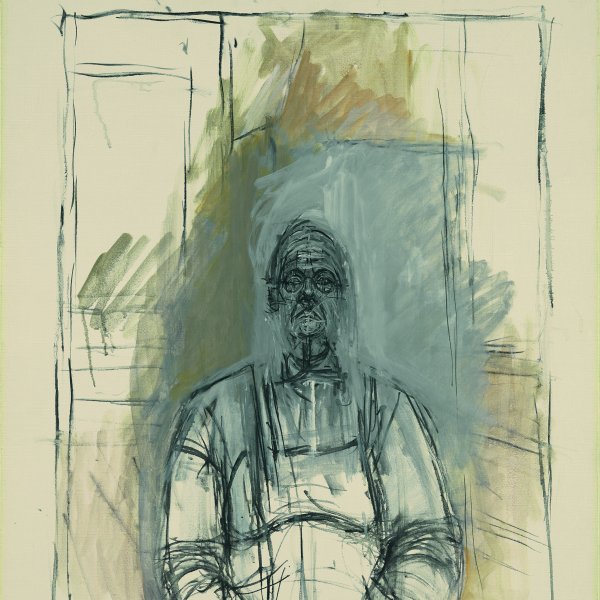
The technique of sweeping, expressive brushstrokes can be linked to the portraits of Frans Hals, whom Freud regarded as a modern artist on account of his rough style. Freud, who was defined — not coincidentally — by William Feaver as a “a Paddington Hals willing himself to spontaneity, ” admired the Dutch master’s firm, direct manner of applying the paint using a heavily loaded hogshair brush, which accentuated the artist’s action in crystallising the sitter on canvas.
Paloma Alarcó