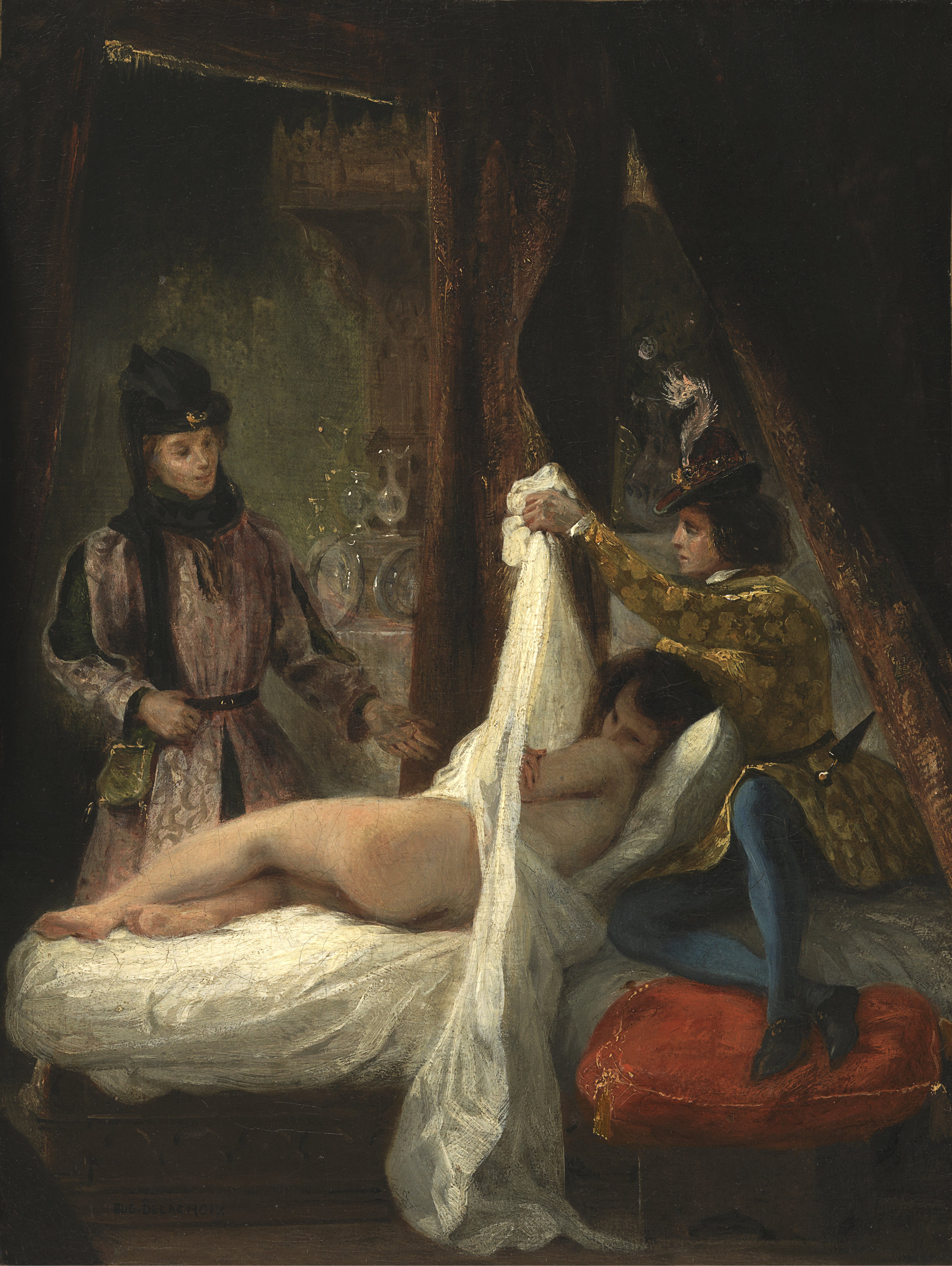
The Duke of Orleans showing his Lover
ca. 1825 - 1826
Oil on canvas.
35 x 25.5 cm
Museo Nacional Thyssen-Bornemisza, Madrid
Inv. no.
127
(1977.19
)
Room 29
Level 2
Permanent Collection
This signed canvas by Delacroix depicting a literary subject has been dated to around 1825–26 following the artist’s return from England where he had been staying between May and August 1825. Since the time of its exhibition at the Musée Colbert in 1832 the painting had been entitled A young Lord shows his Lover’s Body to a Courtier. Some years later when it was auctioned from the collection of Frédéric Villot in 1864 it was entitled The Duke of Burgundy shows his Lover to the Duke of Orléans. Other titles used for this work and which indicate the confusion over its subject matter were The Duke of Burgundy revealing his Lover and The Duke of Orléans showing his Lover to the Duke of Burgundy. The matter was resolved in 1965 when the poet Louis Aragon discovered the literary source that may have inspired the artist. This is a passage in the Histoire des ducs de Borgogne by Barante, republished in 1824. It describes how the Duke of Orléans displayed the naked body of his lover Mariette d’Enghien, wife of his former chamberlain Aubert le Flamenc, to her husband, concealing her face. Her husband failed to recognize her. Together with Barante’s text another more detailed one has been mentioned, which the artist may have used as his source. This is Les vies de dames galantes by Brântome, republished in 1822, two years before Barante’s text. In Brântome’s description the Duke of Orléans shows his lover to her husband, concealing her face with a sheet.
The scene is set in a dark interior in which Delacroix locates the three principal figures. Seated at the end of the bed, which is shielded by heavy curtains, the Duke of Orléans lifts up the sheet to show his illustrious visitor the body of his lover from waist downwards. Delacroix involves the viewer in the deception of the husband as he depicts the woman’s face in the half-shadow. The artist achieves fine contrasts by juxtaposing colours such as the deep red of the cushion on which the Duke rests his feet, the blue of his hose and the gold of his clothing. There are also extremely fine chromatic contrasts in the woman’s body, in which her flesh is set against the white of the bed. The brushstrokes are clearly visible in the more heavily impastoed areas on which the light falls most strongly. These areas correspond to the most important parts of the scene, namely the sheet that conceals the woman’s identity, held up by her lover.
The canvas entered the Thyssen-Bornemisza collection in 1977 from the Lefèvre gallery in London. Its provenance is known since 1832 when it belonged to Frédéric Leblond and was included in an exhibition at the Musée Colbert in Paris.
Mar Borobia
The scene is set in a dark interior in which Delacroix locates the three principal figures. Seated at the end of the bed, which is shielded by heavy curtains, the Duke of Orléans lifts up the sheet to show his illustrious visitor the body of his lover from waist downwards. Delacroix involves the viewer in the deception of the husband as he depicts the woman’s face in the half-shadow. The artist achieves fine contrasts by juxtaposing colours such as the deep red of the cushion on which the Duke rests his feet, the blue of his hose and the gold of his clothing. There are also extremely fine chromatic contrasts in the woman’s body, in which her flesh is set against the white of the bed. The brushstrokes are clearly visible in the more heavily impastoed areas on which the light falls most strongly. These areas correspond to the most important parts of the scene, namely the sheet that conceals the woman’s identity, held up by her lover.
The canvas entered the Thyssen-Bornemisza collection in 1977 from the Lefèvre gallery in London. Its provenance is known since 1832 when it belonged to Frédéric Leblond and was included in an exhibition at the Musée Colbert in Paris.
Mar Borobia