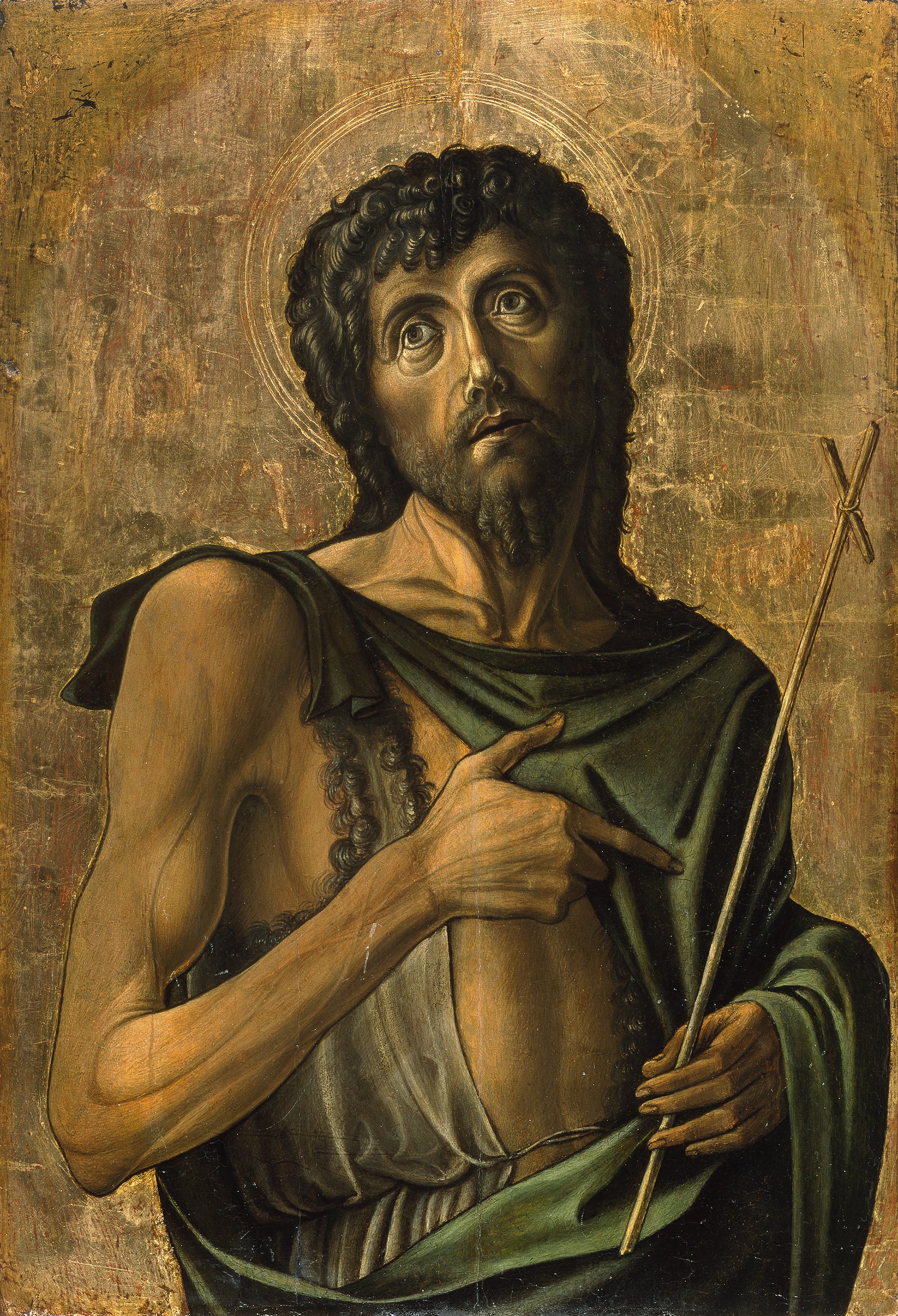
Saint John the Baptist
Alvise Vivarini was born into a family of artists and first trained with his father. The most important artists in the family were his father, Antonio, and his uncle Bartolomeo. The workshop of these painters was one of the most active in Venice and the surrounding area and was greatly in demand, as a result of which collaborators and assistants were employed, in particular for religious scenes intended for altarpieces. Alvise is considered the most individual and imaginative member of the family as he was able to break away from the earlier craft approach that prevailed in the family’s output and to explore more modern ideas associated with the role of a creative artist. Alvise’s work reveals an interest in light, volume, movement and the expressions of the figures, replacing the previously more linear style characteristic of the family’s production. He absorbed the innovations of the Bellini family as well as the style of Antonello da Messina, whose influence is particularly evident in his portraits.
Saint John the Baptist was formerly in the Parisian collection of the Marquis of Magni, where it is recorded in 1902. It was then in the collection of Joseph Spiridon and was auctioned in Berlin in 1929 along with other works from that collection. It was acquired in Berlin by J. Goldsmidt and then entered the Thyssen-Bornemisza collection, where it was to be found in 1930.
The panel was attributed to Bartolomeo Vivarini when it was in the Spiridon collection and this attribution was accepted by various authors including Berenson and Heinemann. It was, however, published as a work by Alvise in the catalogue of the Munich exhibition in 1930 when the Rohoncz collection was presented to a wider public for the first time.Van Marle also attributed it to Alvise and considered it an early work by the artist: this line was pursued by Fleischmann, Pallucchini, Zeri and Steer.
Saint John the Baptist was one of the panels in a now dismantled polyptych, which also included Saint Louis of Toulouse (Gemäldegalerie, Berlin). Pallucchini first made this association while Zeri subsequently added the panel of Saint Ursula in the Heinz Kisters collection and a Mary Magdalen also in Berlin. The structure of this altarpiece, whose central panel would have been a Virgin and Child (as yet unlocated), possibly followed the same arrangement as the Montefiorentino Altarpiece by Alvise, nowin the Galleria Nazionale delle Marche, Urbino. Of the three panels associated with the present altarpiece, only the Magdalen has retained its original dimensions.
The panel has been dated close to the Montefiorentino Altarpiece, which was Alvise’s first independent work. Steer, however, suggested that the altarpiece of which the present panel formed part was slightly earlier than the one now in Urbino.
Mar Borobia