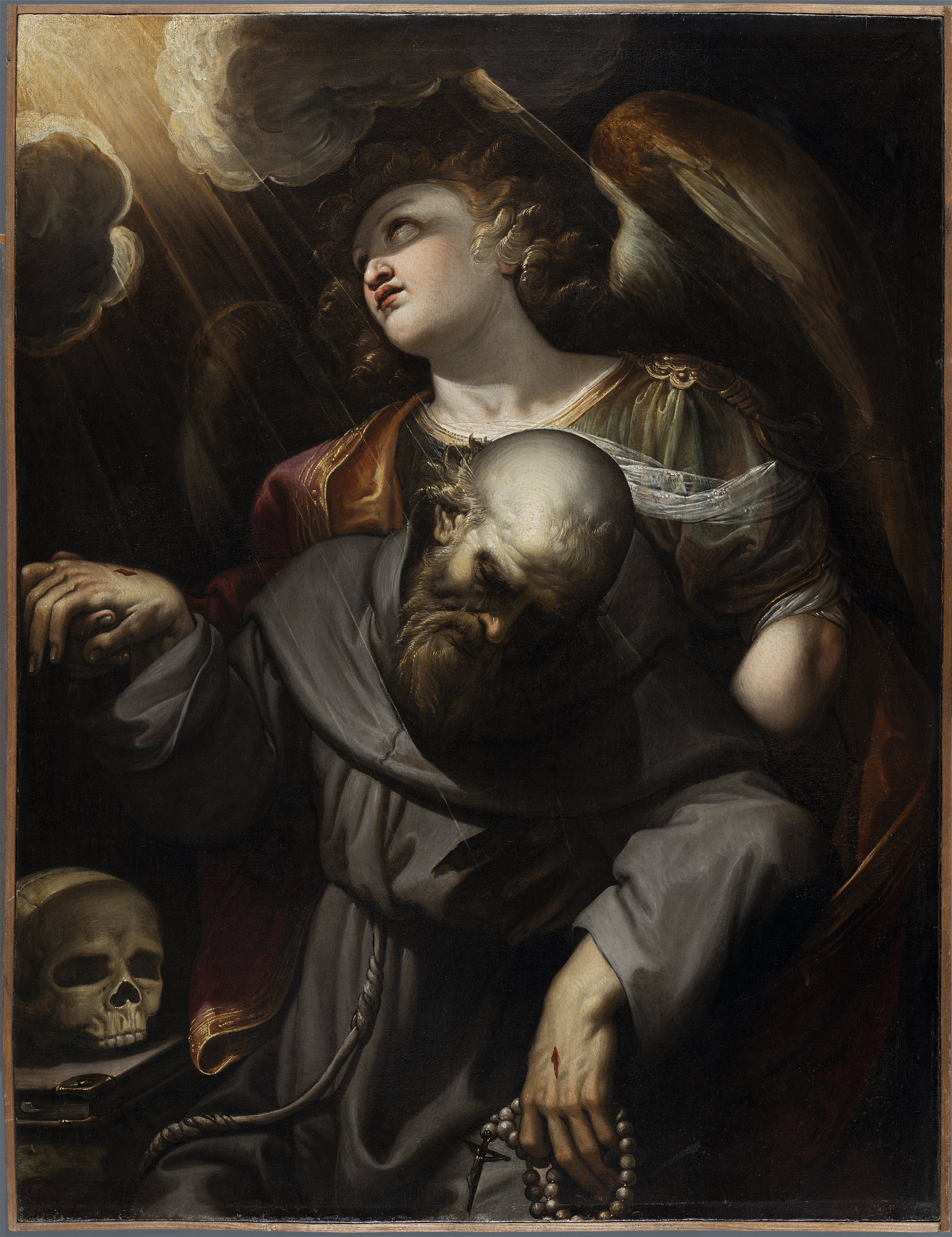
Saint Francis with the Stigmata, held up by an Angel
Ferraù Fenzoni, an artist working in the late Mannerist style, is documented in Rome and Umbria where he produced a large number of works. His style has been related to that of Federico Barocci, particularly with regard to his use of colour and light. In Rome, Fenzoni worked with Andrea Lillo on a series of decorations for rooms in the Vatican and it was in Rome that he executed his finest works for two churches: Santa Maria in Trastevere and Santa Maria Maggiore. Notable works during his Umbrian period include those executed for Todi cathedral and those painted for Perugia cathedral, including a Martyrdom of Saint Lawrence that reveals a change in the style of his brushstroke. From 1599 onwards Fenzoni was back in Faenza where he continued to be active until his death in 1645. The present canvas dates from that period, when the artist was once again living in his native city.
Among the episodes from the life of Saint Francis, the stigmatisation was one of the most popular during the Counter-reformation. Artists painted the saint on mount Albernia, seeing the vision and receiving the stigmata to his hands, feet and side. They also produced compositions of angels who, as here, hold up the saint who has fainted from the emotional intensity of the events. Divine presence is indicated in the present canvas not just through the figure of the protecting angel assisting Saint Francis, who is exhausted from his penance, but also by the fine rays of light from a cloud of glory visible in the sky and towards which the angel is looking.
Fenzoni used a simple, clear composition with the figures located in the foreground where we see Francis’ aids to meditation, the skull and book. The strong contrasts of light emphasise the most moving areas such as the saint’s hands with the stigmata on them, part of his head and face, on which his tears are visible, and the angel’s face turned towards the sky and thus leading our gaze in that direction.
Giuseppe Scavizzi dated the present canvas to the second decade of the 17th century, an opinion shared by Contini. Contini saw late 16th-century Counter-Reformatory elements in the composition and also drew attention to the careful study of the fall of light on specific objects in a manner that recalls Caravaggio’s Roman works. However, Filippo Todini compared this painting with Fenzoni’s Last Judgement in Todi cathedral and thus dated it to the end of the 16th century. In his study, Contini drew attention to the saint’s elegant hands and to those of the angel with their long, delicate fingers, comparing them to the hands of the figures in a Holy Family in the Galleria Spada in Rome. Contini also noted the similarity between the two figures in the present painting and those in two other works by Fenzoni: The Flight into Egypt painted for the Roman church of Santa Maria Maggiore, and The Martyrdom of Saint Lawrence for Perugia cathedral.
The canvas entered the Thyssen-Bornemisza collection in 1977 from a private Italian collection.
Mar Borobia