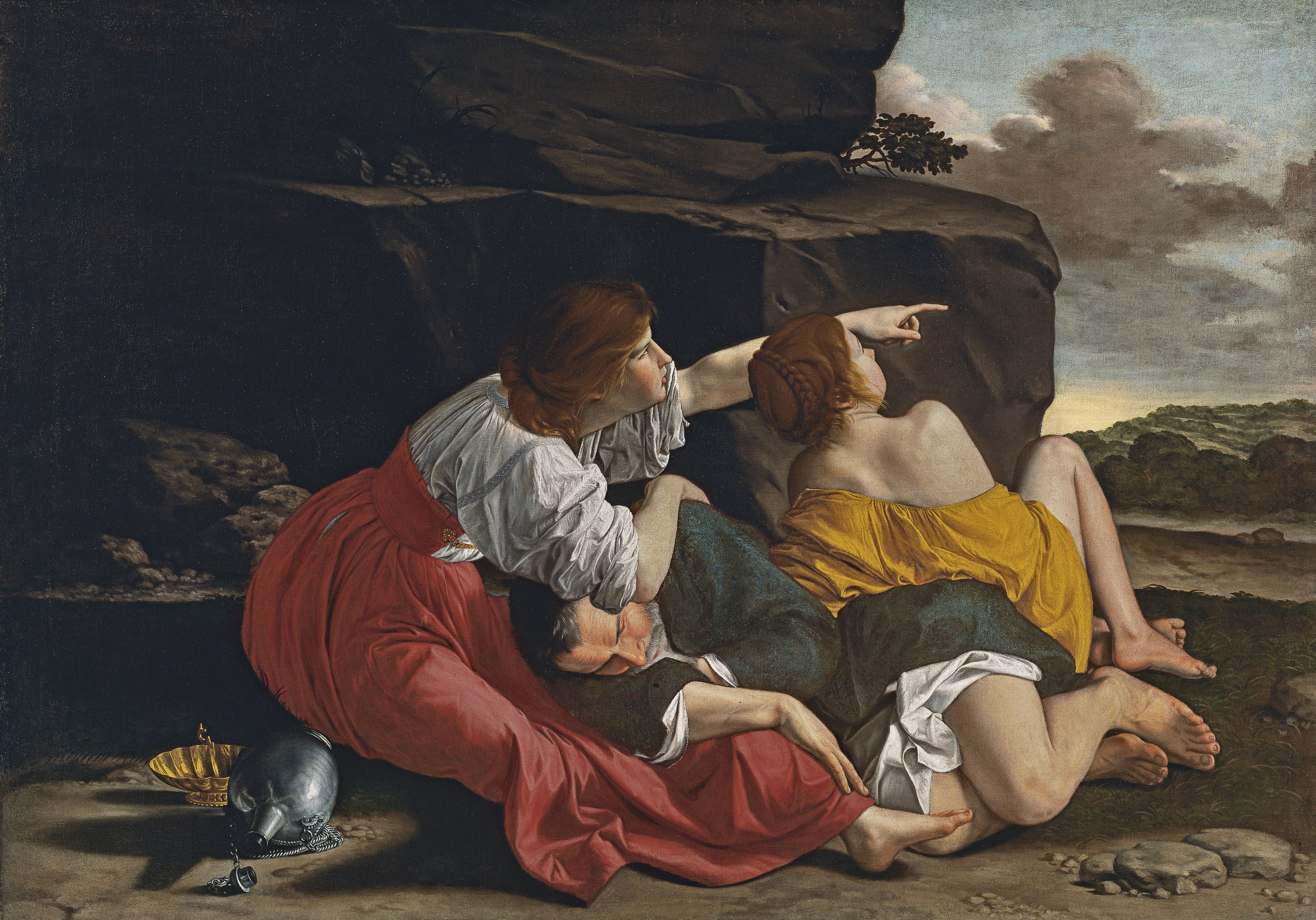
This incestuous biblical episode is to be found in Genesis. It narrates how Lot and his daughters left the city of Zoar, where they had lived after their departure from Sodom, and moved to a cave in the mountains. There, the two daughters decided by common agreement and on the suggestion of the elder one to make their father drunk and then sleep with him in order to ensure the continuation of his line, given that there were no other men left on earth. For two consecutive nights they made Lot drunk, the elder daughter sleeping with him on the first night and the younger on the second night. The elder daughter gave birth to Moab and the younger to Benammi. This story of double incest was depicted by artists during the 16th and 17th centuries in scenes that frequently contained sensual implications or suggestions of eroticism and seduction. Here, Gentileschi has made use of insinuation and suggestion rather than an overt depiction of the events that took place. The painter organised the subject around the three principal figures who are located in an exterior whose rocky backdrop is presumably the cave to which they escaped. The figures on the ground create a well-organised, compact group in which the drunken Lot sleeps between his two daughters who are looking out of the pictorial space towards the events taking place in the distance, towards which the daughter who seems to be the elder one is pointing.
Gentileschi used a limited range of colours but created elegant combinations through the use of large, juxtaposed areas of colour for the clothes in shades of red, yellow, blue and white against a landscape background in which dark greys, blues and earth tones predominate. Also striking are the silver coloured wine flask and the golden wine dish on the ground on the left, which are brilliantly painted with regard to their surface textures and colours.
Gentileschi painted this episode on a number of occasions, as did his workshop. The prototype for this group is the canvas now in the J. Paul Getty Museum in Los Angeles. The present oil painting has been identified as the work that Gentileschi painted in Genoa for Giovanni Antonio Sauli. It is mentioned in 1674 by Raffael Soprani, who stated that the artist painted a Danäe, a Penitent Magdalen and a Lot and his Daughters for this Genoese nobleman. Other versions of this subject are now in the Gemäldegalerie, Berlin and the National Gallery of Canada, while there are copies of those paintings in the castle at Carrù near Turin, at Burghley House, Stamford, and in a private collection in Rome. The Museo de Bellas Artes, Bilbao, has another version of this episode painted for Charles I of England. In that canvas, Gentileschi breaks the compact shape of the central group by setting the events inside the dark cave and moving one of the daughters, who is depicted standing, to one side.
Lot and his Daughters entered the Thyssen-Bornemisza collection in 1977. It was previously in a private UK collection and before that in a private collection in Arenzano.
Mar Borobia
The exploitation rights of the images correspond to the Fundación Coleccion Thyssen-Bornemisza, F.S.P. The Fundación authorizes the downloading of high-resolution images from its website for private use, use for educational and research purposes, and other non-commercial uses.
Use for educational and research purposes is understood as the non-commercial or advertising use of images in presentations, conferences, school or university work, in classes at regulated education institutions, as well as in academic publications, with a circulation of less than 1,000 copies, provided that it is non-profit.
Non-commercial use is understood as the use of the images in a context where no profit, monetary or commercial, is generated, directly or indirectly.
Any use other than those indicated above will require the prior written authorization of the Fundación Any request for educational and research use or for non-commercial use (including academic publications), should be directed by email to the Museum Photo Library through the email address archivo.fotografico@museothyssen.org. This department manages the worldwide distribution of the images of the works of the Museo Nacional Thyssen-Bornemisza and the management of their reproduction rights for those uses.
The user agrees to use the image of the website solely and exclusively for the purposes described above and in accordance with the following terms of use:
Terms of use
- If the image is used for reproduction, the work must be reproduced in its entirety. The image may not be manipulated, deformed, modified, or altered in any way. In particular, no superposition (of images or texts) on the reproduction is allowed.
- The reproduction of a detail or part of the work may only be made with the prior written authorization of the Fundación. In this case, the credit line must include the following mention: “detail”.
- Any total or partial reproduction of the images authorized by the Fundación must be accompanied by the following mention: Author's name. Title, Date © Museo Nacional Thyssen-Bornemisza, Madrid.
- The user will send to the Museum Photo Library of the Fundación one (1) free copy of the edition, publication or reproduction to the following address: Archivo Fotográfico, Museo Nacional Thyssen-Bornemisza, Paseo del Prado, 8 28014 Madrid, Spain.
The Photographic Archive of the Museo Nacional Thyssen-Bornemisza offers sale and rental service of photographic material of all the works on its Permanent Collection.
To request images or permits for commercial use in academic or research publications, that is, catalogues of other institutions, monographs and other specialized publications, you should contact the Museum's Commercial Archive by email at the e-mail @email.
To request images or permits for other commercial or advertising uses (general publications, merchandising, exhibitions, audio-visual works, web pages, etc.), you should contact the Museum's Commercial Archive by email at the e-mail @email.
The Photo Library and the Museum's Commercial Archive manage the worldwide distribution of images of the Museo Thyssen-Bornemisza works, as well as their reproduction rights. The applicable rates are calculated based on the nature and proposed use of the images, as well as the availability of the requested image.
Requests for scans or new photographs will be reviewed on a case-by-case basis. Once approved, an additional fee will apply. Re-photographing a work will require a minimum of six weeks to complete.
However, photographed works are protected by copyright. Therefore, regardless of the terms of use of the photographs set out below by the Foundation, it will be necessary to obtain a license from the author or copyright holder known to the Fundacion in order to reproduce or exploit the work.