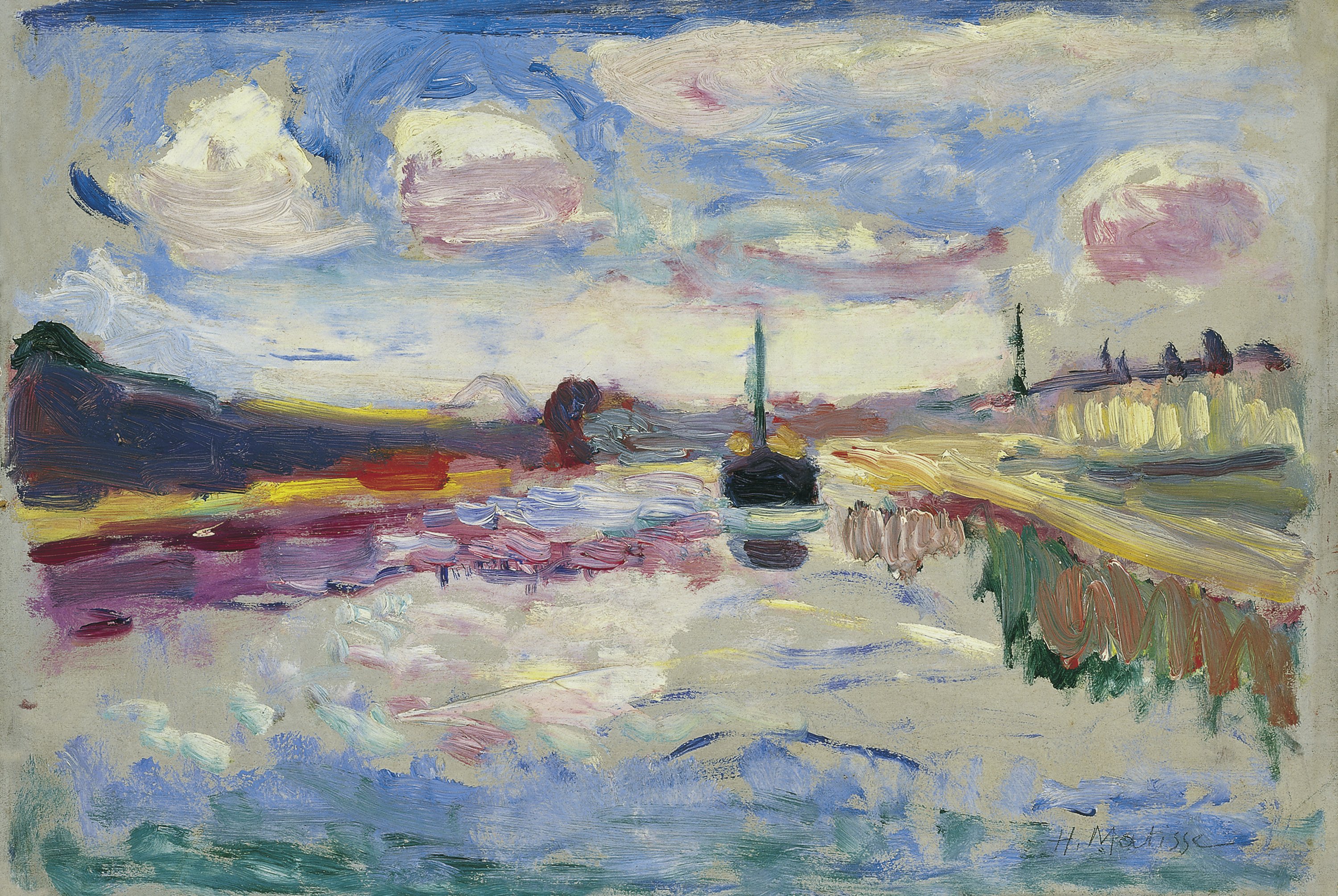
Canal du Midi
Canal du Midi belongs to a series of pictures painted by Matisse near Toulouse during the winter of 1898-1899. Matisse, who left Moreau's studio in the autumn of 1897, married Amélie Parayre in January of the following year. After a brief honeymoon in London, the couple sojourned for six months in Ajaccio, Corsica. Then, in August 1898, Matisse and his wife travelled to Toulouse, and stayed for six months with Amélie's parents.
This was the first time Matisse visited the South and he always remembered it as his first encounter with light and colour. Many of the landscapes he painted during that period, including the one we are commenting on, were probably executed outdoors, directly from the model. Yet the colour in them is not naturalistic. The bright sunlight, as Schneider put it, "brings out the colour, and gradually takes it to a point of incandescence where a mutation takes place, and the local tone becomes subjective colour". In fact, the pictures Matisse painted in that period are generally described as "proto-fauvist", inasmuch as they seem to anticipate the bright subjective chromatism that, five or six years later, would be the most outstanding mark of fauvism.
If we compare the pictures of Corsica with those of Toulouse, we can observe a shift from the thick impastos of the Corsican period and a brighter and lighter style, culminating in a composition which is practically neo-Impressionist, Sideboard and Table, 1899 (Switzerland, private collection), executed towards the end of his sojourn in Toulouse. One of the reasons for this evolution might have been Signac's influence. Matisse took a short break during his stay in Ajaccio and travelled to Paris, where he visited the Salon des Indépendants; there, a remarkable group of paintings by Signac stood out. Besides, his book D'Eugène Delacroix au néo-impressionnisme was published in instalments in La Revue Blanche between May and July of that same year.
Canal du Midi is a hasty work executed with fluid paint, but not with the broken stroke that is found in other pictures that Matisse did in that period. Nevertheless, his desire not to superimpose colours and the fact that he left large areas of the background in a pale grey colour can be related to neo-Impressionism. This grey serves as a neutral shade allowing the deep blues, carmine and oranges of the setting sun to breath.
Canal du Midi belonged for a long time to Leo Stein; he and his sister Gertrude had acquired it in the spring of 1906. In the 1906 Salon des Indépendants (March-April) Matisse had only shown a large format painting, Le Bonheur de vivre, which was immediately acquired by Leo and Gertrude Stein. At the same time, their brother Michael bought the sketch for Le Bonheur de vivre, which had been included in an exhibition at the Galerie Druet, as the same time as the Salon des Indépendants. It was also in the exhibition at the Galerie Druet that Leo and Gertrude acquired Canal du Midi.
Tomàs Llorens