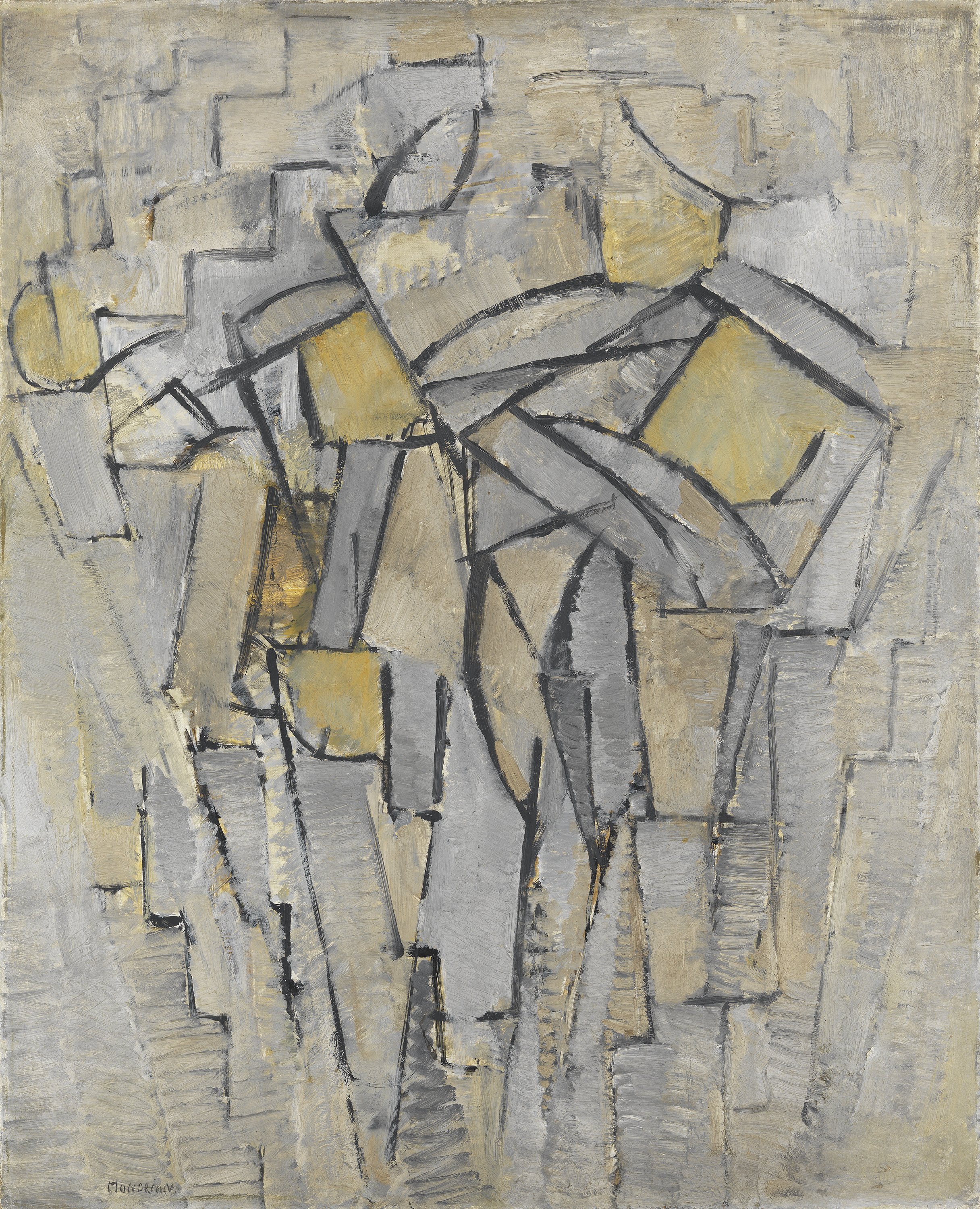
Composition No. XIII/ Composition 2
Mondrian first came under the influence of Cubism in 1911, after viewing the work of Cézanne, Picasso and Braque at the Moderne Kunstring in Amsterdam. This prompted him to move to Paris, where he remained until 1914. He returned to the city in 1919, after the First World War, and lived there until 1938. Composition No. XIII belongs to a suite of works executed during his first months in the French capital, although some authors have linked this painting to a set devoted to the theme of sunflowers. It was called The Eucalyptus Tree in the Mondrian exhibition at the Sidney Janis Gallery in New York in 1949, as years earlier, around 1938, the artist had written this title on the back of a photograph he sent to his painter friend Ben Nicholson. We may therefore deduce that Mondrian had intended to represent the branches of a eucalyptus tree using a language close to Cubism.
Towards 1912 Mondrian began to synthesise and abstract the movements and forms of trees in order to evoke the cycle of life and death, in a sort of metaphysical consideration of nature that is furthermore close to analytical Cubism. Yve-Alain Bois wrote in the catalogue of the Mondrian exhibition held at New York’s Museum of Modern Art in 1995 that, with the assimilation of Cubism, the artist views the picture surface as an uncompromising reality, and “what emerges from it is the idea that a painting is the result of a kind of struggle, a precarious equilibrium that must remain suspended so as to sustain its intensity.”
Mondrian believed that, once painting — thanks to Cézanne — had succeeded in distancing itself from nature, it was necessary to progressively overcome the constraints of optical reality and replace it with a less representative and more musical reality. Years later, in his essay Dialogue on the New Plastic, the artist stressed the need to suppress naturalistic instincts and make visible pure line and colour, in a constant interrelationship.
Paloma Alarcó