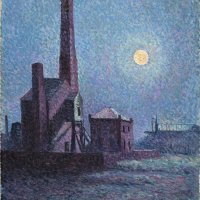
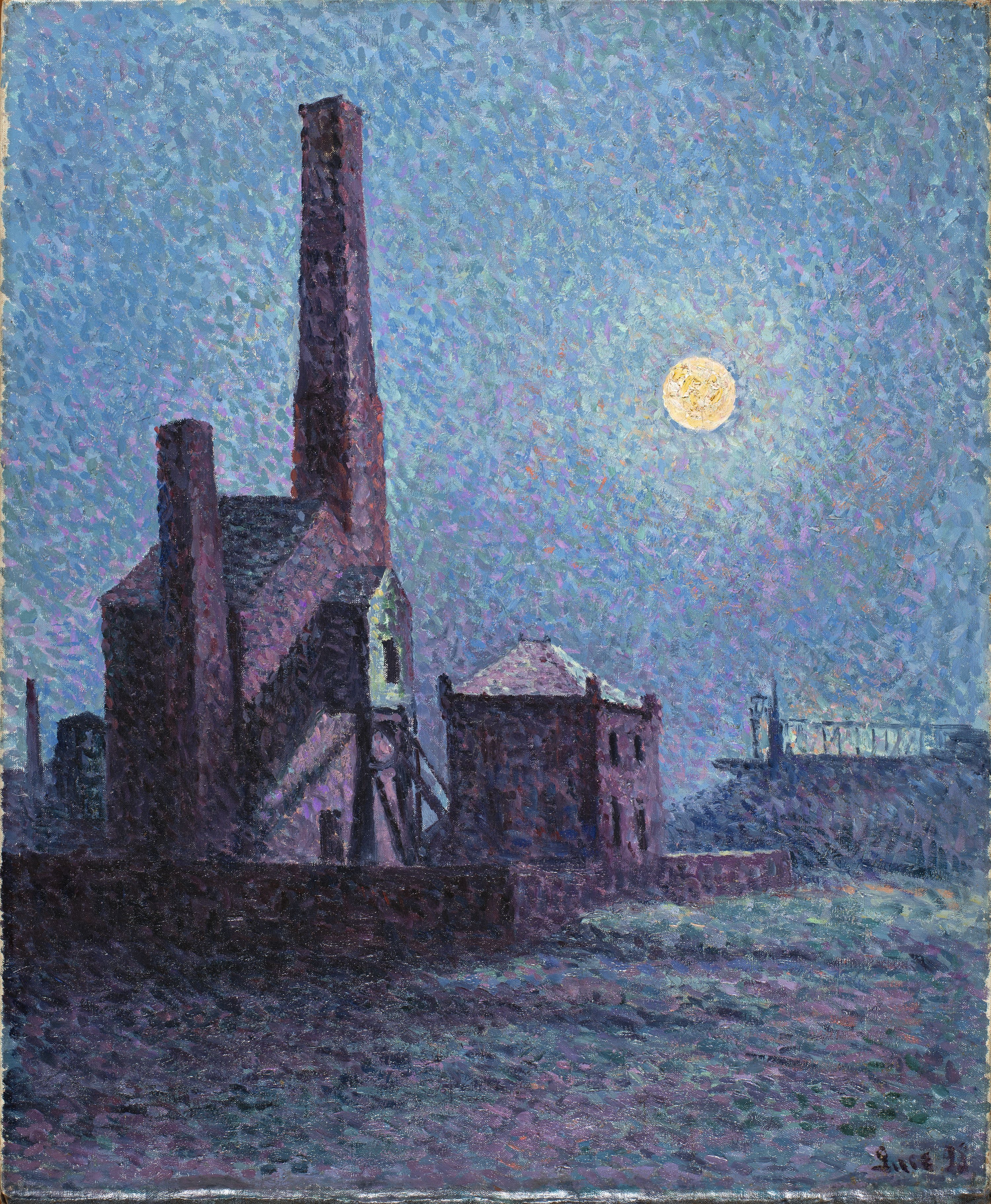
Factory in the Moonlight
1898
Oil on canvas.
55.9 x 46 cm
Carmen Thyssen Collection
Inv. no. (
CTB.1996.9
)
Room G
Level 0
Carmen Thyssen Collection and Temporary exhibition rooms
Introduced by Pissarro to the neo-Impressionists Seurat, Signac and Cross in 1887, Luce quickly became a convinced exponent of the "new" style that aimed to apply scientific principles of colour and light to painting. From the beginning, virtually all the members of the group had strong political beliefs, and Luce himself was certainly a fervent anarchist as well as a committed Pointillist. Even after Seurat's premature death at the age of 31 in 1891, Luce continued to paint in an adapted Pointillist style that Pissarro had rejected by 1889.
Of all the neo-Impressionists, Luce had the most tangible contacts with the Belgian group of Les XX. As well as exhibiting with them in Brussels, he became particularly friendly with the poet Émile Verhaeren and the artist Theo van Rysselberghe. And it was largely at their suggestion that Luce chose to visit the heavily industrialised area of Charleroi in 1895-and again in 1897 and 1898. A large body of work exists depicting foundries, steel-works, furnaces, and factory chimneys in and around Charleroi. As a committed and active anarchist, Luce felt strong sympathies with the Belgian workers. Several paintings depict them at work in near-purgatorial conditions. Other paintings by contrast are almost "still-life" presentations of this industrialised landscape, without figures. And clearly, night-scenes-or moonlight scenes-enabled Luce to present a dramatic heightening of these "still-life" buildings by exploiting the neo-Impressionist discoveries of light and colour.
Thus, the present painting, dated 1898, hinges on these two aspects: the unpeopled factory landscape on the one hand and the exploration of the neo-Impressionist brushstroke in registering effects of moonlit light and colour on the other.
After his prolonged series of industrial subject-matter around Charleroi from 1895 to 1898, Luce rarely returned to such themes after 1900.
Ronald Pickvance
Of all the neo-Impressionists, Luce had the most tangible contacts with the Belgian group of Les XX. As well as exhibiting with them in Brussels, he became particularly friendly with the poet Émile Verhaeren and the artist Theo van Rysselberghe. And it was largely at their suggestion that Luce chose to visit the heavily industrialised area of Charleroi in 1895-and again in 1897 and 1898. A large body of work exists depicting foundries, steel-works, furnaces, and factory chimneys in and around Charleroi. As a committed and active anarchist, Luce felt strong sympathies with the Belgian workers. Several paintings depict them at work in near-purgatorial conditions. Other paintings by contrast are almost "still-life" presentations of this industrialised landscape, without figures. And clearly, night-scenes-or moonlight scenes-enabled Luce to present a dramatic heightening of these "still-life" buildings by exploiting the neo-Impressionist discoveries of light and colour.
Thus, the present painting, dated 1898, hinges on these two aspects: the unpeopled factory landscape on the one hand and the exploration of the neo-Impressionist brushstroke in registering effects of moonlit light and colour on the other.
After his prolonged series of industrial subject-matter around Charleroi from 1895 to 1898, Luce rarely returned to such themes after 1900.
Ronald Pickvance