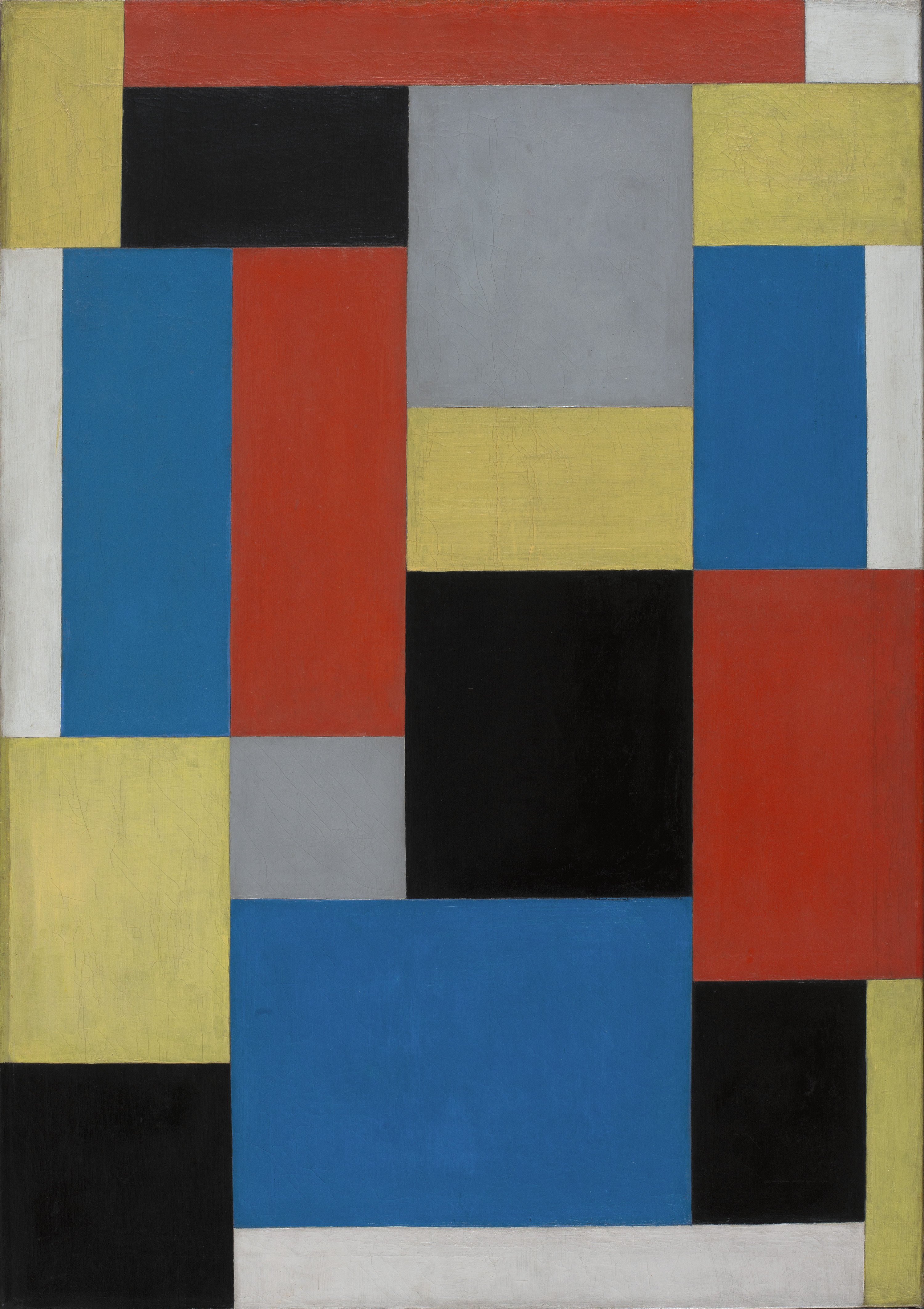
Composition XX
1920
Oil on canvas.
92 x 71 cm
Museo Nacional Thyssen-Bornemisza, Madrid
Inv. no.
528
(1979.4
)
Room 43
Level 1
Permanent Collection
Executed in 1920, Composition XX, which has belonged to the Thyssen-Bornemisza collection since 1979 and is among the works kept by the painter’s widow Nelly van Doesburg after his early death in 1931, follows to the letter the geometric abstraction advocated in De Stijl. During this period Van Doesburg frequently exchanged impressions on the problems of the midpoint of the composition with both Mondrian and his friend Oud, to whom he wrote, “I [...] am still working on a large decomposition [referring to Peinture pure] i.e. a composition in which the midpoint lies outside the painting. I don’t think I will have the painting ready on time.” Despite the difficulty of identifying his works owing to the numerous titles they are given, Christopher Green suggests that the painting in the Museo Thyssen-Bornemisza may be the one shown at The Hague in 1920 with the title Decomposition II. To the artist, the word “decomposition” meant “the moment in which all association with an illusion of reality ends” and these two “decompositions” could therefore be the artist’s first two totally abstract paintings.
According to Joop Joosten, Van Doesburg’s stay at Mondrian’s house in Paris in February 1920 would be decisive in his full-fledged conversion to abstraction. Furthermore, as can be appreciated, the grid structure that Mondrian and Huszár had employed at the end of 1918, before Van Doesburg did so, is not a rigid and even system for him as it was for Mondrian, but is flexible and uneven. Nor is Van Doesburg very orthodox in his choice of palette, as the primary colours are toned down considerably in the present painting.
Paloma Alarcó
According to Joop Joosten, Van Doesburg’s stay at Mondrian’s house in Paris in February 1920 would be decisive in his full-fledged conversion to abstraction. Furthermore, as can be appreciated, the grid structure that Mondrian and Huszár had employed at the end of 1918, before Van Doesburg did so, is not a rigid and even system for him as it was for Mondrian, but is flexible and uneven. Nor is Van Doesburg very orthodox in his choice of palette, as the primary colours are toned down considerably in the present painting.
Paloma Alarcó