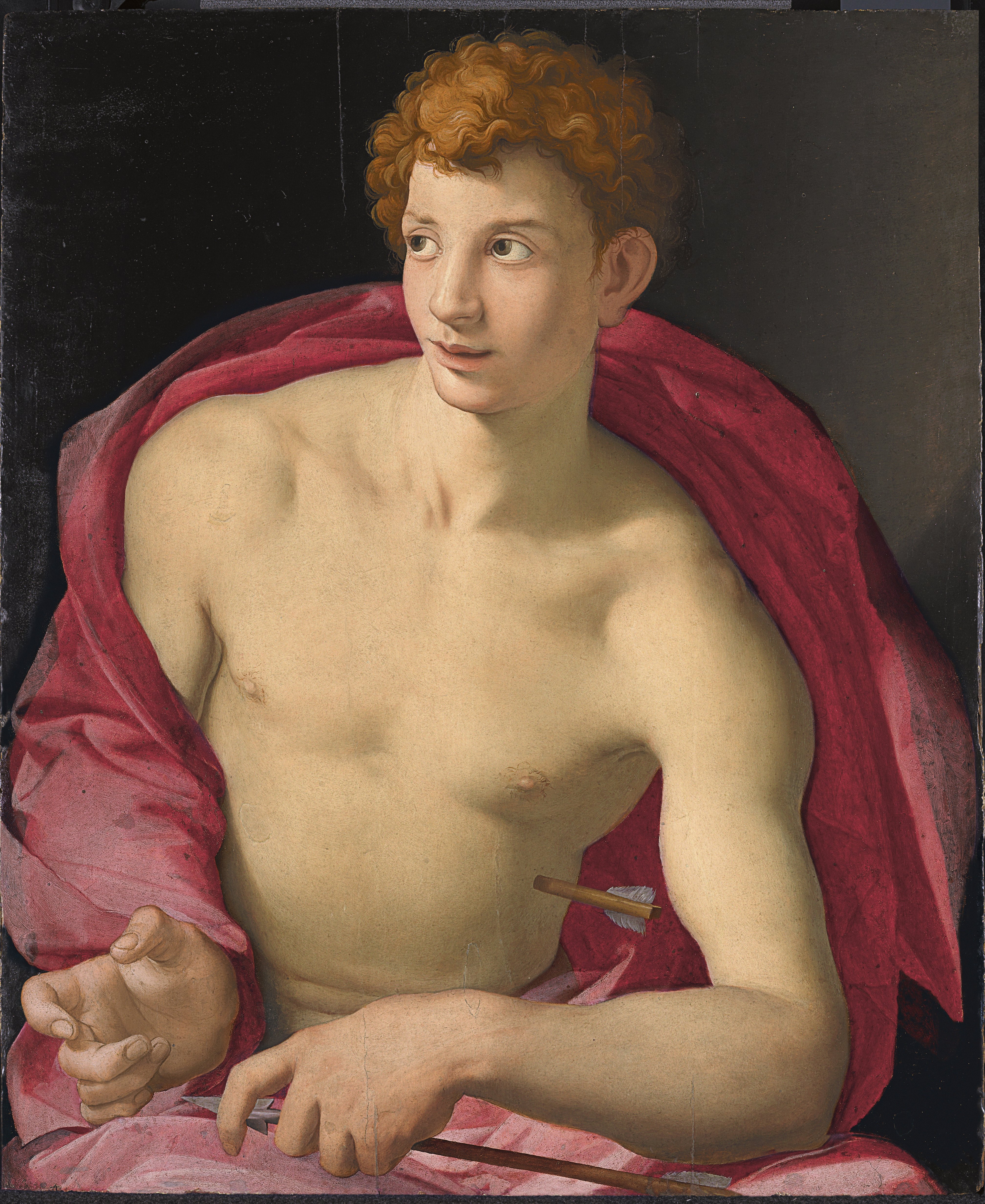
Portrait of a young Man as Saint Sebastian
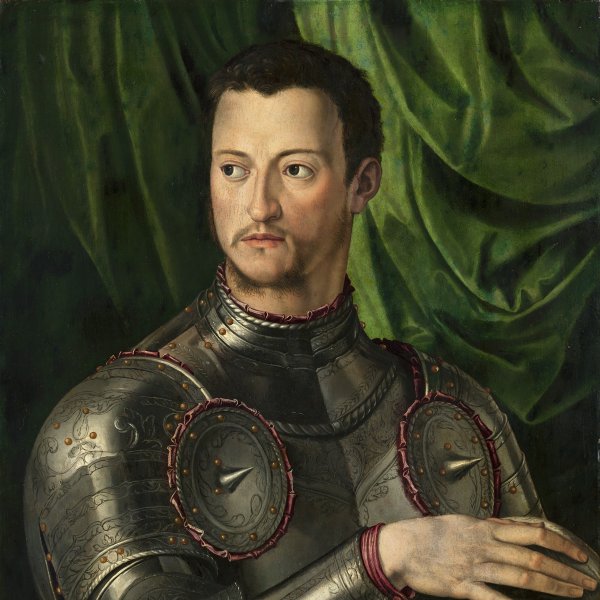
Agnolo di Cosimo di Mariano Tori, known as Bronzino, was one of the leading artists of Florentine Mannerism. Born in Monticelli near Florence, he began his studies with Raffaellino del Garbo. Of crucial importance, however, was the period in Pontormo’s studio where Bronzino continued his training and which would be fundamental for his subsequent development. Bronzino worked with Pontormo on the fresco decoration of the Chapterhouse at Galluzzo, which Vasari stated to be his first project. They later worked together in Florence, where Bronzino assisted his teacher in the Capponi chapel in Santa Felicità between 1526 and 1528. The first works attributed to the artist are closely related to Pontormo’s style and some have been attributed to the latter, indicating the degree to which Bronzino assimilated his master’s approach. This initial group, which features religious and mythological works of high technical merit, includes major compositions such as The Holy Family with Saint Elizabeth and the Infant Saint John the Baptist of around 1525–26 (National Gallery of Art, Washington) and The Pietà with Mary Magdalen (Uffizi, Florence) of 1529. Despite the echoes of Pontormo, these works reflect Bronzino’s own artistic personality, evident in the treatment of the figures, which are more lifelike and emotionally expressive than those of his master. In the 1530s Bronzino is documented in Pesaro where he was in the service of the Duke of Urbino, collaborating with other artists on the Villa Imperiale. There he painted the portrait of Guidobaldo della Rovere, a work now in the Galleria Palatina in the Palazzo Pitti, Florence. Two years later, in 1532, Bronzino was again in Florence and it was at this point that he painted our panel.
The oil entered the Thyssen-Bornemisza collection 1984, having been in a private collection in Rieti according to Federico Zeri. Zeri was the first expert to have shown an interest in this painting and seems to have studied it before it was cleaned. He considered it to be by Jacopino del Conte, an opinion that was not generally accepted. The present panel has been related to an early work by Bronzino on which he collaborated with Pontormo: four tondi depicting the Evangelists painted for the funerary chapel of Ludovico Capponi in Santa Felicità in Florence. Vasari mentions this commission in the Lives, both in his life of Pontormo and of Bronzino. The issue of the attribution of these four compositions, which was clearly uncertain even in Vasari’s day, has been the subject of study by recent authors. The tondo depicting Saint Matthew, attributed to Bronzino, is notably similar in concept to this young man. In these two works the two half-length figures emerge from dark backgrounds, their nude torsos swathed in drapery. Although the figure of Saint Matthew is arranged to form a pronounced diagonal created by the position of his shoulders and the forward slant of his head, the parallels between the two are still clearly evident.
Jean Cox-Rearick related our work to a drawing in the Uffizi, Florence, which is also closely related to the Four Evangelists in the Capponi chapel. The drawing is a study for the figure of Saint Matthew in which the Evangelist has a pose similar to that of the present saint: arranged frontally with the body turned to the right, looking left and supporting the weight of the body on the left elbow, the torso partly covered by a cloak that allows it to be seen.
The present painting has been dated 1533, at a time when Bronzino was defining his own artistic personality following his assimilation of Pontormo’s teachings. The present work has more opaque colours than Pontormo’s, while the solid forms seem to be located in space in an immobile manner, both stylistic features characteristic of Bronzino. Brock suggested that the painting was an allegorical portrait.
Mar Borobia