The Meadows at Éragny, Apple Tree
1894
Oil on canvas.
27.3 x 35.6 cm
Carmen Thyssen Collection
Inv. no. (
CTB.1998.63
)
Room F
Level 0
Carmen Thyssen Collection and Temporary exhibition rooms
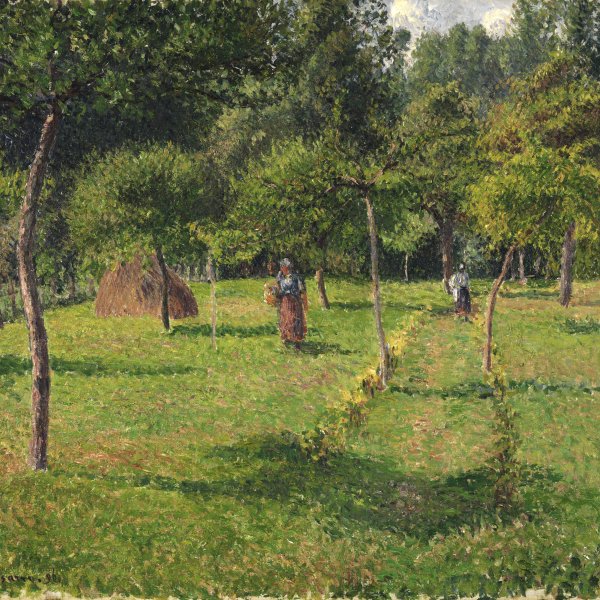
In April 1884, Pissarro moved to the small village of Éragny-sur-Epte, close to Gisors and roughly one-third of the way from Paris to Dieppe. It was to be his last home for almost twenty years. The house was substantial; the grounds fairly extensive, essentially given over to orchard and vegetables rather than cultivated flowers with a few outbuildings, including a barn, and a distant view across the meadows of the winding river Epte to the small village of Bazincourt on the small hills opposite dominated by the church spire. It was an idyllic view of unspoilt countryside.
Already in his first year at Éragny, Pissarro began painting this particular view across the meadows to Bazincourt: three paintings are dated 1884. And the motif continued to appear in his work of the 1880s. But it really began to preoccupy him in the 1890s. Year by year, almost season by season, he painted this all-too-familiar view across the meadows to Bazincourt. Winter scenes-including scenes of inondation, especially in 1892-contrasted with evocations of spring and autumn, and less frequently of summer.
Pissarro's working methods varied too. Sometimes he viewed the motif high up from his studio window and painted it on medium-sized and large canvases. Sometimes he painted it outdoors at ground level, tending often to select small wooden panels rather than canvases. The Thyssen painting, however is executed on a small canvas, and it must have been painted out-of-doors, quickly and directly. The brushstrokes have an immediacy and an irregularity in their placement, not only in the dramatically presented sky but also in the marks that define the trees following the meanderings of the small river Epte through the meadows. And the composition is given a startling introduction: the foreground apple tree, placed asymmetrically, angular in its forms, acts rather like a Degas dancer performing, with the corps-de-ballet backstage represented by the curving banks of the river.
The first recorded owner of the painting was Émile Strauss, the lawyer-husband of Mme Geneviève Strauss, whose first husband was the composer Georges Bizet. She ran a cultured Salon in Paris; and among her visitors and admirers were Degas, Guy de Maupassant and Marcel Proust.
Ronald Pickvance
Already in his first year at Éragny, Pissarro began painting this particular view across the meadows to Bazincourt: three paintings are dated 1884. And the motif continued to appear in his work of the 1880s. But it really began to preoccupy him in the 1890s. Year by year, almost season by season, he painted this all-too-familiar view across the meadows to Bazincourt. Winter scenes-including scenes of inondation, especially in 1892-contrasted with evocations of spring and autumn, and less frequently of summer.
Pissarro's working methods varied too. Sometimes he viewed the motif high up from his studio window and painted it on medium-sized and large canvases. Sometimes he painted it outdoors at ground level, tending often to select small wooden panels rather than canvases. The Thyssen painting, however is executed on a small canvas, and it must have been painted out-of-doors, quickly and directly. The brushstrokes have an immediacy and an irregularity in their placement, not only in the dramatically presented sky but also in the marks that define the trees following the meanderings of the small river Epte through the meadows. And the composition is given a startling introduction: the foreground apple tree, placed asymmetrically, angular in its forms, acts rather like a Degas dancer performing, with the corps-de-ballet backstage represented by the curving banks of the river.
The first recorded owner of the painting was Émile Strauss, the lawyer-husband of Mme Geneviève Strauss, whose first husband was the composer Georges Bizet. She ran a cultured Salon in Paris; and among her visitors and admirers were Degas, Guy de Maupassant and Marcel Proust.
Ronald Pickvance