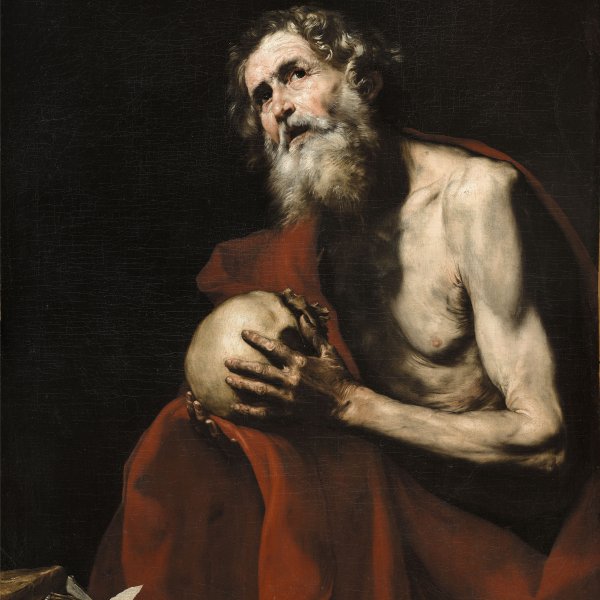
The present canvas was unpublished until 1918 when Hugo Kehrer included it in his monograph on Zurbarán. At that date the painting belonged to a Dr Rohe in Munich where it remained until at least 1953, the date of Martín S. Soria’s book on the artist. It was acquired by Baron Hans Heinrich Thyssen-Bornemisza in April 1956 from Knoedler in New York.
The painting has been dated to an early phase of the artist’s career, during which he depicted this subject on a number of occasions. The earliest known example is the canvas now in the Art Institute of Chicago of 1627, painted for the Dominican monastery of San Pablo, Seville. Considered one of his masterpieces, in that painting Zurbarán’s Christ is suspended from a rough wooden cross to which he is nailed with four nails. The starkly dramatic image is created from a chiaroscuro that defines and sculpts the Saviour’s body. The artist approached the theme in a variety of different manners, depicting him alive, as in the present example; serenely dead, as in the work of 1627 mentioned above; with saints, as in Saint Luke beneath the Cross in the Museo del Prado; and with donors. Zurbarán painted this subject on numerous occasions during the course of his career.
According to María Luisa Caturla, the present example derives from the one in the parish church at Motrico, of which around a dozen versions are known. If we compare that painting with the present one it is clear that they are extremely similar, differing only in small details. Both have dark backgrounds against which the figure of Christ stands out, his body arranged frontally and strongly lit. The head is inclined to one side with the eyes raised in supplication and the mouth half-open, adding to the sense of pleading and pathos. Other than stylistic ones, the only notable differences between the two canvases are the loincloths, which have similar folds but in the present case has a longer fall of drapery on the left, and the fingers, which are more bent and closed inwards in the Motrico version.
Almost all of Zurbarán’s crucified Christs have their feet on a small wooden plinth and are held up by four nails, an iconography that was widely used in Sevillian painting and sculpture, partly through its promotion by Francisco Pacheco, Velázquez’s father-in-law. A letter of 1619 by the Sevillian poet and chronicler Francisco de Rioja congratulates Pacheco for reviving the instructions of “the old writers”.
The present canvas was executed after the project for Llerena in Extremadura and close to the time of the series for the Sevillian religious houses of San Pablo el Real and the Merced Calzada. The success of the two latter commissions would fully establish Zurbarán in Seville.
Mar Borobia
The painting has been dated to an early phase of the artist’s career, during which he depicted this subject on a number of occasions. The earliest known example is the canvas now in the Art Institute of Chicago of 1627, painted for the Dominican monastery of San Pablo, Seville. Considered one of his masterpieces, in that painting Zurbarán’s Christ is suspended from a rough wooden cross to which he is nailed with four nails. The starkly dramatic image is created from a chiaroscuro that defines and sculpts the Saviour’s body. The artist approached the theme in a variety of different manners, depicting him alive, as in the present example; serenely dead, as in the work of 1627 mentioned above; with saints, as in Saint Luke beneath the Cross in the Museo del Prado; and with donors. Zurbarán painted this subject on numerous occasions during the course of his career.
According to María Luisa Caturla, the present example derives from the one in the parish church at Motrico, of which around a dozen versions are known. If we compare that painting with the present one it is clear that they are extremely similar, differing only in small details. Both have dark backgrounds against which the figure of Christ stands out, his body arranged frontally and strongly lit. The head is inclined to one side with the eyes raised in supplication and the mouth half-open, adding to the sense of pleading and pathos. Other than stylistic ones, the only notable differences between the two canvases are the loincloths, which have similar folds but in the present case has a longer fall of drapery on the left, and the fingers, which are more bent and closed inwards in the Motrico version.
Almost all of Zurbarán’s crucified Christs have their feet on a small wooden plinth and are held up by four nails, an iconography that was widely used in Sevillian painting and sculpture, partly through its promotion by Francisco Pacheco, Velázquez’s father-in-law. A letter of 1619 by the Sevillian poet and chronicler Francisco de Rioja congratulates Pacheco for reviving the instructions of “the old writers”.
The present canvas was executed after the project for Llerena in Extremadura and close to the time of the series for the Sevillian religious houses of San Pablo el Real and the Merced Calzada. The success of the two latter commissions would fully establish Zurbarán in Seville.
Mar Borobia