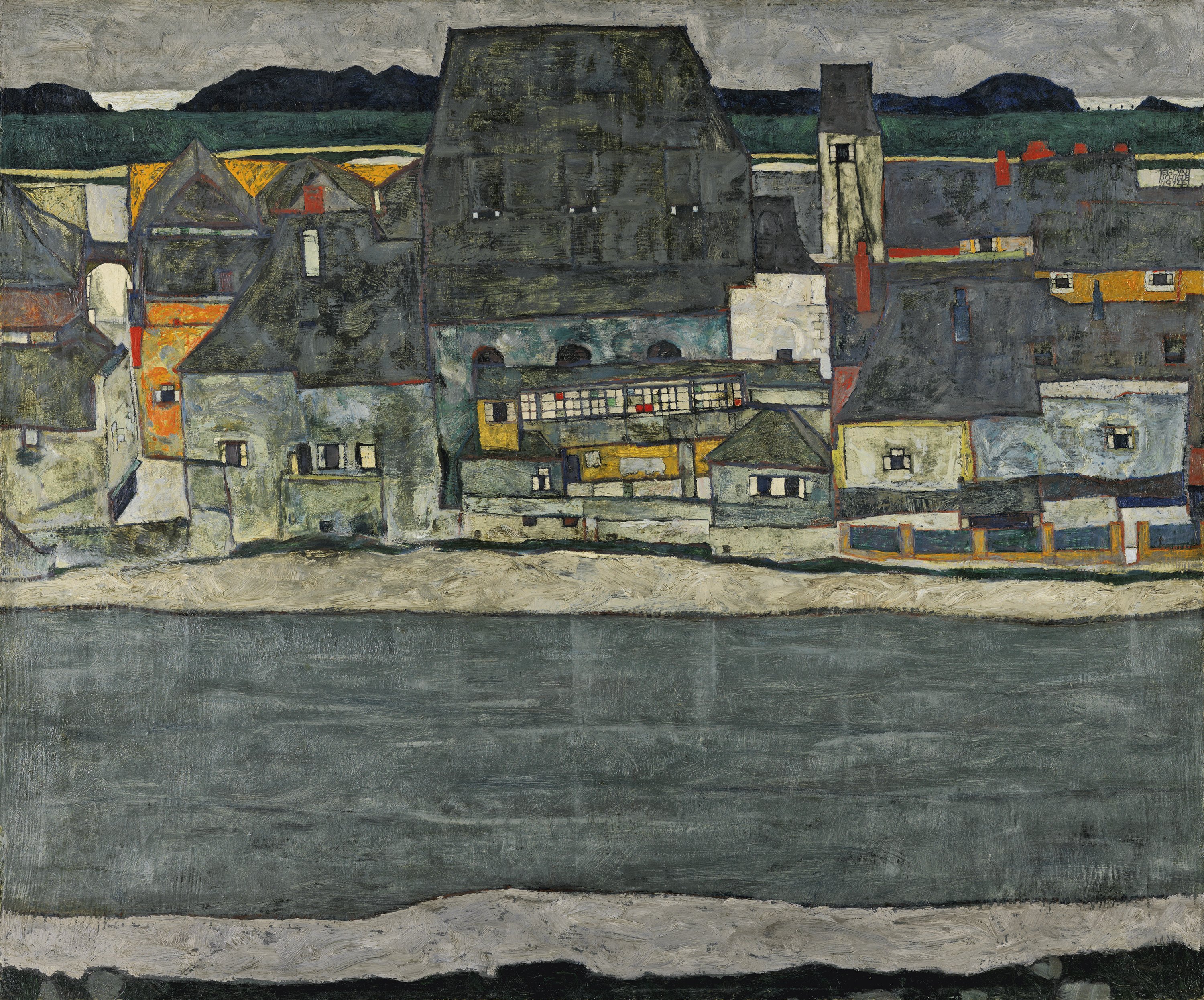
Houses on the River (The Old Town)
1914
Oil on canvas.
100 x 120.5 cm
Museo Nacional Thyssen-Bornemisza, Madrid
Inv. no.
739
(1978.81
)
Room 34
Level 1
Permanent Collection
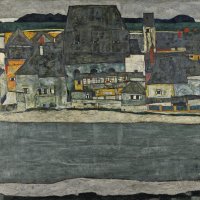
Houses on the River belongs to an extensive group of urban landscapes that Egon Schiele painted during the course of his career. For a long time it was wrongly identified as an urban view of Wachau, a town in lower Austria where Schiele painted on several occasions, until it was subsequently demonstrated that the scene in fact represented Krumau, a small Bohemian village on the banks of the river Moldava (now Cesky´ Krumlov, Czech Republic). After Schiele visited it with his friends Anton Peschka and Ervin Osense in summer 1910, he decided that this village, where his mother was born, was a perfect refuge from hectic Vienna. He settled there permanently in 1911 with his model Wally Neuzil, and its narrow streets, the geometry of its buildings and its medieval constructions soon became one of his favourite motifs. However, this idyllic relationship was short lived. His bohemian and libertine lifestyle brought him serious problems in the provincial and conservative Krumau and he ended up being evicted from his lodgings. The accusations against him continued even after he moved to Neulengback, on the outskirts of Vienna, and he was imprisoned for twenty-four days in 1912 on charges of public immorality.
Like most of the Schiele’s urban landscapes, the composition lacks perspective and is designed as a flat frieze that has sometimes been related to the stained glass windows and Gothic miniatures that fascinated him and his contemporaries, the German Expressionists. A comparison of the image portrayed in the painting with the currently standing constructions shows that the painter is not concerned with faithfully reproducing the sequence of the row of buildings lining the river and takes certain liberties — such as altering the proportions of the roofs and inserting a tower that does not exist. The image of a deserted, spooky town with no trace of human life furthermore gives the composition a melancholic air infused with a certain anxiety — the anxiety that Schiele captured so successfully in his portraits. Indeed, Kimberly A. Smith considered these landscapes to be metaphors of the human condition or “melancholic elegies exhibiting a readily perceptible fascination with death.”
The first owner of the work was the Viennese collector Franz Hauer, whom Schiele, like Kokoschka, portrayed in 1914, the year this painting is dated. It was given by Mr and Mrs Mortimer M. Denker to The Solomon R. Guggenheim Museum in New York in 1965 and entered the Thyssen-Bornemisza Collection in 1978.
Paloma Alarcó
Like most of the Schiele’s urban landscapes, the composition lacks perspective and is designed as a flat frieze that has sometimes been related to the stained glass windows and Gothic miniatures that fascinated him and his contemporaries, the German Expressionists. A comparison of the image portrayed in the painting with the currently standing constructions shows that the painter is not concerned with faithfully reproducing the sequence of the row of buildings lining the river and takes certain liberties — such as altering the proportions of the roofs and inserting a tower that does not exist. The image of a deserted, spooky town with no trace of human life furthermore gives the composition a melancholic air infused with a certain anxiety — the anxiety that Schiele captured so successfully in his portraits. Indeed, Kimberly A. Smith considered these landscapes to be metaphors of the human condition or “melancholic elegies exhibiting a readily perceptible fascination with death.”
The first owner of the work was the Viennese collector Franz Hauer, whom Schiele, like Kokoschka, portrayed in 1914, the year this painting is dated. It was given by Mr and Mrs Mortimer M. Denker to The Solomon R. Guggenheim Museum in New York in 1965 and entered the Thyssen-Bornemisza Collection in 1978.
Paloma Alarcó