The Loam Pit
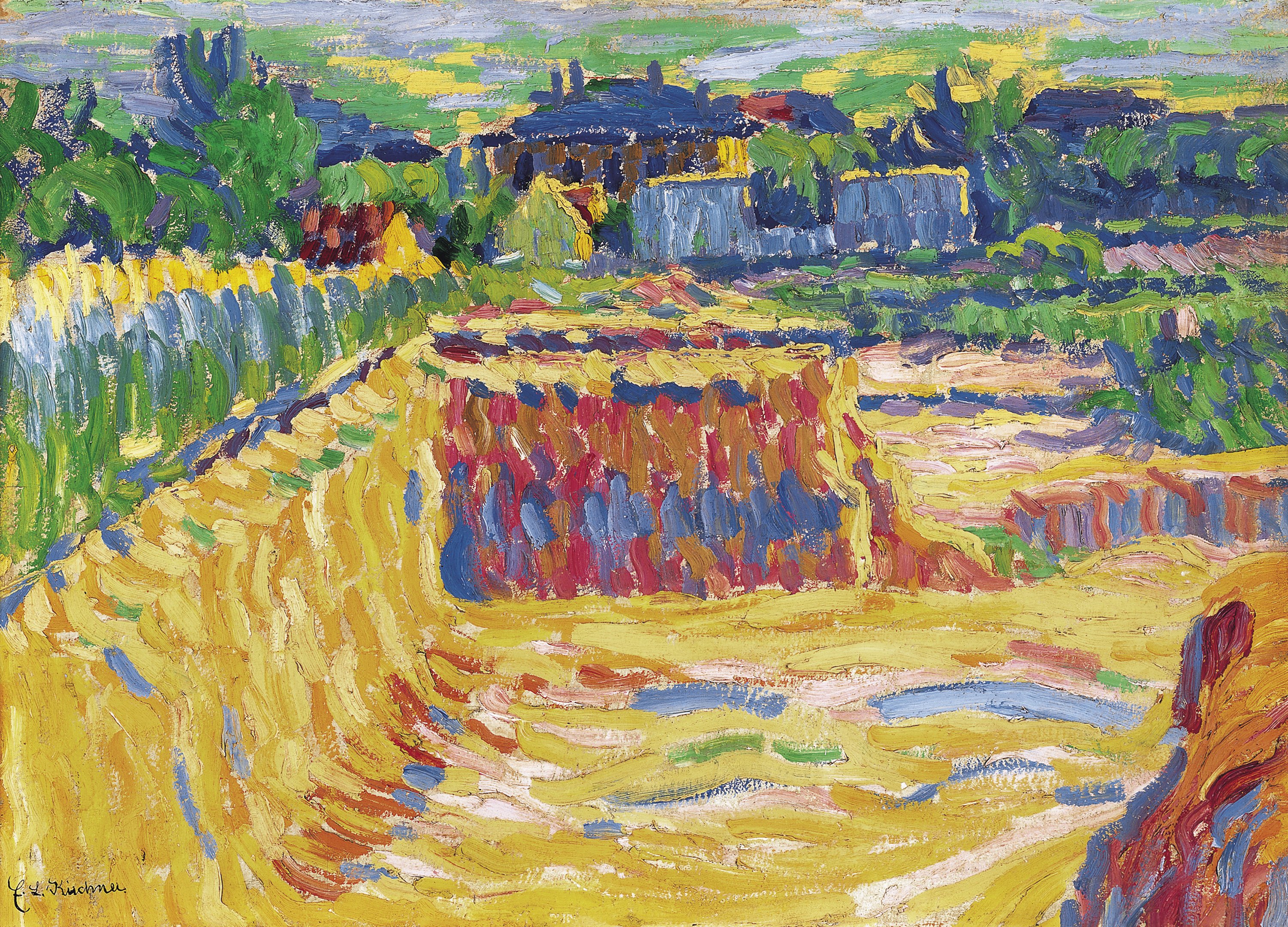
This painting has always been known in German as Die Lehmgrube and is thus entitled in Donald Gordon's oeuvre-catalogue of Kirchner's paintings, but the title is not the artist's own. Like many of Kirchner's early works, it remains otherwise undocumented and, although it probably depicts a scene in the immediate vicinity of Dresden, it has not proved possible to identify the exact location. It is likely that the picture belongs to a group of plein-air paintings done in and around the Saxon capital during spring-summer 1906. However, the dating of Kirchner's earliest Dresden paintings is fraught with difficulties and, in the absence of any significant number of documented works, suggested dates of 1906 and 1907 must be regarded as at best tentative, being based principally on stylistic criteria.
Gordon, in attempting to construct a convincing chronology of the artist's early paintings, has discussed at length the question of the formative influences to which Kirchner responded. Of these, perhaps the most significant was the art of Van Gogh, shown in Germany on a number of occasions during the early years of the century, notably at the Galerie Arnold in Dresden in 1905. Kirchner, like the other artists of the Brücke group, could scarcely have been immune to the effect of such events taking place on his own doorstep. He was also, almost certainly, familiar with the Dutch artist's work in illustration. His personal library, sent for auction in 1951, was found to contain two copies of Julius Meier-Graefe's influential and richly illustrated three-volume Entwicklungsgeschichte der modernen Kunst, containing reproductions of paintings by Van Gogh and other "modern" artists The impact of these works on the development of Kirchner's style is seen clearly in The Loam Pit, with its strident colour contrasts, loose brushwork and heavy impasto.
Another founder member of the Brücke, the architect Fritz Bleyl, later confirmed that the young Dresden artists also regularly devoured the latest illustrated magazines in their search for new sources of inspiration. Among the most important of these was the German periodical Kunst und Künstler, the first issue of which appeared in 1903 and which contained numerous illustrations of works by neo- and post-Impressionist artists, including Cézanne, van Gogh, Pissarro and Signac. By 1908, however, the influence of French neo- and post-Impressionism on Kirchner had begun significantly to diminish, to be replaced by a flatter, more abbreviated style which owes much to the impact of Munch's art. Kirchner probably became acquainted with the Norwegian artist's work through the Munch exhibition shown in Dresden in February 1906 but was, as Gordon notes, at that date "not yet able to enlarge upon the more expressive aspects of post-Impressionist art." His interest in Munch must have been rekindled by the exhibition he saw at the Berlin Secession in autumn 1908, which included several recent paintings.
Peter Vergo