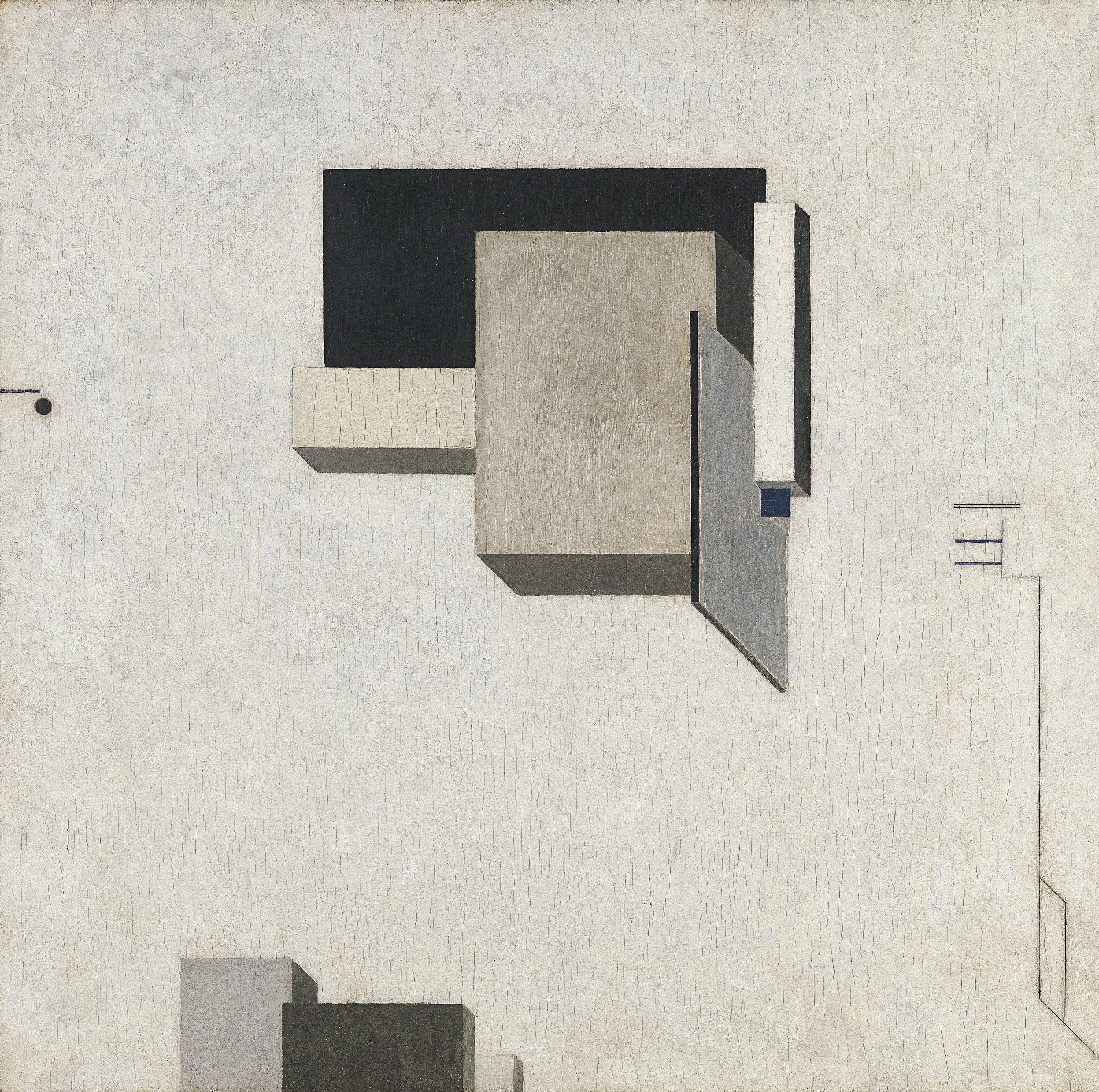
Proun 1 C
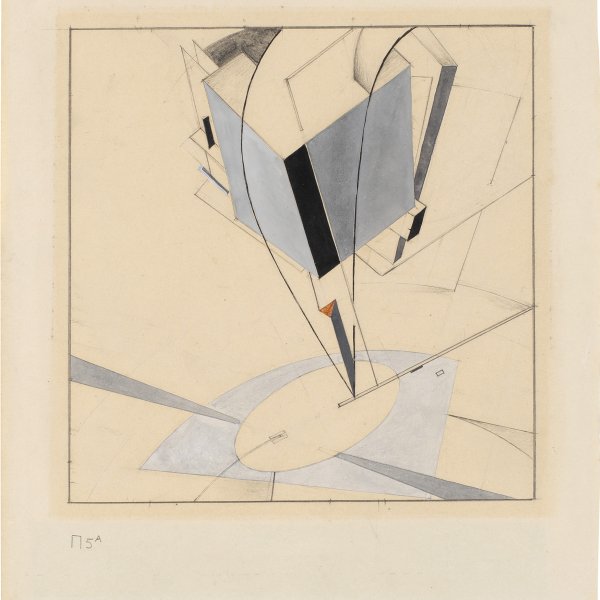
El Lissitzky was among the artists who were most firmly committed to the Great Experiment and one of the most multifaceted and cosmopolitan of revolutionary Russia. He was steered towards abstract art by the influence of Malevich’s Suprematist ideas, which he soon abandoned as he found them excessively mystic. Towards 1919 his wish to integrate painting and architecture led him to create his first Proun pictures, works with a markedly geometric character which constitute his chief contribution to the art world. The word Proun, which has no apparent meaning, is an acronym of the Russian words “PROyect Utverzhdenia Novogo” (Project for the Affirmation of the New), which he defined as “a stage on the path towards the construction of a new configuration (Gestaltung) which emerges from a ground fertilised by the corpses of pictures and their artists.” They are geometrical compositions with powerful spatial and architectural effects in which all the traditional laws of perspective have been abolished. The shapes are drawn with a ruler and compasses, resulting in a very sober geometrical drawing, but each element of the composition is rendered from a different angle of vision, creating a highly dynamic spatial play dominated by asymmetry. The notions of balance and gravity are replaced by a new weightlessness without scale. As the artist himself explained in one of his theoretical texts, “Proun is no longer a picture and becomes a building that must be viewed (by moving around its outside) from all angles.”
The Thyssen-Bornemisza Proun 1 C was one of the first compositions in the series. In their commentary on the painting, John Bowlt and Nicoletta Misler include a photograph of El Lissitzky in his Vitebsk studio in 1919, in which the work can be seen hanging beside other Proun pictures, showing that it was painted in the small Jewish town where he worked from 1919 to 1921 at the People’s Art School, in close collaboration with Malevich. The numbers assigned to the various Proun pictures relate to series established by the artist in his inventories, and the letters to possible owners. The word “unovis” written on the reverse of the painting refers to the group formed by Malevich.
El Lissitzky was also active in the field of architecture and graphic design, and untiringly strove to integrate art into social life. His belligerently iconoclastic streak made him one of the pioneers of the quest for a new language to serve the needs of the new era — a collective, neutral language that would break with earlier art and could be understood by people from all social strata. This desire to wipe the slate clean through a new art was shared by all the Russian avant-gardes of the time and also fuelled the spirit of the revolutionary poets such as Mayakovsky.
Paloma Alarcó