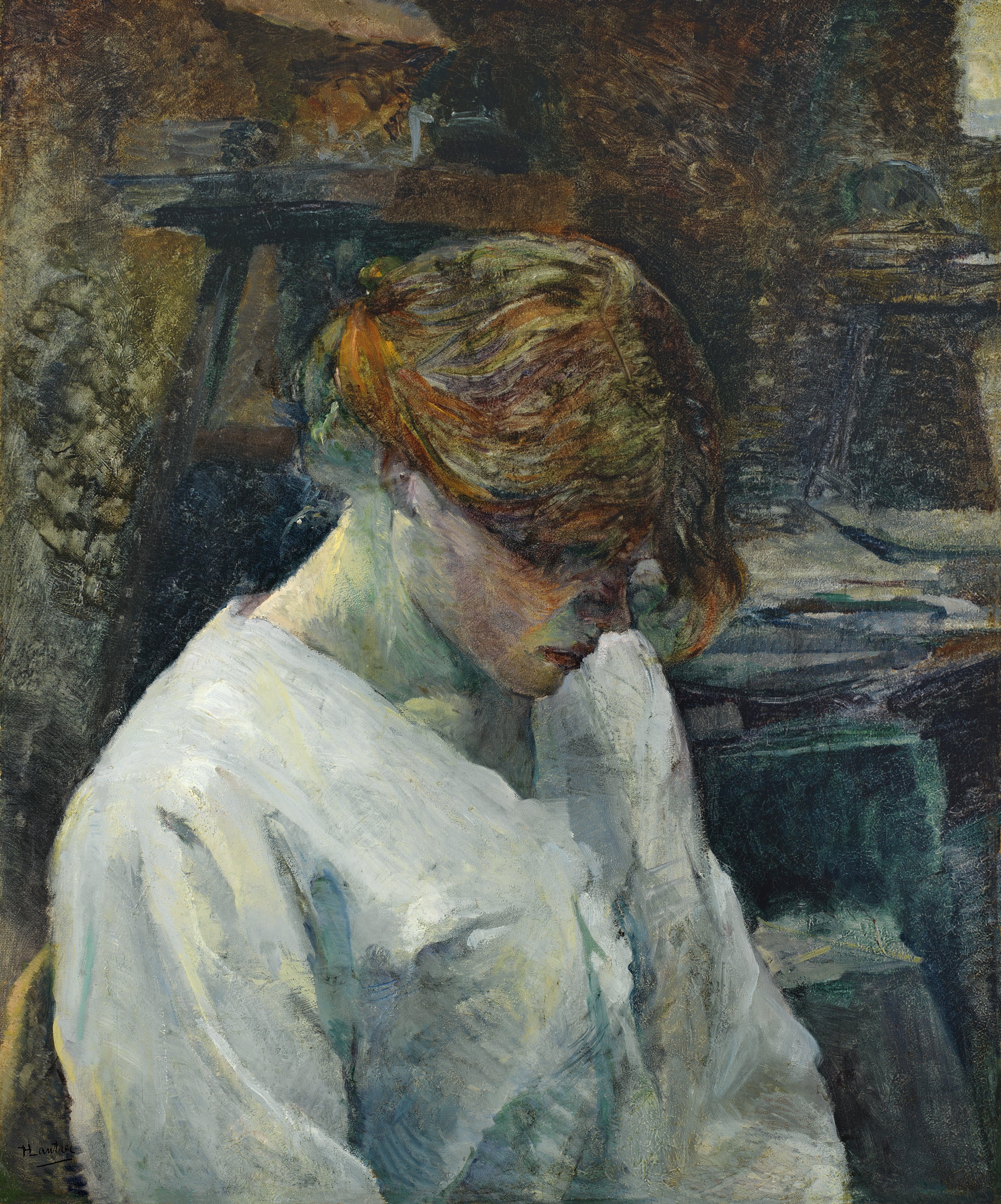
La Rousse in a White Blouse
1889
Oil on canvas.
60.5 x 50.3 cm
Museo Nacional Thyssen-Bornemisza, Madrid
Inv. no.
774
(1978.50
)
Room 33
Level 1
Permanent Collection
Henri de Toulouse-Lautrec was undoubtedly the painter who best captured life in late-nineteenth century Paris. His works provide an unequalled repertory of images of the marginal, bohemian atmosphere of Montmartre, where he sought refuge after voluntarily shunning the high-society world to which he belonged. However, his painting should not be viewed merely as a chronicle of the anecdotal but as a quest for timeless values, for as Baudelaire had written, the painter of modern life should capture “the fugitive, the contingent, the half of art whose other half is the eternal and the immutable.”
In La Rousse in a White Blouse in the Museo Thyssen-Bornemisza collection, Lautrec depicts Carmen Gaudin, a girl of working-class origin whom he had discovered in the avenue Clichy in 1884 and with whom he had felt immediately fascinated. With her red hair and white skin, which enhanced her helpless and melancholic appearance, she was exactly the type of young woman he was keen to portray, and she therefore became the subject of several painting executed during those years. These include Carmen Gaudin, Carmen the Redhead, Carmen the Redhead with Lowered Head, The Washerwoman, and Carmen, in which the painter immortalised her likeness in a host of poses and costumes in his characteristic repetitive and insistent manner.
Lautrec, who generally shunned the plein air painting of the Impressionists, executed these works in the studio he shared with Henri Rachou on the rue Ganneron. In the painting in the Thyssen-Bornemisza collection the studio background is sketched in order to make it go unnoticed and focus all attention on the sitter. Despite the simple pose in which the sitter is rendered, the melancholic atmosphere conveyed by the composition makes it a masterpiece. The technique of slight touches and very spontaneous brushwork is inherited from Impressionism.With this intentionally crude and unfinished execution the artist succeeds in imbuing with poetry an image that is otherwise very real thanks to his acute powers of observation that are evidenced particularly by the hair, which he paints with extreme care — both the wisps of hair that tumble over the girl’s eyes and those that have fallen out of the untidy chignon gathered at the nape of her neck.
As in other paintings featuring the same sitter, Lautrec achieves a new, modern approach to the art of portraiture that goes beyond a mere naturalistic depiction of the subject. By showing her in halfprofile with her head tilted and her hair hanging over her forehead partially concealing her face, he omits any reference to her identity and makes her an eternal and imperishable embodiment of the human being.
Paloma Alarcó
In La Rousse in a White Blouse in the Museo Thyssen-Bornemisza collection, Lautrec depicts Carmen Gaudin, a girl of working-class origin whom he had discovered in the avenue Clichy in 1884 and with whom he had felt immediately fascinated. With her red hair and white skin, which enhanced her helpless and melancholic appearance, she was exactly the type of young woman he was keen to portray, and she therefore became the subject of several painting executed during those years. These include Carmen Gaudin, Carmen the Redhead, Carmen the Redhead with Lowered Head, The Washerwoman, and Carmen, in which the painter immortalised her likeness in a host of poses and costumes in his characteristic repetitive and insistent manner.
Lautrec, who generally shunned the plein air painting of the Impressionists, executed these works in the studio he shared with Henri Rachou on the rue Ganneron. In the painting in the Thyssen-Bornemisza collection the studio background is sketched in order to make it go unnoticed and focus all attention on the sitter. Despite the simple pose in which the sitter is rendered, the melancholic atmosphere conveyed by the composition makes it a masterpiece. The technique of slight touches and very spontaneous brushwork is inherited from Impressionism.With this intentionally crude and unfinished execution the artist succeeds in imbuing with poetry an image that is otherwise very real thanks to his acute powers of observation that are evidenced particularly by the hair, which he paints with extreme care — both the wisps of hair that tumble over the girl’s eyes and those that have fallen out of the untidy chignon gathered at the nape of her neck.
As in other paintings featuring the same sitter, Lautrec achieves a new, modern approach to the art of portraiture that goes beyond a mere naturalistic depiction of the subject. By showing her in halfprofile with her head tilted and her hair hanging over her forehead partially concealing her face, he omits any reference to her identity and makes her an eternal and imperishable embodiment of the human being.
Paloma Alarcó