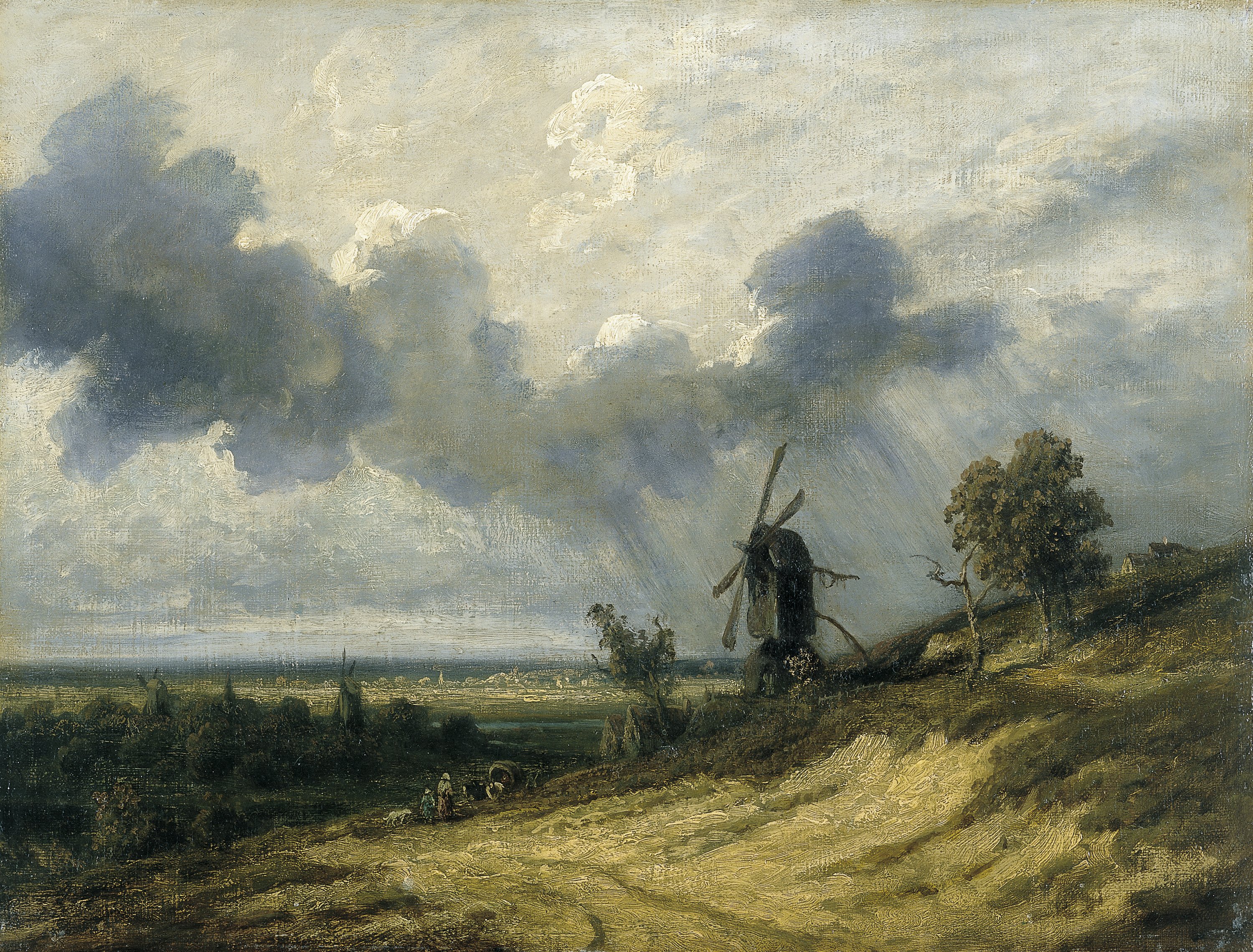
Landscape with Mill
s.f
Oil on canvas.
40 x 52 cm
Carmen Thyssen Collection
Inv. no. (
CTB.1999.105
)
Room C
Level 0
Carmen Thyssen Collection and Temporary exhibition rooms
«Michel, like a good tree, will always yield the same fruit, but will never vary the species in the slightest; he will only modulate its flavour; his effects will only produce two or three combinations, that is all. A foreground in the shade, a lit horizon and a cloudy or clear sky, or else dramatic, or opposing effects; these three problems will be enough for his programme, and his life will not be long enough for him to realise it according to his wishes», wrote Alfred Sensier in his biography of Georges Michel.
The painting Landscape with Mill is therefore part of this "flavour" which Georges Michel, a precursor of landscape painting, depicted so well. Thus, he moved away from his initial period, keeping the subjects and compositions of the Dutch artists, but differentiating himself from them through a personality that would turn him into a great landscape painter before his time. He generally painted from nature, and introduced a number of effects which distanced him from Ruysdael and Hobbema, whom he drew inspiration on and even acknowledged as his masters. His brushstroke became wider, his skies more turbulent, his horizons brighter. Again, as Sensier wrote, Georges Michel is "on the battlefield with nature". A nature around which he rambled, his easel on his shoulder, until his death in 1843.
Georges Michel was a landscape visionary, anticipating his own time and even the great English landscape painters as well as the French artists who were to make the name of the Barbizon School. Neither Bruandet, nor Swebach, with whom he has often been compared, expressed nature like him, in such a contrasting, bright, opulent and earthly manner. It almost seems as if Michel had mixed the earth of the roads and ravines he painted; as if he had received the rainwater from the clouds that fight ardently in his sumptuous skies. But in spite of his vigour and originality, Michel's technique exposed the artist to the disdain of his contemporaries. Why exactly? Sensier provides an answer: "It was because Michel conceded nothing to the public; it was because he exercised his inborn faculties with the honesty and the brutality of his good instincts.".
From 1820 to his death in 1843, Georges Michel retired from the world of business and art-lovers. He remained almost forgotten while the English artists first and then the French painters made landscapes blossom under new forms.
Taking a stand with regard to himself and to the world of art, Michel had decided never to sign his works: it was a way of asserting himself while at the same time almost dissociating his art from the name of its creator. A decision which must have been heavy with meaning, insofar as, later, he was often imitated and even copied; this must have enabled many forgers to pass for this great artist, who still has to be discovered and revealed to the public.
Michel Schulman
The painting Landscape with Mill is therefore part of this "flavour" which Georges Michel, a precursor of landscape painting, depicted so well. Thus, he moved away from his initial period, keeping the subjects and compositions of the Dutch artists, but differentiating himself from them through a personality that would turn him into a great landscape painter before his time. He generally painted from nature, and introduced a number of effects which distanced him from Ruysdael and Hobbema, whom he drew inspiration on and even acknowledged as his masters. His brushstroke became wider, his skies more turbulent, his horizons brighter. Again, as Sensier wrote, Georges Michel is "on the battlefield with nature". A nature around which he rambled, his easel on his shoulder, until his death in 1843.
Georges Michel was a landscape visionary, anticipating his own time and even the great English landscape painters as well as the French artists who were to make the name of the Barbizon School. Neither Bruandet, nor Swebach, with whom he has often been compared, expressed nature like him, in such a contrasting, bright, opulent and earthly manner. It almost seems as if Michel had mixed the earth of the roads and ravines he painted; as if he had received the rainwater from the clouds that fight ardently in his sumptuous skies. But in spite of his vigour and originality, Michel's technique exposed the artist to the disdain of his contemporaries. Why exactly? Sensier provides an answer: "It was because Michel conceded nothing to the public; it was because he exercised his inborn faculties with the honesty and the brutality of his good instincts.".
From 1820 to his death in 1843, Georges Michel retired from the world of business and art-lovers. He remained almost forgotten while the English artists first and then the French painters made landscapes blossom under new forms.
Taking a stand with regard to himself and to the world of art, Michel had decided never to sign his works: it was a way of asserting himself while at the same time almost dissociating his art from the name of its creator. A decision which must have been heavy with meaning, insofar as, later, he was often imitated and even copied; this must have enabled many forgers to pass for this great artist, who still has to be discovered and revealed to the public.
Michel Schulman