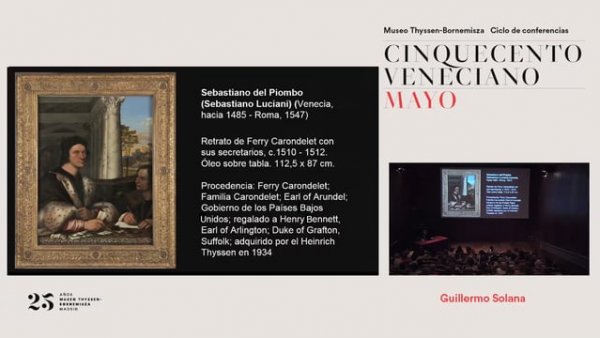
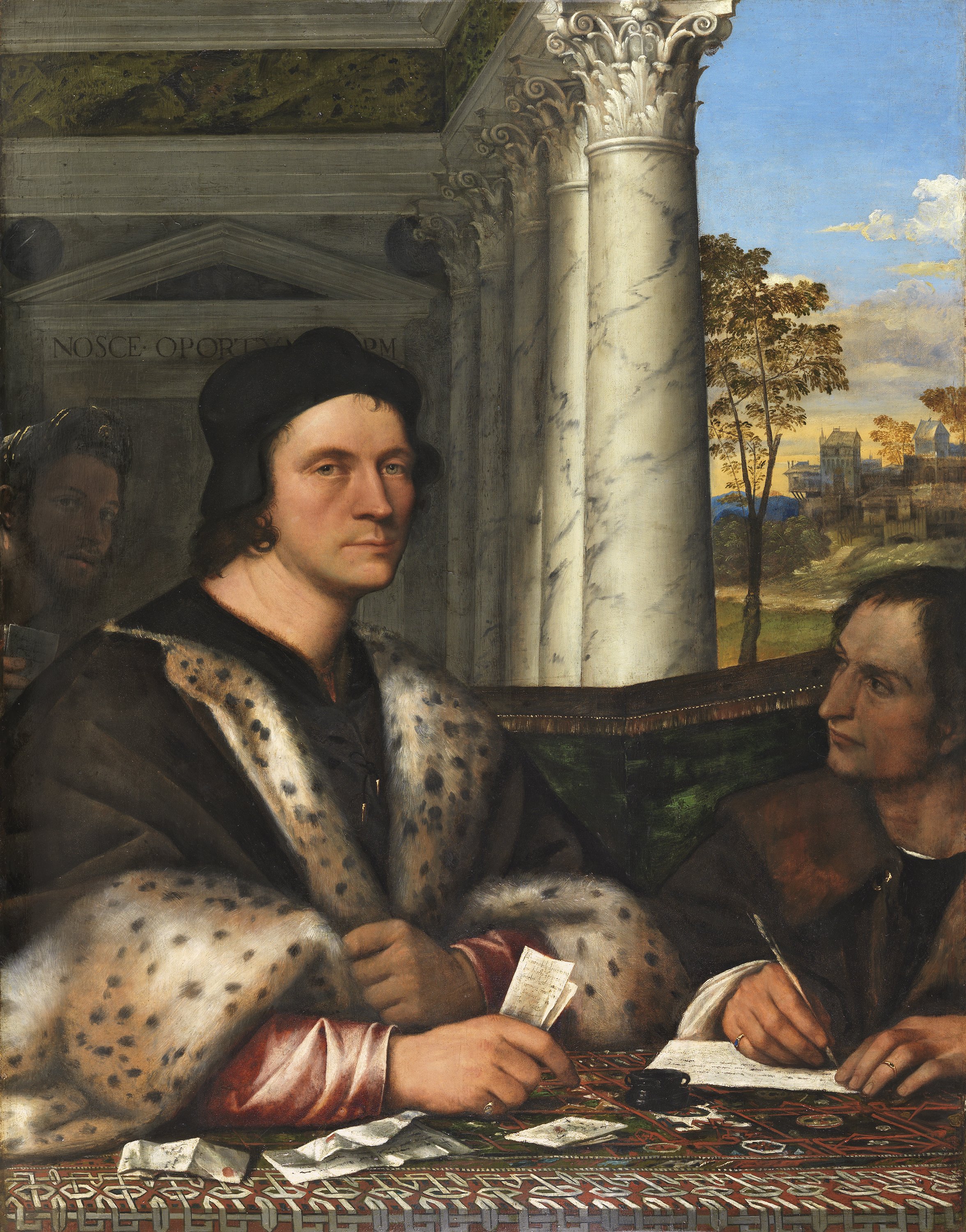
Portrait of Ferry Carondelet with his Secretaries
Sebastiano del Piombo was one of the great painters of the Renaissance. Highly esteemed in his own day, his figure was later overshadowed by the great personalities with whom he competed: Titian in Venice and Raphael and Michelangelo in Rome. Vasari devoted a chapter to him in his Lives (“Sebastiano Veneziano, pintor”) filled with information on his interests and commissions as well as lengthy comments that help us to understand this artist’s character. Among the information supplied by Vasari is the fact that Sebastiano was restless and enquiring by nature, leading him to experiment with unusual supports for his oil paintings and to work with new techniques. Vasari also refers to Sebastiano’s enormous application in the commissions that he received as he lacked the natural facility of other artists such as Raphael. Despite this, he was enormously gifted as a portraitist. Vasari praised his portraits as “exceptionally alive” on numerous occasions and considered this skill to be one of Sebastiano’s greatest gifts. Referring to his portrait of Anton Francesco degli Albizzi, he praised its “delicacy and beauty”, stating that these qualities made Sebastiano “superior to all the others” in portraiture.
This superb panel, which depicts Ambassador Carondelet and two secretaries, perfectly demonstrates the skills that Vasari praised in the artist. Attributed for many years to Raphael, it was correctly attributed in 1894 by Costanza Jocelyn Ffoulkes. Acquired for the Thyssen-Bornemisza collection in 1934, it had previously been in a number of collections including that of the Carondelet family, the Duke of Grafton and the Earl of Arundel, who was its last owner before it entered the present collection in the Villa Favorita. With regard to the design of the composition, Manuela Mena has drawn attention to the fact that Carondelet was from the north of Europe, a fact that might have influenced Sebastiano. By showing him busily engaged in his work at his desk, for example, the artist did not fully conform to Italian models for depicting such an illustrious sitter. In addition, Sebastiano used some clearly Venetian elements such as the half-length format for these figures, which are set in a portico that opens onto a luminous landscape on the right. Along with these Venetian elements are other clearly Roman ones, such as the monumental approach to the figure and its setting.
The inscription on the letter held by Carondelet enabled him to be identified. Ferry Carondelet was born in Malines in 1473, studied in Dole and embarked on a brilliant diplomatic and ecclesiastical career. In 1504 he was appointed Archdeacon of Besançon; in 1508 he became ecclesiastical adviser to Margaret of Austria; and in 1510 was Maximilian I’s papal envoy to Julius II. In 1511 Carondelet is recorded in Rome, where he remained until 1513, the date of his return to Flanders. This magnificent portrait dates from his time in Rome, which was also marked by the creation of another portrait by Fra Bartolommeo and Mariotto Albertinelli, now in Besançon, in which Carondelet is depicted as the donor.
Mar Borobia