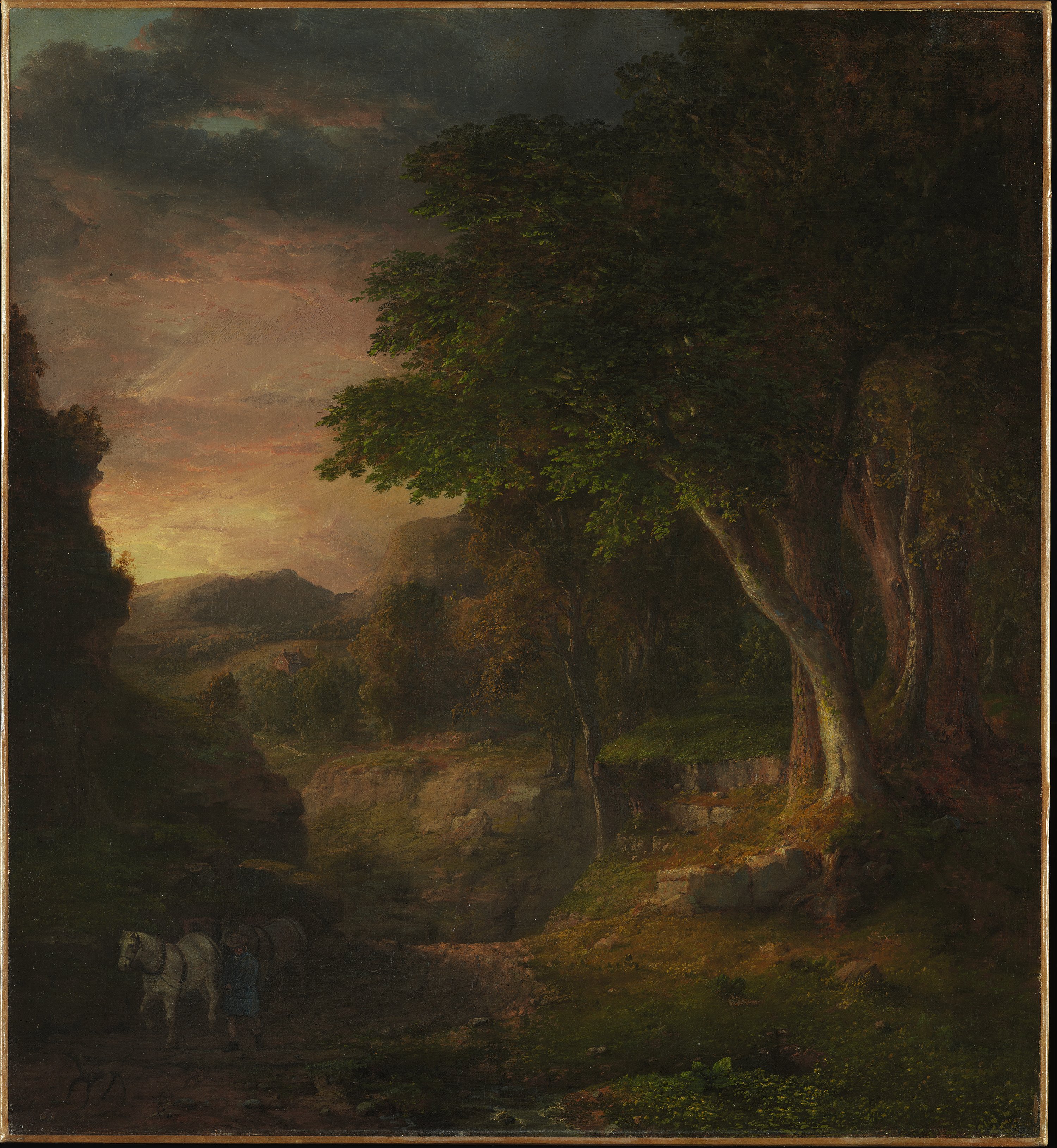
In the Berkshires
ca. 1848 - 1850
Oil on canvas.
61 x 56 cm
Carmen Thyssen Collection
Inv. no. (
CTB.1980.22
)
Not exhibited
Level 2
Permanent Collection
Level 1
Permanent Collection
Level 0
Carmen Thyssen Collection and Temporary exhibition rooms
Level -1
Temporary exhibition rooms, Conference room and EducaThyssen Studio
Inness' style of the late 1840s and early 1850s was formed largely from prints after the Old Masters seen in New York shops and in the studio of his teacher, the French émigré Régis F. Gignoux. Engravings and mezzotints after 17th-century Dutch landscapes and the pastoral compositions of Claude and Gaspar Dughet fascinated him, he later recalled, in a way which "I could not then analize." "There was a power of motive, a bigness of grasp, in them. They were nature, rendered grand instead of being belittled by trifling details and puny execution. I began to take them out with me to compare them with nature as she really appeared, and the light began to dawn. I had no originals to study, but I found some of their qualities in Cole and Durand [...] There was in Durand a more intimate feeling. 'If, ' though I, 'these two can only be combined."
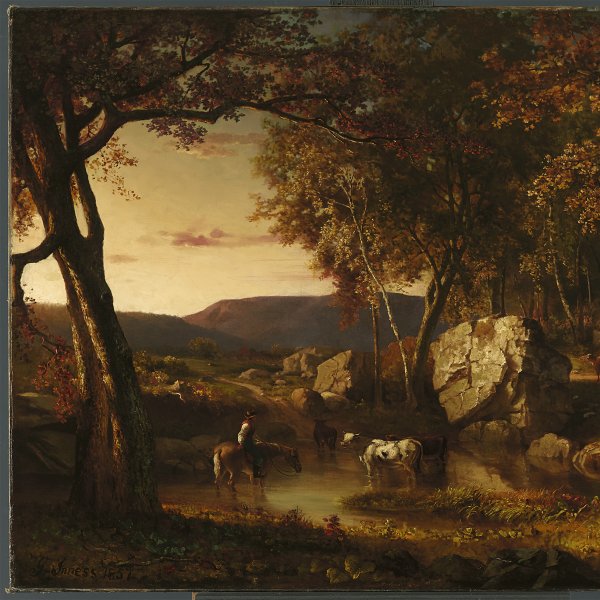
In the Berkshires is a little known and very beautifully painted example of this early style. Dating from the late 1840s when Inness exhibited several views of the Berkshire mountains of Western Massachusetts, the late afternoon woodland scene combines the deep forest opening to a luminous distance and the feathery leaves of Meindert Hobbema with the upright format that Ascher B. Durand first employed in 1845.
His aesthetic concerns set Inness apart from his Hudson River contemporaries. As Nicolai Cikovsky Jr. observed, rather than forging a landscape style based on a literal reverence for American scenery, Inness held nature up to art-an orientation that disturbed New York critics. A writer for the Literary World in 1848 cautioned the young artist not "to lose sight of nature in the 'Old Masters'." Four years later a reviewer complained that Inness's landscapes -among them a Berkshire scene- then on display at the National Academy of Design "betray a much profounder regard for 'old masters' than for Nature [...] He is consumed by the old landscapes."
Yet there is an uncommonly seen and felt presence in In the Berkshires that belies the characterisation of Inness's early paintings as mannered or "purely intellectual." Enclosed by trees and rocky hills and contained by a relatively limited palette of greens, browns and gold, the landscape turns in on itself. The farmer, the cottage and fence which catch the edge of sunset suggest an intimacy between man and nature. Inness preferred, as he later wrote, "civilized landscape" to the wilderness "untouched by human sentiment", and in In the Berkshires he painted it with an assurance that makes this one of his most evocative early pictures.
Elizabeth Garrity Ellis
In the Berkshires is a little known and very beautifully painted example of this early style. Dating from the late 1840s when Inness exhibited several views of the Berkshire mountains of Western Massachusetts, the late afternoon woodland scene combines the deep forest opening to a luminous distance and the feathery leaves of Meindert Hobbema with the upright format that Ascher B. Durand first employed in 1845.
His aesthetic concerns set Inness apart from his Hudson River contemporaries. As Nicolai Cikovsky Jr. observed, rather than forging a landscape style based on a literal reverence for American scenery, Inness held nature up to art-an orientation that disturbed New York critics. A writer for the Literary World in 1848 cautioned the young artist not "to lose sight of nature in the 'Old Masters'." Four years later a reviewer complained that Inness's landscapes -among them a Berkshire scene- then on display at the National Academy of Design "betray a much profounder regard for 'old masters' than for Nature [...] He is consumed by the old landscapes."
Yet there is an uncommonly seen and felt presence in In the Berkshires that belies the characterisation of Inness's early paintings as mannered or "purely intellectual." Enclosed by trees and rocky hills and contained by a relatively limited palette of greens, browns and gold, the landscape turns in on itself. The farmer, the cottage and fence which catch the edge of sunset suggest an intimacy between man and nature. Inness preferred, as he later wrote, "civilized landscape" to the wilderness "untouched by human sentiment", and in In the Berkshires he painted it with an assurance that makes this one of his most evocative early pictures.
Elizabeth Garrity Ellis