Thyssen-Bornemisza Museo Nacional Search Ir al contenido principal

Navegación superior (EN)

About Us Support Friends Shop Tickets
Español
Visit Collection Exhibitions Activities Education Search
  • Visit
  • Collection
  • Exhibitions
  • Activities
  • Education

Thyssen - Navegación superior (EN)

About Us Support Friends Shop Tickets
Español
©
René Magritte, VEGAP, Madrid
René Magritte

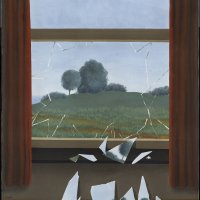
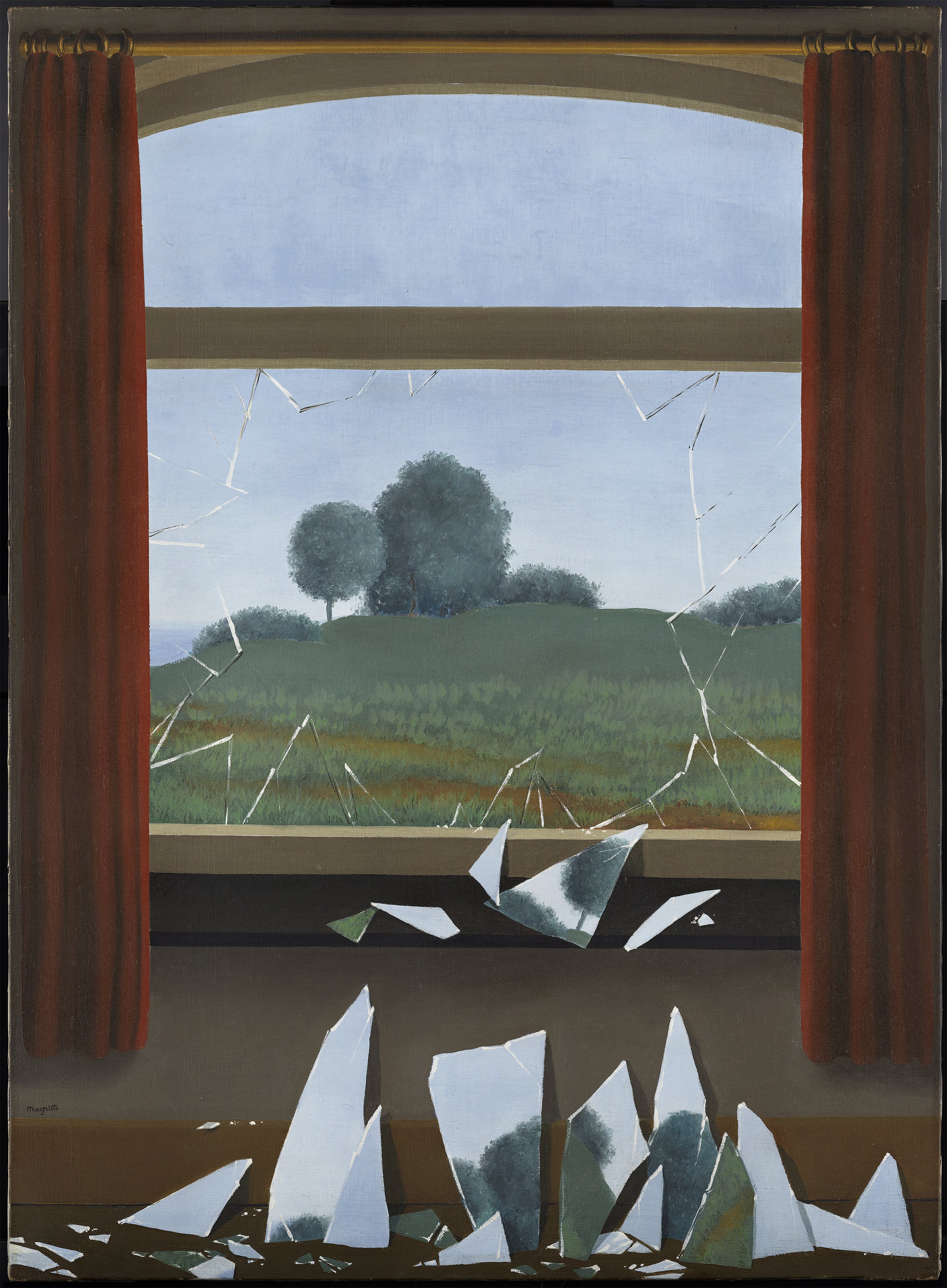
The Key of the Fields (La Clef des champs)

1936
Oil on canvas.
80 x 60 cm
Museo Nacional Thyssen-Bornemisza, Madrid
Inv. no.
657
(
1976.3
)
Room 44
Level 1
Permanent Collection
30 31 32 33 34 35 36 37 38 39 40 41 42 43 44 45 46 47 48 49 50 51 52 53 54 55 56 Postpop rooms Rodin room
30 18th and 19th Centuries. Transatlantic Relations 31 19th Century. American Landscape and Environmental Awareness 32 19th Century. American Landscape and Urban Life 33 19th Century. The Impressionist Period 34 20th Century. Expressionist Landscapes 35 20th Century. Expressionist Portraits 36 20th Century. The Language of the Body 37 20th Century. Urban unrest 38 20th Century. Flowers 39 20th Century. Pioneers of abstraction 40 20th Century. Popular flavor 41 20th Century. The Cubist Tradition I 42 20th Century. The Cubist Tradition II 43 20th Century. Abstract Utopias 44 20th Century. Dada and Surrealism 45 20th Century. Interwar Realisms 46 20th Century. American Abstraction I 48 20th Century. Post-ward American Art 49 20th Century. Post-ward European Figurative Art 50 20th Century. Informalisms 51 20th Century. Homo Ludens 52 20th Century. Pop Art 53 Postpop rooms 54 Postpop rooms 55 Postpop rooms 56 Postpop rooms • Exhibition room

“People who look for symbolic meanings [in my work] fail to grasp the inherent poetry and mystery of the image”. For the Belgian painter René Magritte, painting harbours the mystery of the poetry of the incongruous. Despite being one of the greatest exponents of international Surrealism, this atypical Belgian Surrealist deliberately eschewed the world of the unconscious. His painting shows no trace whatsoever of Romanticism and is constructed with a methodical, almost calculating precision. Through the visual enigmas of his paintings, Magritte succeeded in creating a highly original body of work in which images that in themselves are visually understandable, painted in a naturalistic technique, conveyed obscure and complex meanings by revealing to us the more mysterious side of the everyday world.

The Key of the Fields (La Clef des champs) was painted in 1936. By then Magritte was internationally known, as Alfred Barr had included his work in the legendary exhibition of Fantastic Art, Dada, Surrealism, as an exponent of photographic Surrealism, together with Dalí and Tanguy. Magritte depicts a landscape framed by a window that has been broken by an impact and the shards of glass lying on the ground are painted from fragments of a landscape identical to the one outside. Through the traditional theme of the picture within a picture, in the manner of a painted collage, Magritte explores the world of absurd associations as Max Ernst had done before him and appears to wish to reveal to us that what we saw through the window was not a real landscape but an image painted on the glass, albeit identical to that of the scenery outside. The landscape painted on the broken glass therefore shows that illusion and reality are one of the same thing. The painting was executed during the period in which Magritte, under the influence of Lewis Carroll, abandoned his earlier enigmatic Surrealist formulas in favour of the meaningless laws governing Alice’s world.

In the catalogue raisonné of the artist’s work, David Sylvester explains that Magritte attempted to raise questions about the problem of representing images and in this regard the present canvas may be considered a continuation of the problem of the window he had addressed three years earlier in The Human Condition. In an essay on the artist José Pierre analyses the relationship between the two compositions and states: “In La Condition humaine I (1933), the landscape painted on the canvas on the easel matches exactly that which he has used as a model. So the question arises: ‘if we take the canvas away, will there be a hole in the landscape?’ An indirect answer to this question is found in The Key of the Fields (La Clef des champs) (1936): if a stone breaks the window, the reflected landscape is smashed into pieces, while outside the real landscape remains unchanged”.

Magritte basically poses the problem of the window not only as an allusion to the Renaissance concept of perspective in painting, but the window as an example of the problem of representing the exterior and the interior: “The essential thing was to eliminate the difference between what can be seen from outside the window and what can be seen from inside", Magritte wrote to Breton in 1934. Christopher Green believes that this painting also includes the Surrealist theme of the mirror and that the broken window is inviting the viewer to step inside. Bearing in mind that Breton regarded both the window and the mirror as images of liberation, and that in French la clef des champs has the colloquial meaning of liberation, the window thus becomes the path of freedom.

Paloma Alarcó
20th Centurys. XX - Pintura europea. SurrealismoPaintingOilcanvas
Listen
Download image Print page

More details about The Key of the Fields (La Clef des champs)

Imagen
Vídeo
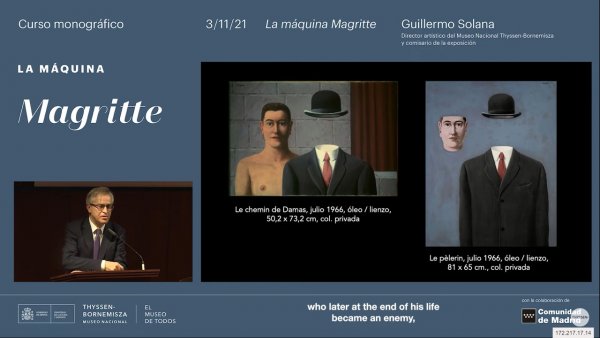
Conferencia "Cinco surrealistas: René Magritte"
Monographic course The Magritte machine
Video
Monographic course The Magritte machine
Various lecturers
To coincide with the exhibition The Magritte machine the museum organized a monographic course which focused on different aspects of the work of this key figure in Surrealist painting.

Related exhibitions

René Magritte René Magritte
Temporary Exhibition
The Magritte machine
From 14 September 2021 to 30 January 2022
The Key of the Fields (La Clef des champs), 1936
Small format exhibition
<exchanging gazes> 6: Reflections. From Van Eyck to Magritte
From 10 June to 15 September 2013

Tours to find it

Flemish, Netherlandish and Dutch Painting in the collection
Tours
Flemish, Netherlandish and Dutch Painting in the collection
A history of the evolution of painting step by step in the Low Countries from the 15th to the 20th centuries.
A journey through the Performing Arts
Tours
A journey through the Performing Arts
The performing arts as an arena of encounter.  

Related content

Video
Lecture series Five Surrealists in the Thyssen-Bornemisza Collection. 
With Guillermo Solana, museum’s artistic director
Video
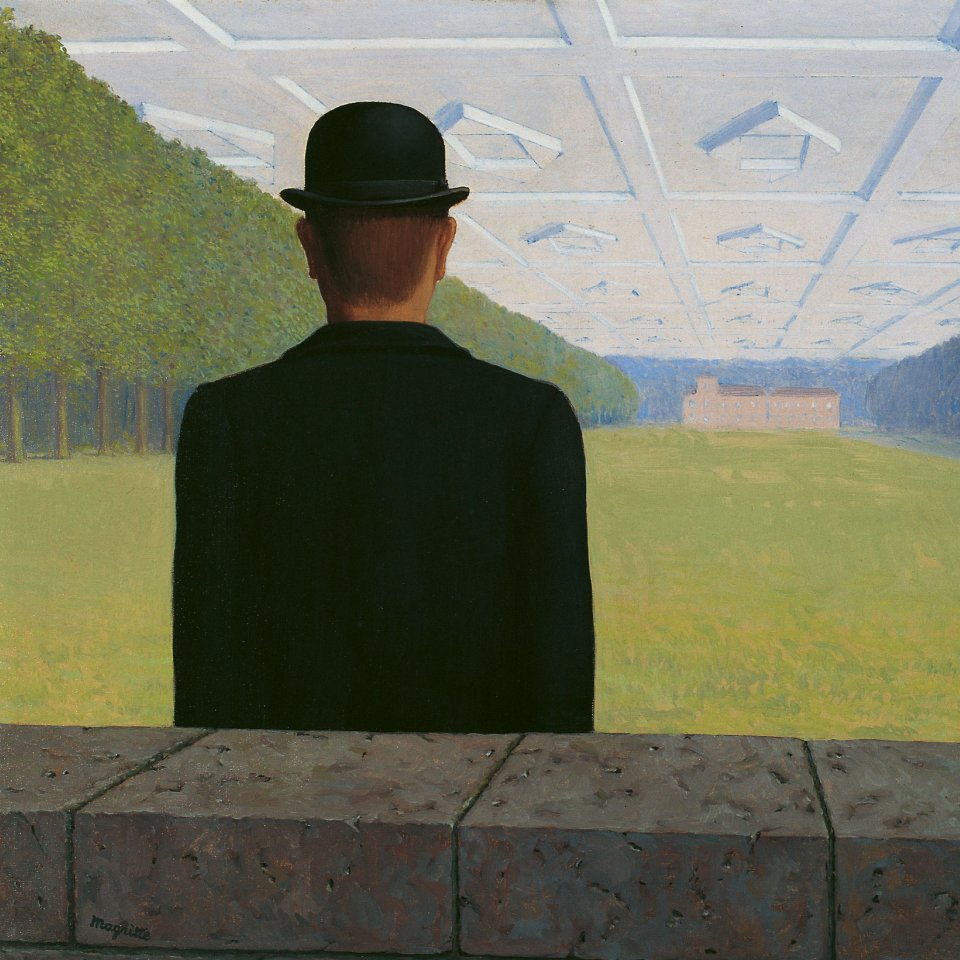
La máquina Magritte. Fragmento del vídeo de Guillermo Solana
Para la plataforma Priceless Cities de Mastercard
Teaser del vídeo en el que Guillermo Solana recorre la exposición La máquina Magritte para los clientes de Priceless Cities de Mastercard. 
Publication
Art and Science
Publication released for the Art and Science meet.

Products and publications

The Impressionists and Photography. Exhibition Catalogue. Hardcover. English

The Impressionists and Photography. Exhibition Catalogue. Hardcover. English

38,00 €

Visit online shop

More from the collection

Max Ernst
Max Ernst
Untitled (Dada)
ca. 1922 - 1923
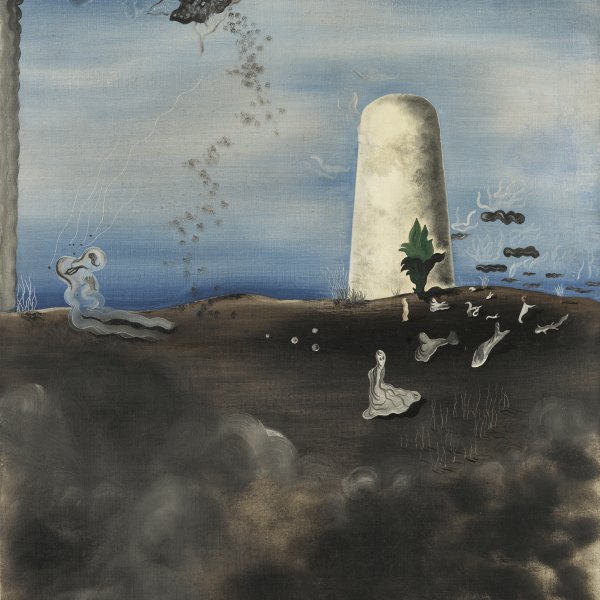
Yves Tanguy
Yves Tanguy
Death Watching his Family
1927
Salvador Dalí
Salvador Dalí
Gradiva rediscovers the Anthropomorphic Ruins (Retrospective Fantasy)
1932
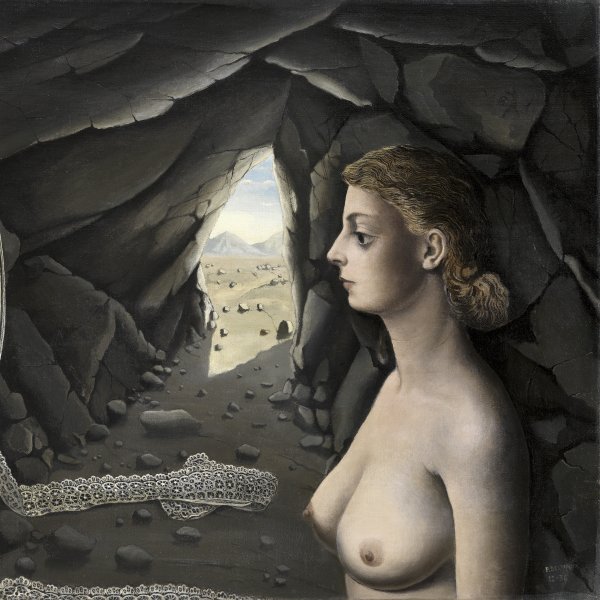
Paul Delvaux
Paul Delvaux
Woman in the Mirror
1936
  • Private and/or didactic use
  • Commercial use
Private and/or didactic use
The Key of the Fields (La Clef des champs), 1936
The Key of the Fields (La Clef des champs)
René Magritte

©

René Magritte, VEGAP, Madrid

Terms of Use

The exploitation rights of the images correspond to the Fundacion Coleccion Thyssen-Bornemisza, F.S.P. The Fundación authorizes the downloading of high-resolution images from its website for private use, use for educational and research purposes and non-commercial uses.

However, photographed works are protected by copyright. Therefore, regardless of the terms of use of the images set out below by the Foundation, it will be necessary to obtain a license from VEGAP (www.vegap.es), or from the corresponding collective management organization in the country where the work is going to be used or, where appropriate, from the holder of their rights in order to reproduce or exploit the work.

Use for educational and research purposes is understood as the non-commercial or advertising use of images in presentations, conferences, school or university work, in classes at regulated education institutions, as well as in academic publications, with a circulation of less than 1,000 copies, provided that it is non-profit.

Non-commercial use is understood as the use of the images in a context where no profit, monetary or commercial, is generated, directly or indirectly.

Any use other than those indicated above will require the prior written authorization of the Fundación.

Any request for educational and research use or for non-commercial use (including academic publications), should be directed by email to the Museum Photo Library through the email address archivo.fotografico@museothyssen.org. This department manages the worldwide distribution of the images of the works of the Museo Nacional Thyssen-Bornemisza and the management of their reproduction rights for those uses.

The user agrees to use the image of the website solely and exclusively for the purposes described above and in accordance with the following terms of use, which, however, do not apply to the reproduction of the works included in the photographs, as they are protected by Copyright.

Terms of use

  • If the image is used for reproduction, the work must be reproduced in its entirety. The image may not be manipulated, deformed, modified or altered in any way. In particular, no superposition (of images or texts) on the reproduction is allowed.
  • The reproduction of a detail or part of the work may only be made with the prior written authorization of the Fundación In this case, the credit line must include the following mention: “detail”.
  • Any total or partial reproduction of the images of the Fundación that has been previously authorized must be accompanied by the copyright text indicated by the owners or their copyright holders as well as the following mention: Provenance: Museo Nacional Thyssen-Bornemisza, Madrid”.
  • The user will send free of charge to the Museum Photo Library one (1) free copy of the edition, publication or reproduction to the following address: Archivo Fotografico, Museo Nacional Thyssen-Bornemisza, Paseo del Prado, 8 28014 Madrid, Spain.
Download image
Commercial use
The Key of the Fields (La Clef des champs), 1936
The Key of the Fields (La Clef des champs)
René Magritte

©

René Magritte, VEGAP, Madrid

Terms of Use

The Photo Library of the Museo Nacional Thyssen-Bornemisza offers sale and rental service of photographic material of all the works on its Permanent Collection.

To request images or permits for commercial use in academic or research publications, that is, catalogues of other institutions, monographs and other specialized publications, you should contact the Museum's Photo Library by email at the e-mail @email.

To request images or permits for other commercial or advertising uses (general publications, merchandising, exhibitions, audio-visual works, web pages, etc.), you should contact the Museum's Commercial Archive by email at the e-mail @email.

The Photo Library and the Museum's Commercial Archive manage the worldwide distribution of images of the Museo Thyssen-Bornemisza works, as well as their reproduction rights. The applicable rates are calculated based on the nature and proposed use of the images, as well as the availability of the requested image.

Requests for scans or new photographs will be reviewed on a case-by-case basis. Once approved, an additional fee will apply. Re-photographing a work will require a minimum of six weeks to complete.

However, photographed works are protected by copyright. Therefore, regardless of the terms of use of the photographs set out below by the Foundation, it will be necessary to obtain a license from  VEGAP (Visual Entidad de Gestión de Artistas Plásticos www.vegap.es) or from the corresponding collective management organizations in the country where the work is going to be used or, where appropriate, from the holder of their rights in order to reproduce or exploit the work.

Download image
Thyssen-Bornemisza Museo Nacional

Navegación secundaria (EN)

  • #Thyssenmultimedia
  • Press
  • Corporate events
  • Tourism
  • Join our team
  • Newsletter
Instagram
Facebook
X
Youtube
TikTok
iVoox
LinkedIn

The Museo Nacional Thyssen-Bornemisza would like to thanks for the collaboration of:

Fundación Mutua Madrileña Master Card Comunidad de Madrid
©2026 Thyssen-Bornemisza National Museum

Menú al pie (EN)

  • Legal terms
  • Public tenders
  • Transparency site
  • Whistleblower channel
  • Use of images
  • Accessibility and quality
  • Environment, Sustainability & 2030 Agenda
  • Contact
Ministry of Culture España es cultura | Spain is culture. The website promoting Spanish culture Paisaje de la Luz | Paseo del Prado y Buen Retiro. Paisaje de las Artes y las Ciencias
Certificación de Conformidad con el Esquema Nacional de Seguridad. Categoría Media. RD 311/2022