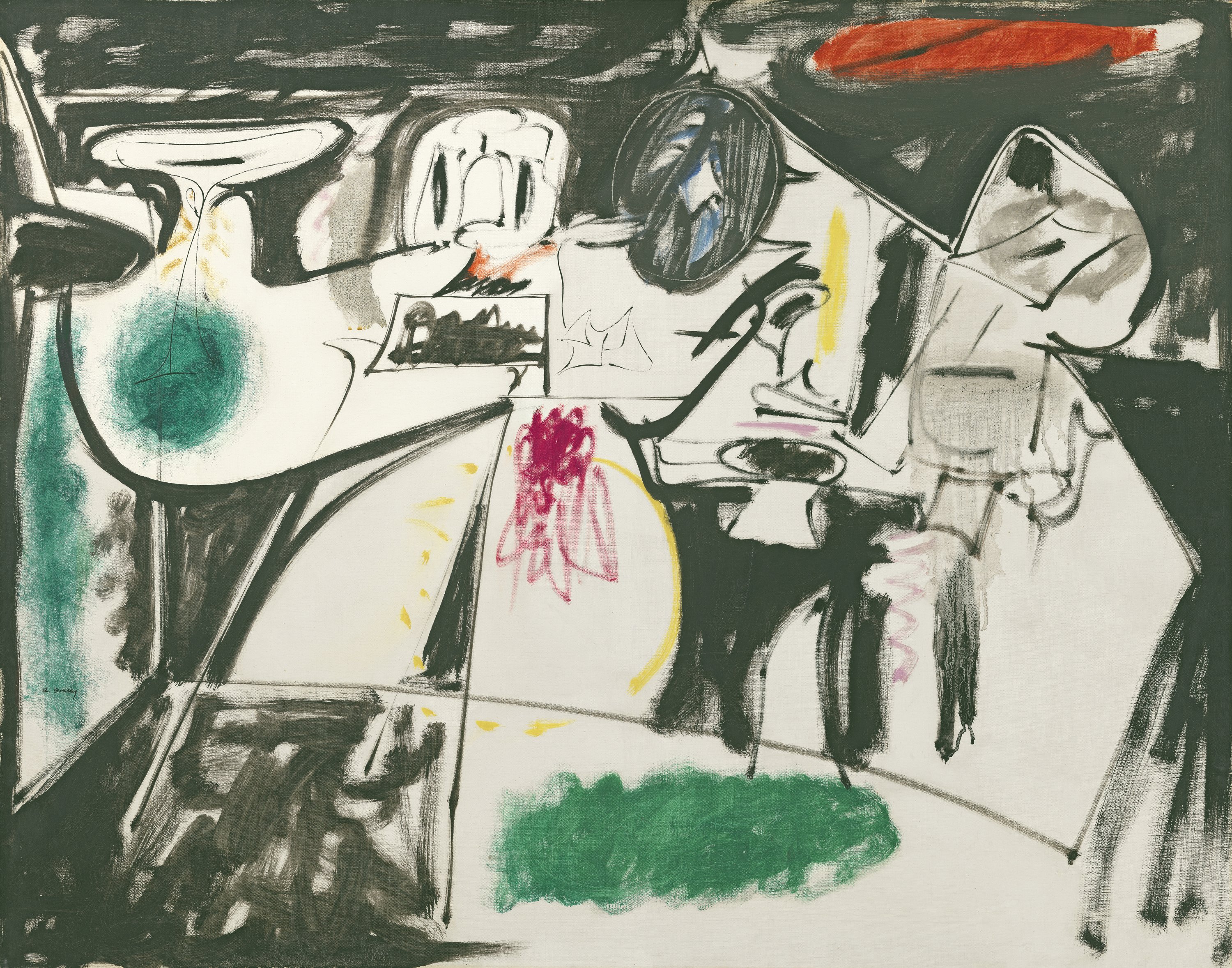
Last Painting
The dealer Julien Levy revealed in his monograph on Gorky that Last Painting was on the artist’s easel on the day he committed suicide in July 1948 and can therefore be considered to embody his depressed emotional state. The iconography of the painting, that sometimes has also been entitled The Black Monk, could stem from Gorky’s reaction to reading Anton Chekhov’s short story The Black Monk. Written in January 1894, it tells of the degeneration and delirium of a man to whom a menacing black monk appears and announces to him that he is a genius: “Beneath the balcony the serenade was being played, and the Black Monk whispered to him that he was a genius, and he died only because his feeble, mortal body had lost its balance, and could no longer serve as the covering of genius. ”Harry Rand took this quotation, which is stressed by Levy, to be a suicide note.
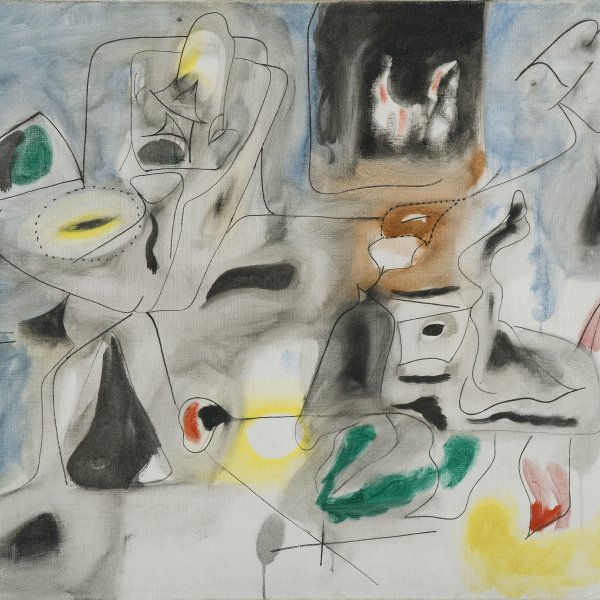
In addition to this symbolic narration, the painting displays formal characteristics of great emotional intensity. It is executed rapidly in a claustrophobic gestural style; the large patches of black appear to intimidate the biomorphic forms, which are no longer linear and delicately drawn as in previous works but gestural and aggressive. As in many of Gorky’s paintings, the compositional complexity of Last Painting and the accumulation of forms and figures that interact without losing their identity might be linked to the tradition of great Baroque painting, while the appearance of an unfinished oil painting or enlarged sketch, resulting from the manner of separating line and colour typical of his late works (which Clement Greenberg defined as “tinted drawings”), stems from the influence of Picasso, Matisse and, above all, Joan Miró. The Miró retrospective held at The Museum of Modern Art in New York in 1941 provided Gorky with the key to resolving the tension between his desire for spontaneity and his need to clarify his compositions. Although the influence of the New York-based Surrealists on Gorky’s fanciful imagery is more than proven, it was the Catalan who led him to realise that he could “draw” the essential forms in black on the canvas and then add with greater freedom a series of bright colours, applied in very thin layers and not with the thick impastos of his earlier works.
Paloma Alarcó