Materials for a Leisure Hour
William Michael Harnett achieved enormous popularity with a type of still life that involved the use of trompe l’oeil. This concept, which offered a modern rethinking of the traditional vanitas using everyday, contemporary objects, had a profound influence on American painters and a series of great masters of trompe l’oeil arose around the end of the 19th century. Some of Harnett’s compositions were so successful that they were imitated by his numerous followers.
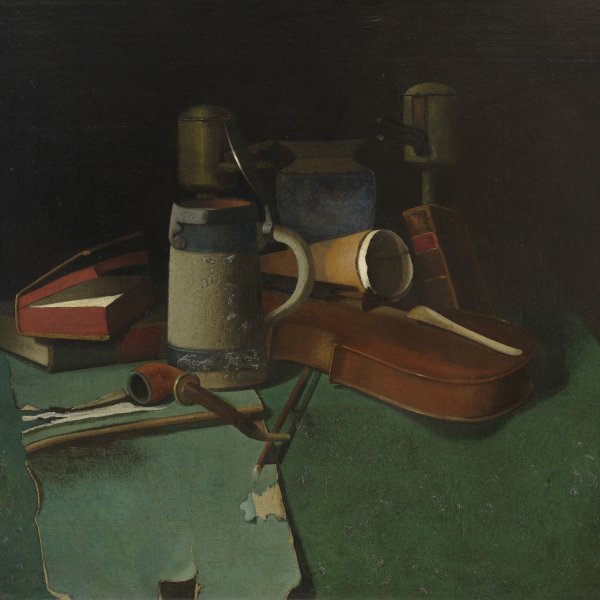
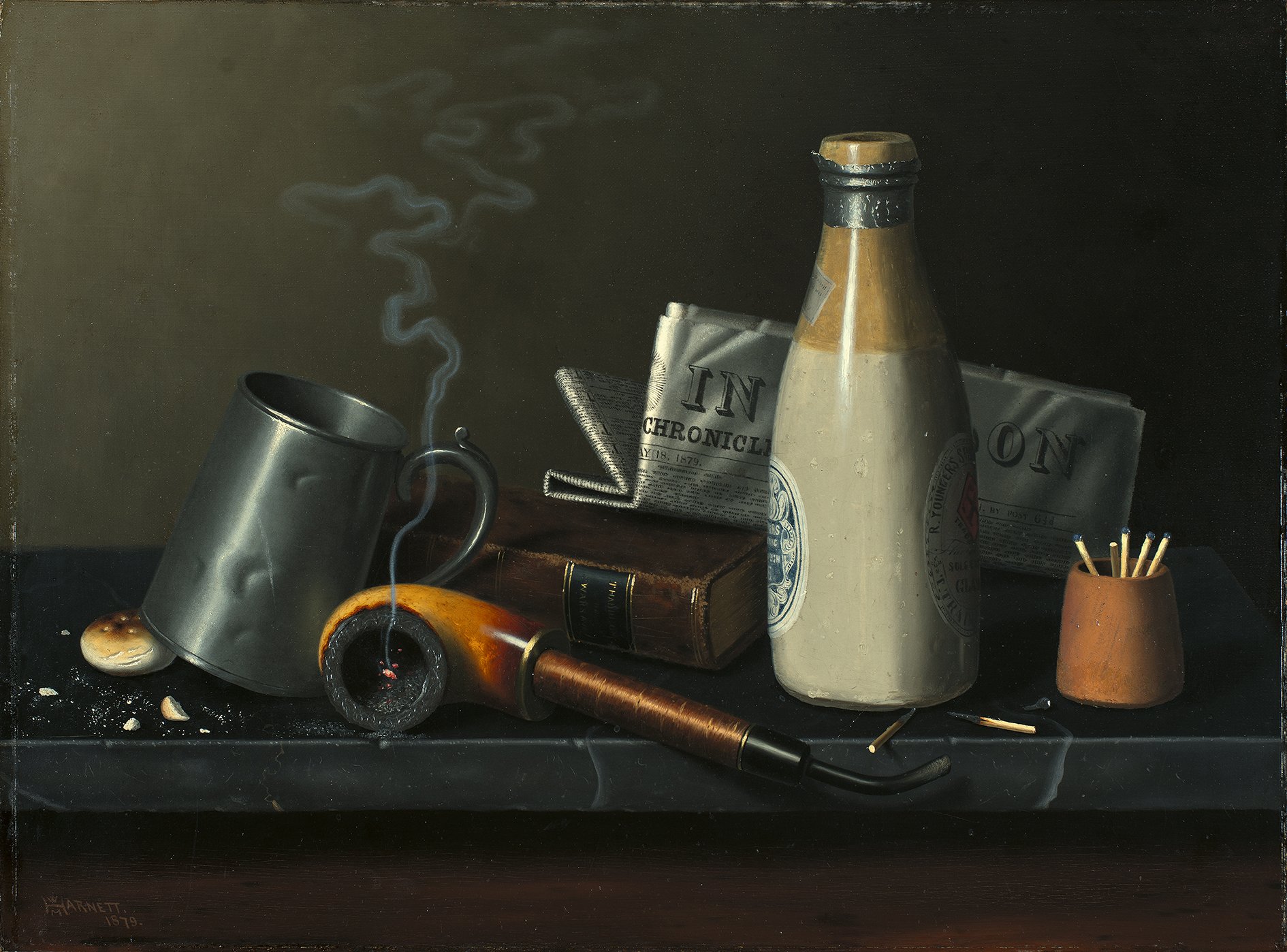
Objects for a Leisure Hour conveys the sense of recent human presence through the smouldering pipe resting on the edge of the table, the used matches and the half-eaten biscuit and its crumbs. The sense of fleeting time is also conveyed through the folded-up newspaper in the middle-ground, with its date of publication visible. All these objects are seemingly arranged at random but reveal a subtle sense of harmony and carefully meditated equilibrium.
CM
Whereas traditional vanitas painting featured skulls or hourglasses as symbols of the transitory nature of existence, in Harnett’s painting allusions to death are found in extinguished matches, smouldering pipes and old newspapers, arranged in unstable, disorderly compositions. As John Wilmerding states, the ideas conveyed by the painter Thomas Eakins, his firm conviction about the connection between moral integrity and the solid three-dimensionality of nature, may have influenced Harnett’s work.
The elements featured in the still life in the Thyssen-Bornemisza collection — smoking pipes, jugs and folded newspapers placed on a table — were the most widely used by Harnett throughout his artistic career. Here, as in so many other paintings, the artist seeks a balance between the veiled allusions to a human presence, such as the smoke curling from the pipe, and the inscrutable solitude of the existence of things. At the same time, the variety of manufactured objects hint at his interest in showing off his skill at rendering different textures and surfaces in a lifelike manner, using an astonishingly meticulous technique that makes the brushstrokes practically invisible. To cite Kathleen Pyne, Harnett’s careful handling of the brush and his mastery of light and shade give the objects depicted in this work a “magic palpability.”
Paloma Alarcó