Vertumnus and Pomona
1637 - 1640
Oil on panel.
47.9 x 38.9 cm
Museo Nacional Thyssen-Bornemisza, Madrid
Inv. no.
136
(1983.19
)
Room 20
Level 2
Permanent Collection
Brother of the landscape painter Allart van Everdingen, little is known regarding Everdingen’s training. He was active as a portraitist, working in a manner that recalls the influence of Bartholomeus van der Helst, but was particularly noted for his mythological, historical, allegorical and religious paintings and for half-length figures. The earliest known works by the artist are the portraits of his parents, Pieter Cornelisz. van Everdingen and Aechje Claesdr. Moer of 1636. Between 1641 and 1643 he is documented in Amersfoort and after 1648, in Haarlem. Together with other Dutch painters he was involved in the decoration of the Oranjezaal in The Hague, executing, among other works, the paintings of The Four Muses and Pegasus on Parnassus and an Allegory of the Birth of Frederick Henry, dated to around 1639‒40.
Vertumnus and Pomona appeared on the art market in 1915 when it was auctioned in Berlin. It was then with the Jacques Goudstikker gallery in Amsterdam and with Auslander & Wittgenstein in New York, from whom it was acquired by Baron Hans Heinrich Thyssen-Bornemisza in 1983. It was first discussed in the scholarly literature by Pigler in 1956.
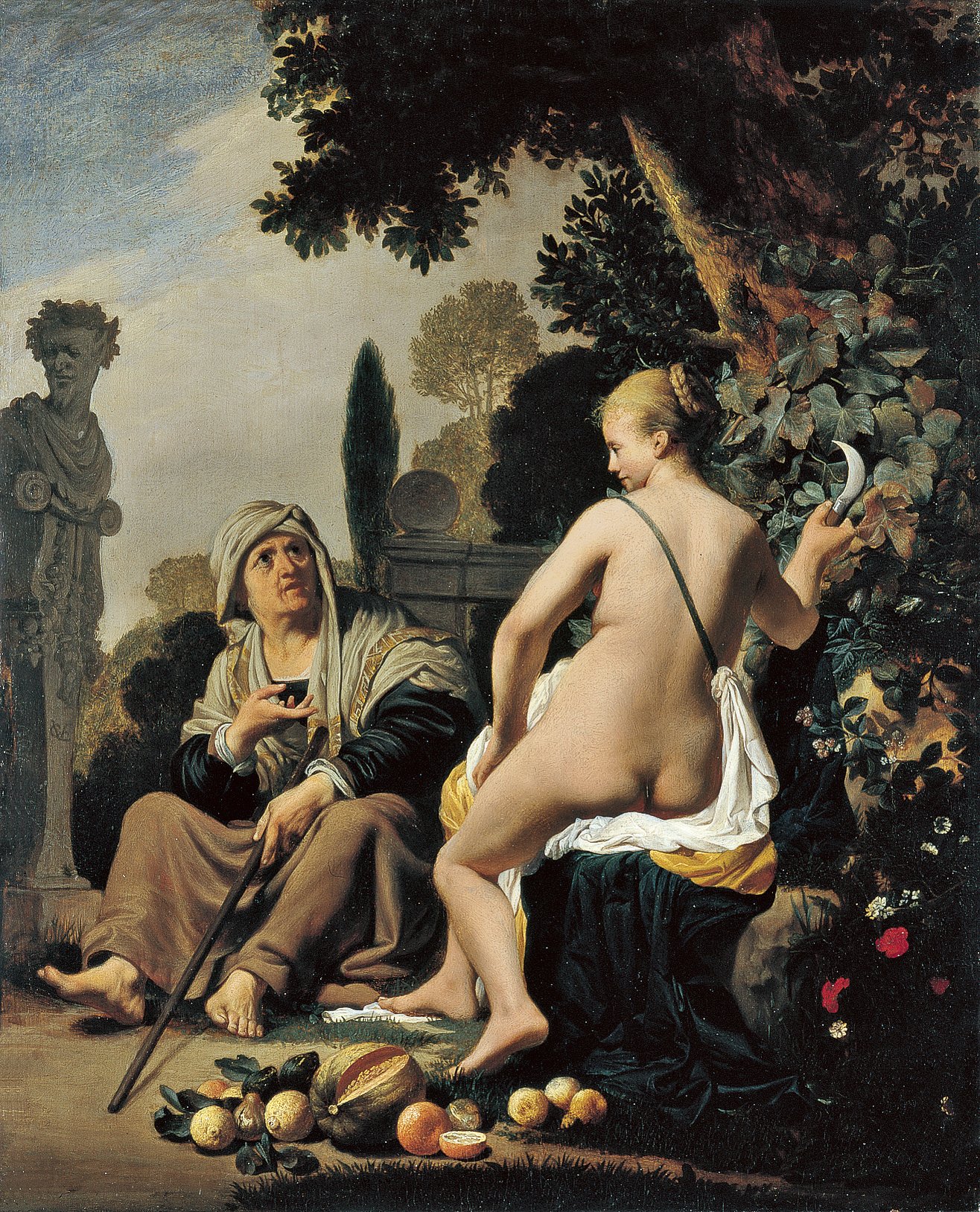
Huys Janssen has dated the panel to between 1637 and 1640 at an early phase in Everdingen’s career. It depicts an episode from Book XIV of Ovid’s Metamorphoses. The meeting between the two figures takes place in Pomona’s garden where she appears nude, seen from behind and holding the curved pruning knife that is one of her attributes. Seated beside her on the ground is Vertumnus with a staff, disguised as an old woman, while below Pomona’s feet, Everdingen has placed a fine still life of fruit. The Roman god Vertumnus, protector of fruit trees and responsible for the change of seasons, fell in love with the goddess Pomona, protector of fruit and flowers but immune to the delights of love, for which reason she enclosed her garden to prevent the entry of any man wishing to seduce her. In order to enter the garden and gain the love of Pomona, Vertumnus disguised himself as a woman. The scene is completed on the left with the bust of a satyr symbolising sexual desire.
As Janssen noted, this episode was popular with Haarlem artists who were inspired by a print by Jan Saenredam. According to Janssen, the figure of Pomona with her back to the viewer was used by Everdingen in other compositions including The Rape of Europa in the National Gallery of Canada, Ottowa, which dates from the same period as the present panel. Gaskell reproduced a drawing now in the Biblioteca Reale in Turin that depicts the same episode in a very similar way.
Mar Borobia
Vertumnus and Pomona appeared on the art market in 1915 when it was auctioned in Berlin. It was then with the Jacques Goudstikker gallery in Amsterdam and with Auslander & Wittgenstein in New York, from whom it was acquired by Baron Hans Heinrich Thyssen-Bornemisza in 1983. It was first discussed in the scholarly literature by Pigler in 1956.
Huys Janssen has dated the panel to between 1637 and 1640 at an early phase in Everdingen’s career. It depicts an episode from Book XIV of Ovid’s Metamorphoses. The meeting between the two figures takes place in Pomona’s garden where she appears nude, seen from behind and holding the curved pruning knife that is one of her attributes. Seated beside her on the ground is Vertumnus with a staff, disguised as an old woman, while below Pomona’s feet, Everdingen has placed a fine still life of fruit. The Roman god Vertumnus, protector of fruit trees and responsible for the change of seasons, fell in love with the goddess Pomona, protector of fruit and flowers but immune to the delights of love, for which reason she enclosed her garden to prevent the entry of any man wishing to seduce her. In order to enter the garden and gain the love of Pomona, Vertumnus disguised himself as a woman. The scene is completed on the left with the bust of a satyr symbolising sexual desire.
As Janssen noted, this episode was popular with Haarlem artists who were inspired by a print by Jan Saenredam. According to Janssen, the figure of Pomona with her back to the viewer was used by Everdingen in other compositions including The Rape of Europa in the National Gallery of Canada, Ottowa, which dates from the same period as the present panel. Gaskell reproduced a drawing now in the Biblioteca Reale in Turin that depicts the same episode in a very similar way.
Mar Borobia