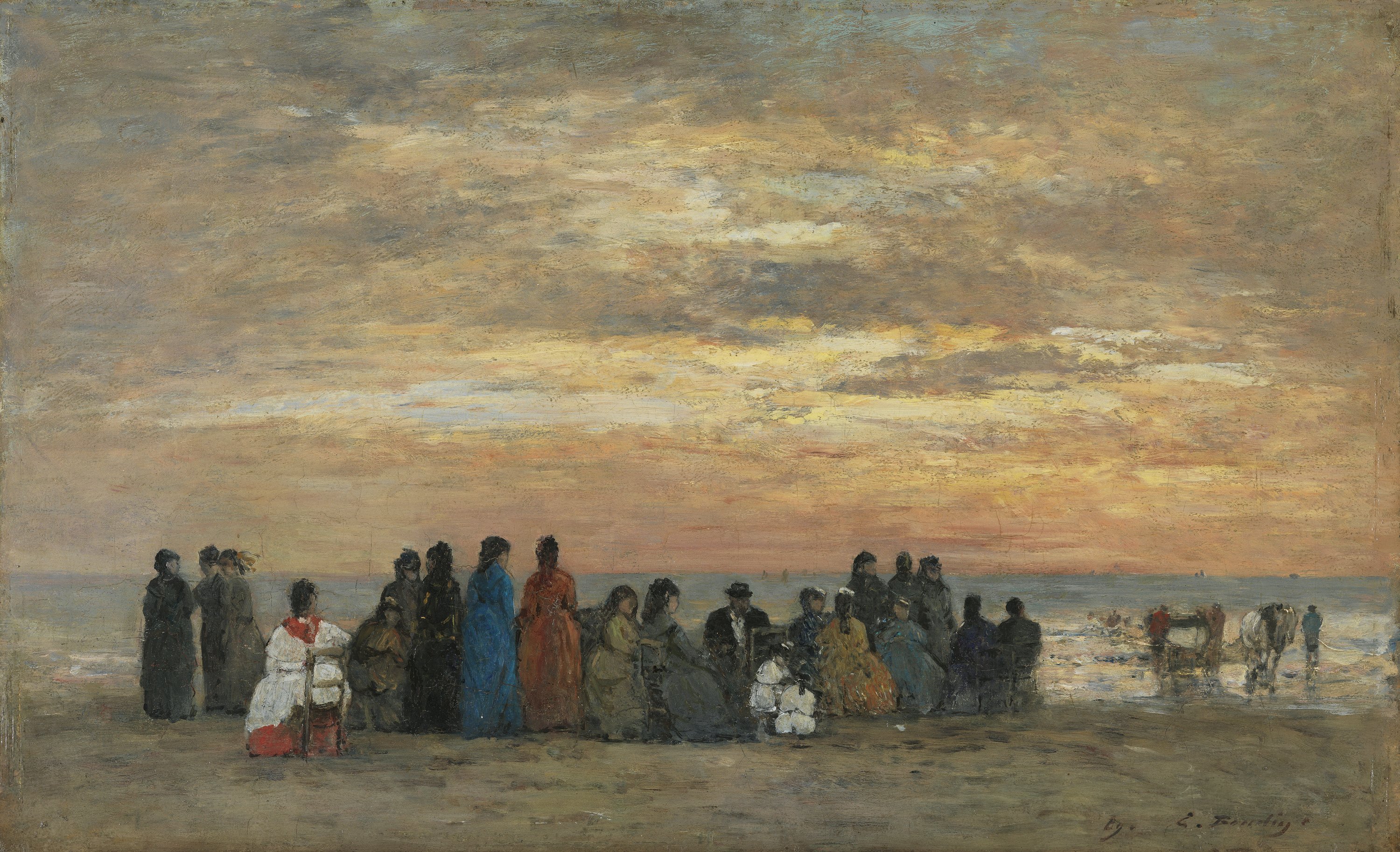
Figures on the Beach in Trouville
1869
Oil on panel.
29 x 47 cm
Carmen Thyssen Collection
Inv. no. (
CTB.1970.29
)
Room C
Level 0
Carmen Thyssen Collection and Temporary exhibition rooms
"Mister Boudin [...] has even invented a type of seascape which belongs entirely to him and which consists in painting, along with the beach itself, the exotic high society which gathers in our sea resorts during the summer." This sentence, written by an art critic in 1869, reveals the fact that Boudin was acknowledged as the creator of a genre, and that he obtained a certain degree of success by fixing on the canvas the high society of the resorts of Trouville and Deauville.
It was in fact towards 1860 that he started producing his first beach scenes in Trouville, and he developed that subject periodically throughout his life. In the minds of many art lovers, Boudin remains the painter of beach scenes. But among the approximately 4500 paintings catalogued to this day, only eight percent concern "crinoline beaches." His most fruitful period regarding this subject are the years 1860-1871. Eighty percent of the beach scenes are painted on wood panels, and the formats most often used are 5, 6, 8 or 10 "seascape, " and rarely larger formats. The painting from the Carmen Thyssen-Bornemisza Collection belongs to this most common category: it has approximately an 8 "seascape" format on wood. Boudin paid great attention to the quality of this support. In 1894 he wrote: "I think I will go back to mahogany, the only stable wood, together with old oak. But mahogany is so heavy. And it has another drawback, it blackens even through the primers if they are not thick enough and applied in several coats." Boudin returned to the painting of beach scenes in the middle of the 1870s and again towards 1880-1886.
So in 1868 he was acknowledged as the painter of seascapes and this specialisation brought him some financial security, but also criticisms and jealousy. He was accused of producing commercial paintings. Boudin provided the following explanation to justify his work: "[...] those middle-class people strolling along the pier towards the sunset, do they not have the right to be fixed on the canvas, to be brought to light? Between you and me, those people are only resting after a hard day's work, having left their bureaus and offices [...]." Peasants have their painters, and middle-class people deserve to have theirs too...
In 1869, Boudin presented at the Paris Salon two paintings depicting beach scenes and, that same year, 40 percent of his pictures, sold to dealers and registered in the accounts books, have as their subject the beaches in Trouville and Deauville. In 1869, Boudin's accounts show a clear rise in his annual income: 4420 FF against the average 2500 to 3500 since 1866.
Until the 1860s, Boudin regularly spent his summers in Honfleur. From 1863, he abandoned that town and chose Trouville for his summer holiday. There, he was in the right place for painting beach scenes. When he started depicting this subject, he often chose a wide angle view, and used the elements of the landscape to frame the scene: the villas of the coast, the Roches Noires hotel, the cabins, the horses pulling the beach huts. The paintings, which are sometimes anecdotal, are an account of a period. Gradually, the "classical" composition of his beach scenes changed and the space was divided into horizontal bands parallel to the shore and to the canvas. The beach scene from the Carmen Thyssen-Bornemisza Collection is a good example of this type of composition. The sky takes up two-thirds of the canvas. Here it is dense and loaded with colours, illuminated by the setting sun. Most of the figures have their backs turned to the beholder (which is quite a novelty in painting) and are spread in a regular band. In order to avoid monotony, some (faceless) holidaymakers look towards us, and a lady, sitting away from the group, sets the foreground of the composition. To this group of characters, closed up on itself, Boudin has skilfully added, to the right, an anecdotal motif, composed of a horse and some fishermen pulling a boat ashore.
Boudin skilfully balances the bright colours throughout the work, as they bring out the blacks and beiges: he uses vermilion, yellow and blue, and white for the final touch of brightness. The sky, whose brilliance is enhanced by the use of impasto, is the subject of this painting. The summer visitors relaxing on the beach are somewhat rigid, but the beauty of the sky and the silver brightness of the boat being pulled ashore give this painting a timeless poetry and splendour.
Anne-Marie Bergeret-Gourbin
It was in fact towards 1860 that he started producing his first beach scenes in Trouville, and he developed that subject periodically throughout his life. In the minds of many art lovers, Boudin remains the painter of beach scenes. But among the approximately 4500 paintings catalogued to this day, only eight percent concern "crinoline beaches." His most fruitful period regarding this subject are the years 1860-1871. Eighty percent of the beach scenes are painted on wood panels, and the formats most often used are 5, 6, 8 or 10 "seascape, " and rarely larger formats. The painting from the Carmen Thyssen-Bornemisza Collection belongs to this most common category: it has approximately an 8 "seascape" format on wood. Boudin paid great attention to the quality of this support. In 1894 he wrote: "I think I will go back to mahogany, the only stable wood, together with old oak. But mahogany is so heavy. And it has another drawback, it blackens even through the primers if they are not thick enough and applied in several coats." Boudin returned to the painting of beach scenes in the middle of the 1870s and again towards 1880-1886.
So in 1868 he was acknowledged as the painter of seascapes and this specialisation brought him some financial security, but also criticisms and jealousy. He was accused of producing commercial paintings. Boudin provided the following explanation to justify his work: "[...] those middle-class people strolling along the pier towards the sunset, do they not have the right to be fixed on the canvas, to be brought to light? Between you and me, those people are only resting after a hard day's work, having left their bureaus and offices [...]." Peasants have their painters, and middle-class people deserve to have theirs too...
In 1869, Boudin presented at the Paris Salon two paintings depicting beach scenes and, that same year, 40 percent of his pictures, sold to dealers and registered in the accounts books, have as their subject the beaches in Trouville and Deauville. In 1869, Boudin's accounts show a clear rise in his annual income: 4420 FF against the average 2500 to 3500 since 1866.
Until the 1860s, Boudin regularly spent his summers in Honfleur. From 1863, he abandoned that town and chose Trouville for his summer holiday. There, he was in the right place for painting beach scenes. When he started depicting this subject, he often chose a wide angle view, and used the elements of the landscape to frame the scene: the villas of the coast, the Roches Noires hotel, the cabins, the horses pulling the beach huts. The paintings, which are sometimes anecdotal, are an account of a period. Gradually, the "classical" composition of his beach scenes changed and the space was divided into horizontal bands parallel to the shore and to the canvas. The beach scene from the Carmen Thyssen-Bornemisza Collection is a good example of this type of composition. The sky takes up two-thirds of the canvas. Here it is dense and loaded with colours, illuminated by the setting sun. Most of the figures have their backs turned to the beholder (which is quite a novelty in painting) and are spread in a regular band. In order to avoid monotony, some (faceless) holidaymakers look towards us, and a lady, sitting away from the group, sets the foreground of the composition. To this group of characters, closed up on itself, Boudin has skilfully added, to the right, an anecdotal motif, composed of a horse and some fishermen pulling a boat ashore.
Boudin skilfully balances the bright colours throughout the work, as they bring out the blacks and beiges: he uses vermilion, yellow and blue, and white for the final touch of brightness. The sky, whose brilliance is enhanced by the use of impasto, is the subject of this painting. The summer visitors relaxing on the beach are somewhat rigid, but the beauty of the sky and the silver brightness of the boat being pulled ashore give this painting a timeless poetry and splendour.
Anne-Marie Bergeret-Gourbin