David With the Head of Goliath and Two Soldiers
ca. 1620 - 1622
Oil on canvas.
99 x 134 cm
Museo Nacional Thyssen-Bornemisza, Madrid
Inv. no.
415
(1930.119
)
Room 12
Level 2
Permanent Collection
Of French origin, Valentin de Boulogne worked throughout his career in Italy where it is thought that he arrived around 1613 or 1614. His father was a painter and maker of stained glass and one of his brothers was also a painter. Valentin de Boulogne may have trained within this context, possibly completing his studies in Paris or Fontainebleau. The first reference to the artist in Rome dates from 1620, at which date he was living in the Santa Maria del Popolo quarter, sharing lodgings with other French artists. In Rome, Valentin de Boulogne enjoyed the support of the Barberini family, of Cassiano del Pozzo and of Fabrizio Valguarnera. When the artist arrived in Italy he was profoundly impressed by the work of Caravaggio and that artist’s innovative manner of interpreting reality. He continued to use this approach throughout his career and became one of Caravaggio’s closest followers. He deployed a repertoire of themes comparable to those used by Bartolomeo Manfredi, another Caravaggesque artist, and which were inspired by the most popular, picturesque aspects of that movement. Valentin de Boulogne also produced portraits, as well as religious and allegorical compositions.
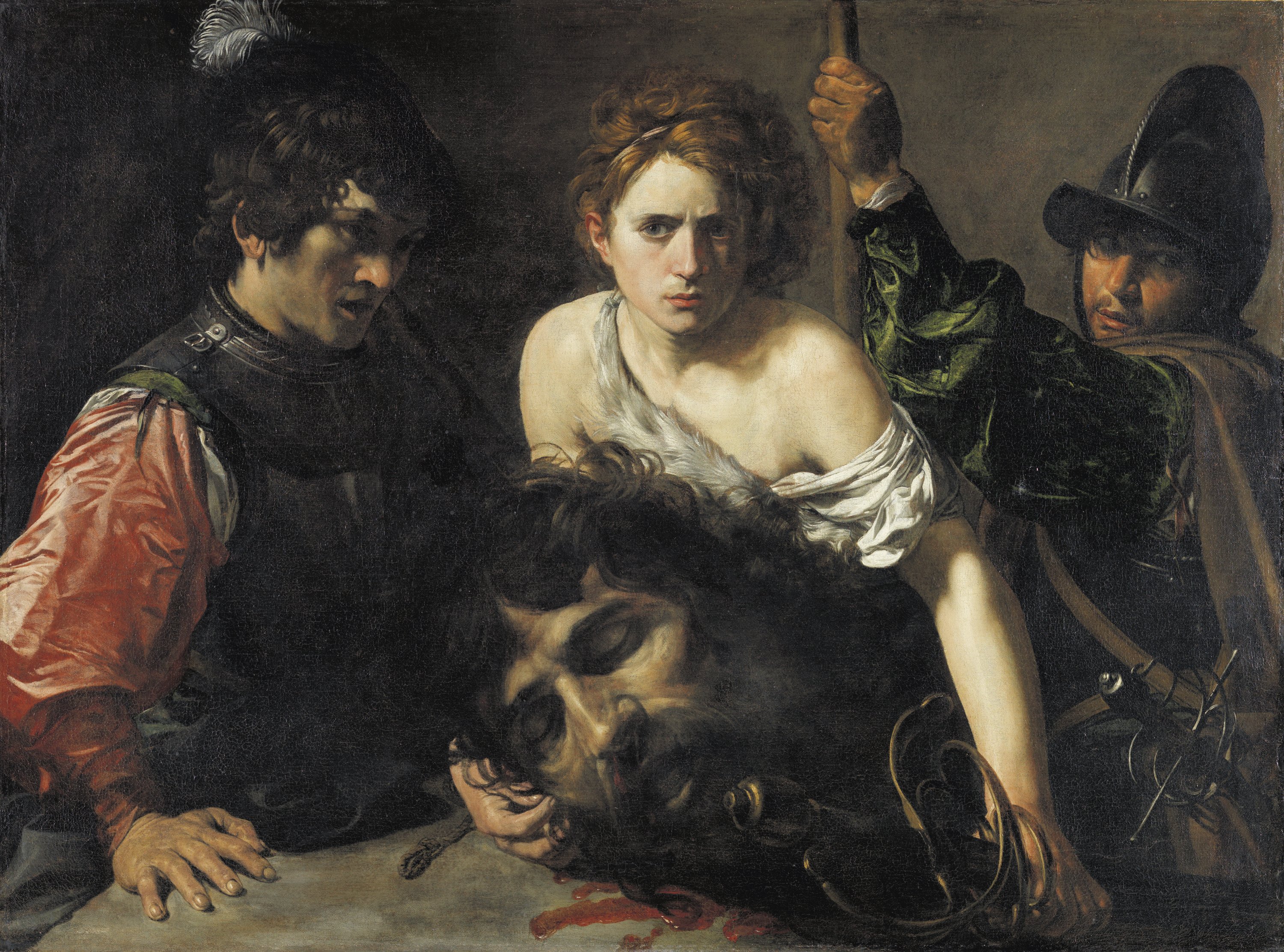
David with the Head of Goliath has been dated to around 1620–22 at an early phase in the artist’s career. It thus dates from a period in his life that is not well documented and during which it is difficult to date his work. The artist depicts an Old Testament episode when the young David set out to fight the Philistine warrior Goliath. David put on Saul’s armour but felt uncomfortable in it. He therefore decided to confront the giant wearing his shepherd’s clothes and took five stones for his sling, putting them in a bag. David shot a stone with his sling that hit the giant on the forehead and he fell to the ground, at which point David killed him with his sword and decapitated him. Having gathered up Goliath’s armour and his head, David took them to Jerusalem where he left the armour in his tent.
Valentin de Boulogne depicts the final verses of the biblical account. We see the young and handsome David in rustic dress holding the giant’s head, which is still dripping blood. Supporting the immense head on the table and holding his opponent’s sword in the other, David is framed by two figures wearing armour. The painting consists of a limited number of figures in a composition characteristic of the artist’s early style, which is notable for its sense of tension and energy, reflected in the disquieting intensity of the figures’ gazes. The astonishment and horror of the figure on the left is balanced by David’s meditative, concentrated and absent gaze and by that of the soldier on the right, who looks out of the pictorial space. The painting is solidly constructed with the textures particularly well conveyed, for example the salmon coloured sleeve with silver toned highlights.
The painting was reproduced in a print of 1817 by the Genoese artist Domenico del Pino in which the painting is attributed to Caravaggio. The Wallraf-Richartz Museum in Cologne has a copy of the present painting.
Mar Borobia
David with the Head of Goliath has been dated to around 1620–22 at an early phase in the artist’s career. It thus dates from a period in his life that is not well documented and during which it is difficult to date his work. The artist depicts an Old Testament episode when the young David set out to fight the Philistine warrior Goliath. David put on Saul’s armour but felt uncomfortable in it. He therefore decided to confront the giant wearing his shepherd’s clothes and took five stones for his sling, putting them in a bag. David shot a stone with his sling that hit the giant on the forehead and he fell to the ground, at which point David killed him with his sword and decapitated him. Having gathered up Goliath’s armour and his head, David took them to Jerusalem where he left the armour in his tent.
Valentin de Boulogne depicts the final verses of the biblical account. We see the young and handsome David in rustic dress holding the giant’s head, which is still dripping blood. Supporting the immense head on the table and holding his opponent’s sword in the other, David is framed by two figures wearing armour. The painting consists of a limited number of figures in a composition characteristic of the artist’s early style, which is notable for its sense of tension and energy, reflected in the disquieting intensity of the figures’ gazes. The astonishment and horror of the figure on the left is balanced by David’s meditative, concentrated and absent gaze and by that of the soldier on the right, who looks out of the pictorial space. The painting is solidly constructed with the textures particularly well conveyed, for example the salmon coloured sleeve with silver toned highlights.
The painting was reproduced in a print of 1817 by the Genoese artist Domenico del Pino in which the painting is attributed to Caravaggio. The Wallraf-Richartz Museum in Cologne has a copy of the present painting.
Mar Borobia