The Cook
ca. 1657 - 1662
Oil on canvas.
40 x 33.7 cm
Museo Nacional Thyssen-Bornemisza, Madrid
Inv. no.
285
(1930.74
)
Room 25
Level 2
Permanent Collection
Gabriel Metsu specialised in genre paintings although his earliest works include historical and allegorical subjects and portraits. According to the information supplied by Houbraken, Metsu trained in Leiden with Gerrit Dou, but no evidence of Dou’s style is to be detected in Metsu’s early works, which should rather been related to the work of two Utrecht painters, Nicolaus Knüpfer and Jan Baptist Weenix. In the 1650s Metsu introduced significant innovations into his style, paying more attention to the depiction of interiors and making a careful study of the work of other artists who specialized in genre interiors such as Gerrit Dou, Frans van Mieris and Nicolas Maes, some of whose characteristics are evident in his own work. In the 1660s Metsu looked at Delft painters and his work became markedly influenced by the style of Pieter de Hooch and Vermeer.
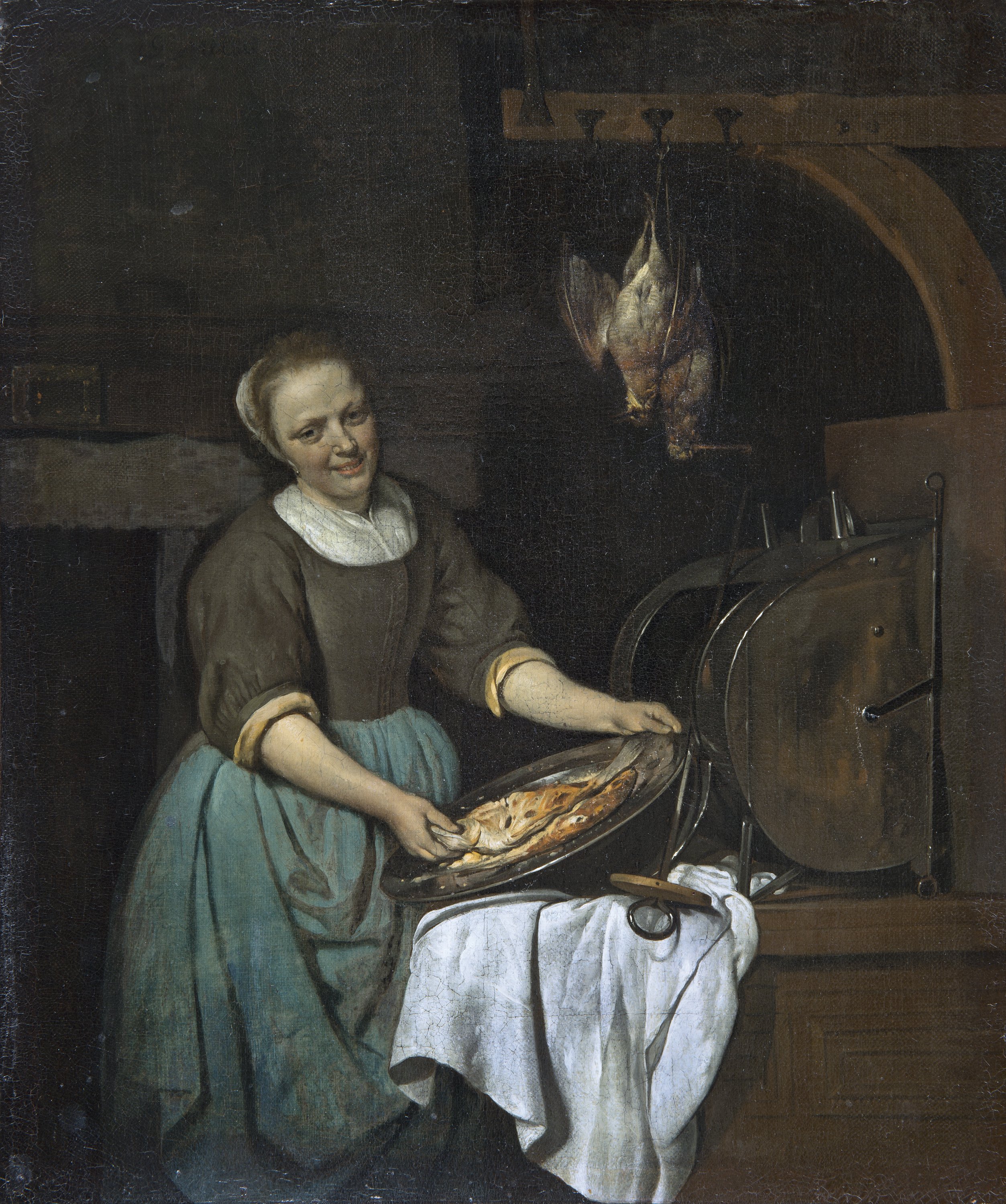
The present canvas has been dated by Robinson to the time close to Metsu’s move to Amsterdam, around 1657–62. Painted in small-format, it depicts a female cook in her workplace, showing us a dish with two fish. The figure stands out against a dark background in which we can barely make out the shaft of a high oven at which she is cooking. Both the woman and the other elements in the foreground are illuminated by a soft light. Metsu used a relatively restrained chromatic range with whites and yellows for some of the textiles, blue for the cook’s apron and subtle touches of red in the roasted fish.
Metsu repeated this composition on two other occasions, with the woman in a similar setting. These are the oil on canvas now in the Gemäldegalerie, Berlin, and a smaller panel in the Alte Pinakothek in Munich. In the Berlin work the cook, wearing a coif, is standing full-length holding the poker for the oven, which in the present canvas is to be seen on the table. Both the Berlin canvas and the present one include the oven, the dish for the fish and the simple system of hooks from which the dead game is hanging at the top. These objects and others in the present work are also to be found in other compositions by Metsu.
In some cases the elements in Metsu’s paintings have been interpreted as erotic allusions, which in the present work might be the case with the two partridges hanging from a hook, combined with the smile on the cook’s face as she offers the plate of roasted fish. The birds may be a sexual reference, as is clearly the case in other Dutch paintings, while the figure may be offering herself as available by showing us the results of her labours. This reading is reinforced by the symbolism of the pair of partridges that refer to lust and sexual pleasure. This aspect of the painting was analysed by Gaskell.
Mar Borobia
The present canvas has been dated by Robinson to the time close to Metsu’s move to Amsterdam, around 1657–62. Painted in small-format, it depicts a female cook in her workplace, showing us a dish with two fish. The figure stands out against a dark background in which we can barely make out the shaft of a high oven at which she is cooking. Both the woman and the other elements in the foreground are illuminated by a soft light. Metsu used a relatively restrained chromatic range with whites and yellows for some of the textiles, blue for the cook’s apron and subtle touches of red in the roasted fish.
Metsu repeated this composition on two other occasions, with the woman in a similar setting. These are the oil on canvas now in the Gemäldegalerie, Berlin, and a smaller panel in the Alte Pinakothek in Munich. In the Berlin work the cook, wearing a coif, is standing full-length holding the poker for the oven, which in the present canvas is to be seen on the table. Both the Berlin canvas and the present one include the oven, the dish for the fish and the simple system of hooks from which the dead game is hanging at the top. These objects and others in the present work are also to be found in other compositions by Metsu.
In some cases the elements in Metsu’s paintings have been interpreted as erotic allusions, which in the present work might be the case with the two partridges hanging from a hook, combined with the smile on the cook’s face as she offers the plate of roasted fish. The birds may be a sexual reference, as is clearly the case in other Dutch paintings, while the figure may be offering herself as available by showing us the results of her labours. This reading is reinforced by the symbolism of the pair of partridges that refer to lust and sexual pleasure. This aspect of the painting was analysed by Gaskell.
Mar Borobia